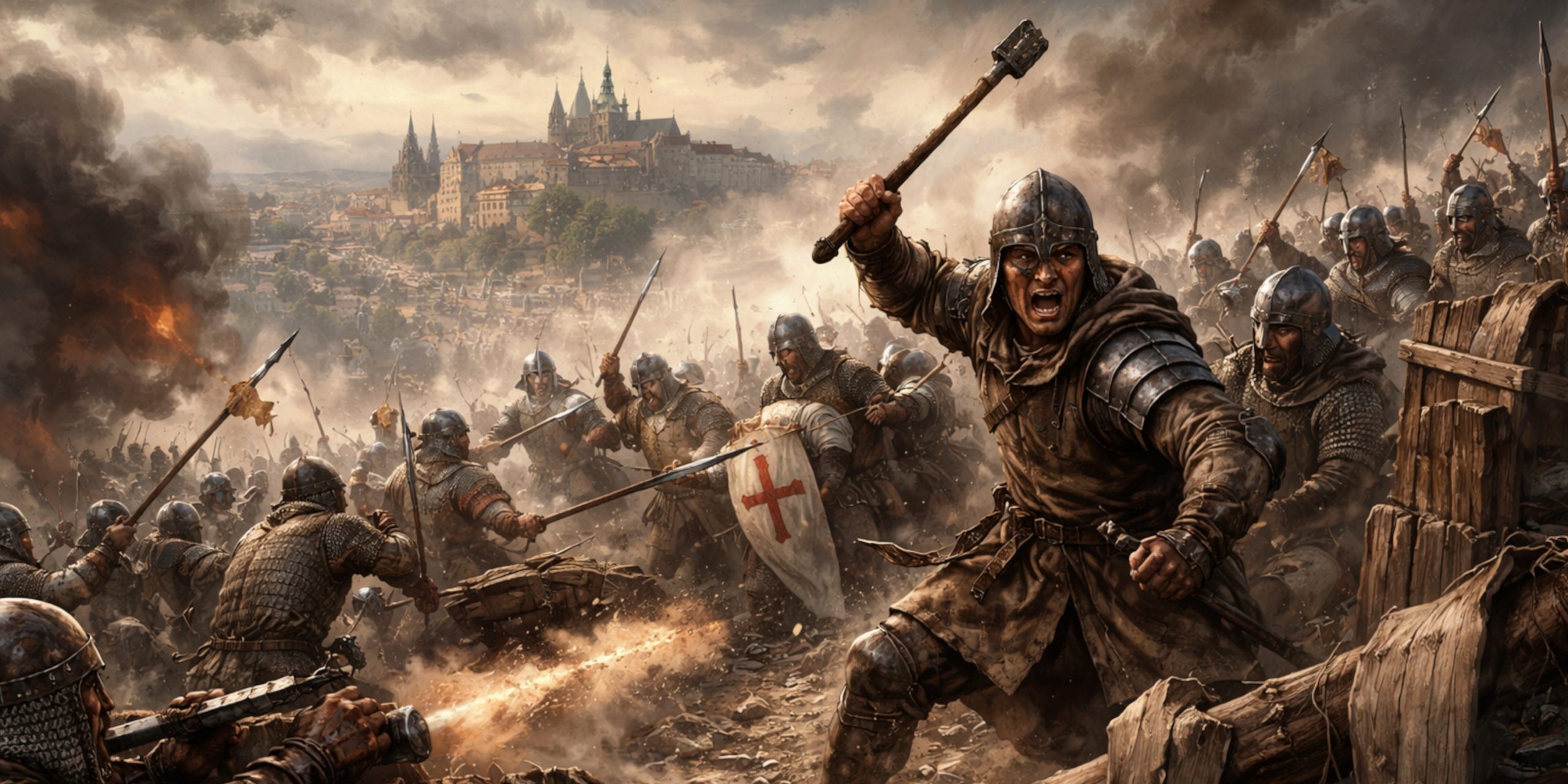
The Battle of Vítkov Hill, fought on 14 July 1420, was a defining moment in the early phase of the Hussite Wars. A relatively small engagement by medieval standards, it nonetheless shaped the fate of Prague and helped cement the reputation of one of Europe’s most formidable commanders, Jan Žižka.
From a historian’s perspective, this was not just a skirmish on a dusty ridge. It was a clash between crusading ambition and local religious revolution, between heavy cavalry confidence and tactical improvisation. The result exposed the vulnerability of knightly warfare when confronted by discipline, terrain, and a stubborn refusal to yield.
Background to the Battle
The execution of Jan Hus in 1415 ignited religious unrest across Bohemia. By 1420, Pope Martin V had declared a crusade against the Hussites. The principal champion of this campaign was Sigismund, King of Hungary and claimant to the Bohemian crown.
Prague became the focal point. Vítkov Hill, a steep ridge east of the city, commanded vital supply routes. If it fell, Prague could be strangled into submission. If it held, the Hussites retained breathing space and morale.
Žižka chose to defend it with characteristic pragmatism. He fortified the crest with earthworks and wagon barricades. It was not grand architecture. It was practical, ugly, and brutally effective.
Forces
Hussite Defenders
| Category | Estimated Strength | Composition |
|---|---|---|
| Total troops | 60 to 100 | Mixed infantry and militia |
| Command | Jan Žižka | Experienced veteran |
| Fortifications | Wagon laager, earthworks | Positioned along ridge crest |
The defenders were few, drawn from Prague’s townsmen and committed Hussite fighters. Their strength lay not in numbers but in cohesion and defensive positioning.
Crusader Attackers
| Category | Estimated Strength | Composition |
|---|---|---|
| Assault force | 7,000 to 8,000 in wider army | German and Hungarian knights, infantry |
| Command | Sigismund’s captains | Noble cavalry elite |
| Objective | Seize Vítkov Hill | Break Prague’s resistance |
The wider crusading army was substantial, though only a portion assaulted the hill directly. They expected to sweep aside a minor obstacle. Instead, they met a prepared defence.
Leaders and Troop Composition
Hussite Command
- Jan Žižka
- Veteran of earlier conflicts, partially blind by this stage
- Master of defensive tactics
- Advocate of wagon fort warfare
Crusader Leadership
- Captains serving under Sigismund
- Heavily armoured knights accustomed to battlefield dominance
- Reliant on cavalry shock tactics
The contrast is striking. One side commanded by a pragmatic tactician with limited resources, the other by aristocratic commanders confident in conventional superiority.
Arms and Armour
Hussite Equipment
- Primary weapons
- Flails adapted from agricultural tools
- Spears and polearms
- Early handguns and crossbows
- Swords
- Defensive gear
- Padded jacks
- Mail shirts
- Captured plate elements
The Hussites embraced practicality. Their weapons were accessible and often improvised, but not crude. They integrated early firearms with discipline, something many contemporaries underestimated.
Crusader Equipment
- Primary weapons
- Lances for cavalry charges
- Longswords, often Type XVIII variants
- Maces and war hammers
- Defensive gear
- Full plate harness for knights
- Visored bascinets
- Heraldic surcoats
On open ground, such armour and weaponry proved devastating. On a steep, fortified ridge, their advantage diminished rapidly.
The Battle Timeline
Early July 1420
Crusading forces encircle Prague. Vítkov Hill identified as a strategic priority.
Mid July
Crusaders prepare an assault. Hussites strengthen wagon fortifications.
14 July 1420, Morning
Crusader infantry and cavalry advance up the narrow ridge.
Midday
Heavy fighting at close quarters. Hussite missile fire and terrain slow the attackers.
Afternoon
Counterattack led by Žižka’s forces. Crusaders pushed back down the slope.
Evening
Assault collapses. Vítkov remains in Hussite hands.
The entire engagement unfolded in hours. Its consequences lasted decades.
Archaeology and Material Evidence
Archaeological investigations on Vítkov Hill have uncovered:
- Arrowheads and crossbow bolts
- Lead shot consistent with early firearms
- Fragments of armour fittings
While large scale excavation is limited by modern development in Prague, the artefacts recovered confirm close quarter fighting and projectile exchange. The terrain itself remains the most compelling evidence. Standing on the slope today, one immediately understands the defensive advantage.
The monumental statue of Žižka now dominates the hill. It is imposing, almost defiant. A fitting tribute to a commander who understood ground better than glory.
Contemporary Accounts
Chroniclers of the period, often sympathetic to the Hussite cause, described the event with clear pride. One account recounts that the crusaders “were cast down from the hill in great shame and disorder.”
Another noted the defenders’ courage despite their small number, portraying the victory as divine favour.
Naturally, sources are partisan. Medieval chroniclers were rarely neutral observers. Yet even hostile accounts concede the unexpected ferocity of the defence.
Significance and Legacy
The victory at Vítkov Hill:
- Preserved Prague from immediate capture
- Elevated Jan Žižka to near legendary status
- Demonstrated the effectiveness of wagon fort tactics
- Undermined crusader confidence
From this point onward, European powers could not dismiss the Hussites as a minor uprising. They had defeated heavily armoured knights on chosen ground. That lesson echoed across central Europe.
As a historian, I find this battle quietly fascinating. It lacks the sprawling drama of Grunwald or the political theatre of Agincourt. Instead, it offers something sharper: proof that discipline, terrain, and innovation can overturn tradition. Knights charging uphill into a fortified wagon line rarely ends well. One suspects they realised that slightly too late.
Seven Swords Takeaway
The Battle of Vítkov Hill was a small engagement with outsized consequences. It secured Prague, strengthened the Hussite movement, and helped shape a new form of warfare in Central Europe.
In the narrow space of a fortified ridge, the old order met a determined reform movement armed with faith, flails, and an unblinking commander. The hill held. History shifted.