Ramesses III and the Sea Peoples in Southern Canaan
The Battle of Djahy stands among the most dramatic confrontations of the Late Bronze Age collapse. Fought around 1178 BC during the reign of Ramesses III, it marked Egypt’s decisive stand against the migrating confederations we call the Sea Peoples.
Djahy was the Egyptian name for southern Canaan, roughly corresponding to parts of modern Israel and Lebanon. By the late twelfth century BC, this region was a frontline zone. Empires were falling, cities burning, trade networks fragmenting. Egypt remained wealthy but exposed. Ramesses III understood that if Djahy fell, the Nile Delta would be next.
The pharaoh chose to meet the threat before it reached the Egyptian heartland. That decision alone speaks volumes about his military judgement.
Historical Context
The wider setting is the Late Bronze Age collapse. The great powers of the eastern Mediterranean, including the Hittite Empire and the Mycenaean kingdoms, were disintegrating. Coastal cities were sacked, some permanently abandoned.
Egypt had faced Sea Peoples before, notably under Ramesses II and Merneptah. What made this wave different was scale. According to Egyptian inscriptions, whole populations moved with ox carts, families and livestock in tow. This was not a raid. It was migration under arms.
Ramesses III’s inscriptions at Medinet Habu describe a coalition including the Peleset, Tjekker, Shekelesh, Denyen and Weshesh. Whether these names map neatly onto known Aegean or Anatolian peoples remains debated, but their impact was unmistakable.
Forces
Precise numbers are impossible to confirm. Egyptian records favour grand claims. Archaeology provides caution. Still, we can outline relative composition.
Egyptian Forces
| Component | Description |
|---|---|
| Infantry | Spearmen, shield bearers, archers |
| Chariotry | Two-man crews, driver and archer |
| Navy | Riverine and coastal vessels in support |
| Auxiliary troops | Likely Levantine contingents |
Leadership
- Ramesses III, overall command
- Senior chariot officers and regional commanders, unnamed in surviving records
Strengths
- Organised state logistics
- Defensive preparation in Djahy
- Professional archery corps
Sea Peoples Coalition
| Component | Description |
|---|---|
| Infantry | Heavy sword infantry with round shields |
| Families and wagons | Evidence of migration movement |
| Naval elements | Ships capable of Mediterranean travel |
Leadership
- Unknown confederate chiefs
- Possibly clan based or tribal command structures
Strengths
- Aggressive shock infantry
- Mobility across sea and land
- Experience from prior campaigns
The Egyptian inscriptions depict captured ox carts, suggesting the coalition expected to settle rather than withdraw.
Arms and Armour
The reliefs at Medinet Habu are invaluable here, offering detailed depictions of equipment.
Egyptian Arms
- Khopesh: The iconic sickle sword, curved and effective for hacking.
- Straight double edged swords, possibly of Near Eastern influence.
- Composite bows of wood, horn and sinew.
- Spears with bronze heads.
Egyptian infantry carried large shields of wood and leather. Armour was typically scale corselets for elite troops. Charioteers often fought with minimal body armour for mobility.
Sea Peoples Arms
- Long Naue II type swords, straight and double edged, associated with Aegean warfare.
- Short spears and javelins.
- Round shields with central grips.
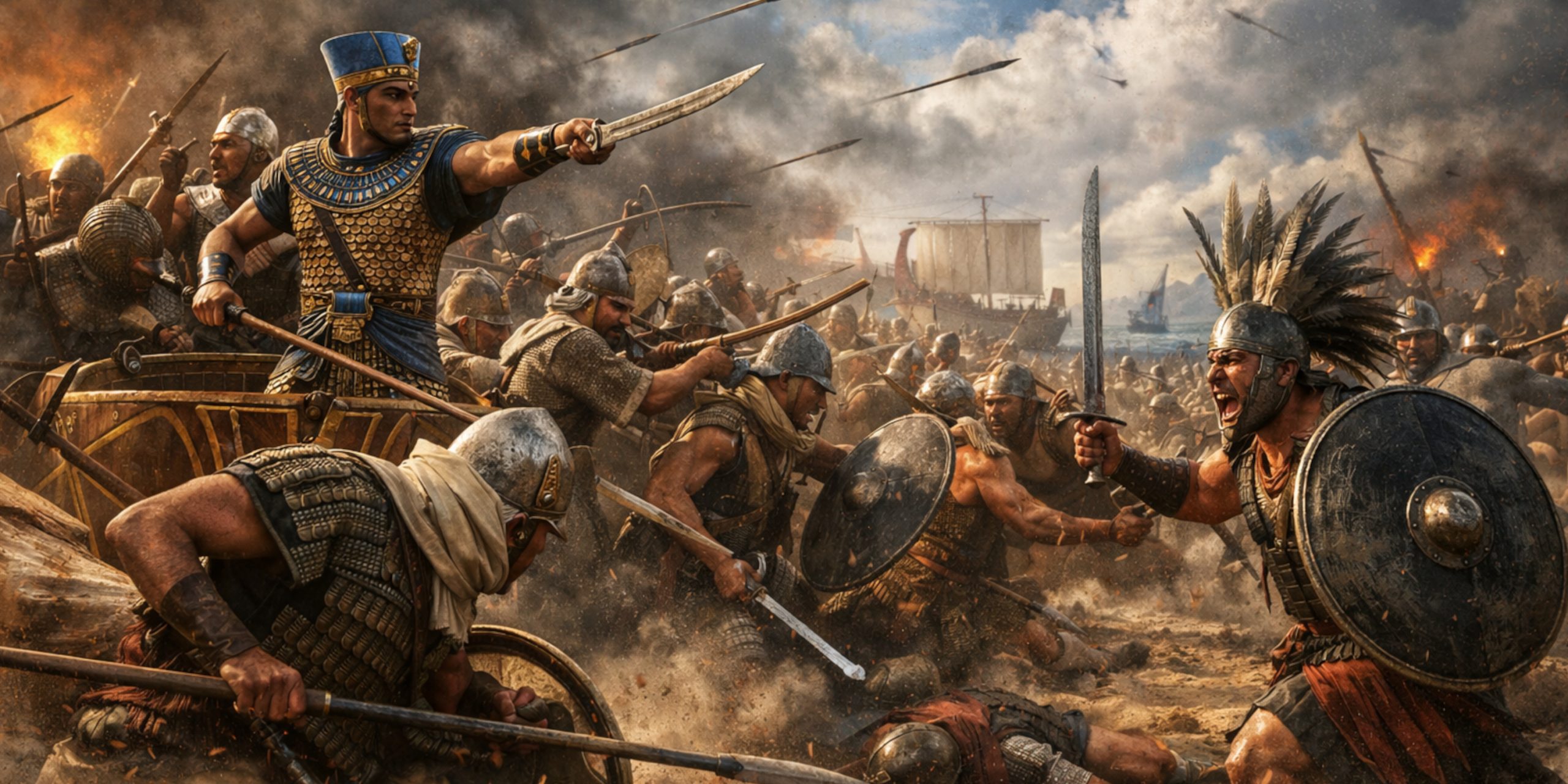
Helmets are especially striking. Feathered or horned headgear appears frequently in reliefs. Whether ceremonial or practical remains debated, but they made an impression. One suspects that was part of the point.
The Sea Peoples appear more heavily equipped for close combat than typical Egyptian infantry, suggesting a tactical contrast between missile dominance and shock assault.
Battle Timeline
Phase One: Approach into Djahy
The Sea Peoples advance along the Levantine coast, likely overwhelming local polities.
Phase Two: Egyptian Interception
Ramesses III mobilises and blocks their movement inland. Preparations likely include fortified positions and chariot deployment.
Phase Three: Land Engagement
Reliefs depict chaotic close combat. Egyptian archers support infantry lines while chariots disrupt formations.
Phase Four: Naval Clash
Though more clearly recorded in the Delta campaign, naval elements in Djahy may have attempted landings or coastal support.
Phase Five: Collapse and Capture
Egyptian inscriptions emphasise mass casualties and prisoners taken. Surviving groups were reportedly settled in Egyptian controlled territory.
Contemporary Quotes
The principal source is the Great Harris Papyrus and temple inscriptions at Medinet Habu. Ramesses III proclaims:
“The foreign countries made a conspiracy in their islands. All at once the lands were removed and scattered in the fray.”
And of his victory:
“Those who reached my frontier, their seed is not. Their heart and their soul are finished for ever.”
Pharaonic rhetoric is not modest. Yet behind the flourish lies genuine relief. Egypt survived when others did not.
Archaeology
Material evidence in southern Canaan supports a period of upheaval. Destruction layers in coastal cities align broadly with the late twelfth century BC.
The site of Medinet Habu itself provides the most detailed visual record. The reliefs remain among the finest military depictions from ancient Egypt, with clear portrayals of weapons, ships and foreign dress.
Philistine material culture in the southern Levant, including distinctive pottery styles, has been linked by many scholars to the Peleset mentioned in Egyptian texts. The transition is gradual rather than sudden, suggesting settlement rather than extermination.
Egyptian control over Canaan weakens soon after. Victory at Djahy bought time, not permanence.
Military Assessment
From a strategic perspective, Ramesses III achieved his aim. He prevented a hostile confederation from overrunning Egypt’s Asiatic territories and reaching the Delta unopposed.
Tactically, Egyptian strengths lay in combined arms coordination. Archers, infantry and chariots worked in concert. The Sea Peoples appear formidable in close combat but less coordinated at scale.
One suspects the Egyptian state apparatus, supply lines, disciplined ranks, made the difference. Migration columns are formidable, but they are not as cohesive as standing armies.
Legacy
The Battle of Djahy forms part of a wider defensive campaign that defined Ramesses III’s reign. He is often styled the last great warrior pharaoh. There is truth in that, though it carries a hint of melancholy. After him, Egypt’s imperial reach contracts.
The Sea Peoples did not vanish. Groups such as the Philistines established themselves in the Levant. The Mediterranean world was permanently reshaped.
Djahy reminds us that collapse is rarely neat. It is contested, chaotic and deeply human. And occasionally, as at Djahy, someone manages to hold the line.
Takeaway
The Battle of Djahy was a defensive stand at the edge of a crumbling world system. Through a mixture of preparation, tactical flexibility and perhaps a measure of good fortune, Ramesses III preserved Egypt’s sovereignty for another generation.
As historians, we rely heavily on Egyptian testimony, which is confident to the point of theatrical. Even so, the archaeological and cultural evidence confirms a genuine crisis.
Djahy was real. The danger was real. And for a moment in 1178 BC, the fate of Egypt hung in the balance.