If you have spent hours riding through forests, squinting at distant towers, and getting absolutely humbled in sword fights, you already know that Kingdom Come Deliverance 2 is obsessed with historical accuracy. What makes it even better is this: much of what you see is rooted in real places.
Bohemia is not just a backdrop. It is a landscape shaped by political chaos, local feuds, royal ambitions and some very tense medieval standoffs. The game pulls from genuine castles, towns and battlegrounds that still exist today, many only a train ride away from Prague.
Let’s step out of the saddle for a moment and look at the real medieval Bohemia behind the pixels.
Kutná Hora
Kutná Hora is not just pretty scenery. In the late fourteenth and early fifteenth centuries, it was one of the wealthiest towns in Europe thanks to silver mining. If Prague was the crown, Kutná Hora was the treasure chest.
Under the reign of Wenceslaus IV, the region became politically unstable. Noble factions competed for influence. Royal authority weakened. Tensions simmered.
The game leans heavily into this atmosphere of uncertainty. The sense that something is about to go wrong at any moment is not creative exaggeration. It reflects a real period of unrest that would eventually explode into the Hussite Wars.
Walking through modern Kutná Hora today feels surreal if you have played the game. The Gothic lines of St Barbara’s Cathedral still dominate the skyline. The narrow streets remain tight and defensible. You can almost hear armour clinking in the distance, although it is usually just tourists.
Rataje nad Sázavou
Rataje is one of the strongest links between the game and real history. The town and its castle appear in the first game and remain central to the wider setting.
In reality, Rataje was a fortified settlement controlling river routes and regional trade. It changed hands between noble families and stood as a strategic anchor in a fragmented political landscape.
When you roam its hills in game, that layout is not random. The positioning of the castle above the valley makes tactical sense. Medieval lords built high for a reason. It is easier to defend when gravity is on your side.
What I appreciate most is how unglamorous it feels. It is not some grand fantasy citadel. It is practical, defensive and slightly austere. Medieval power was often like that.
Trosky Castle
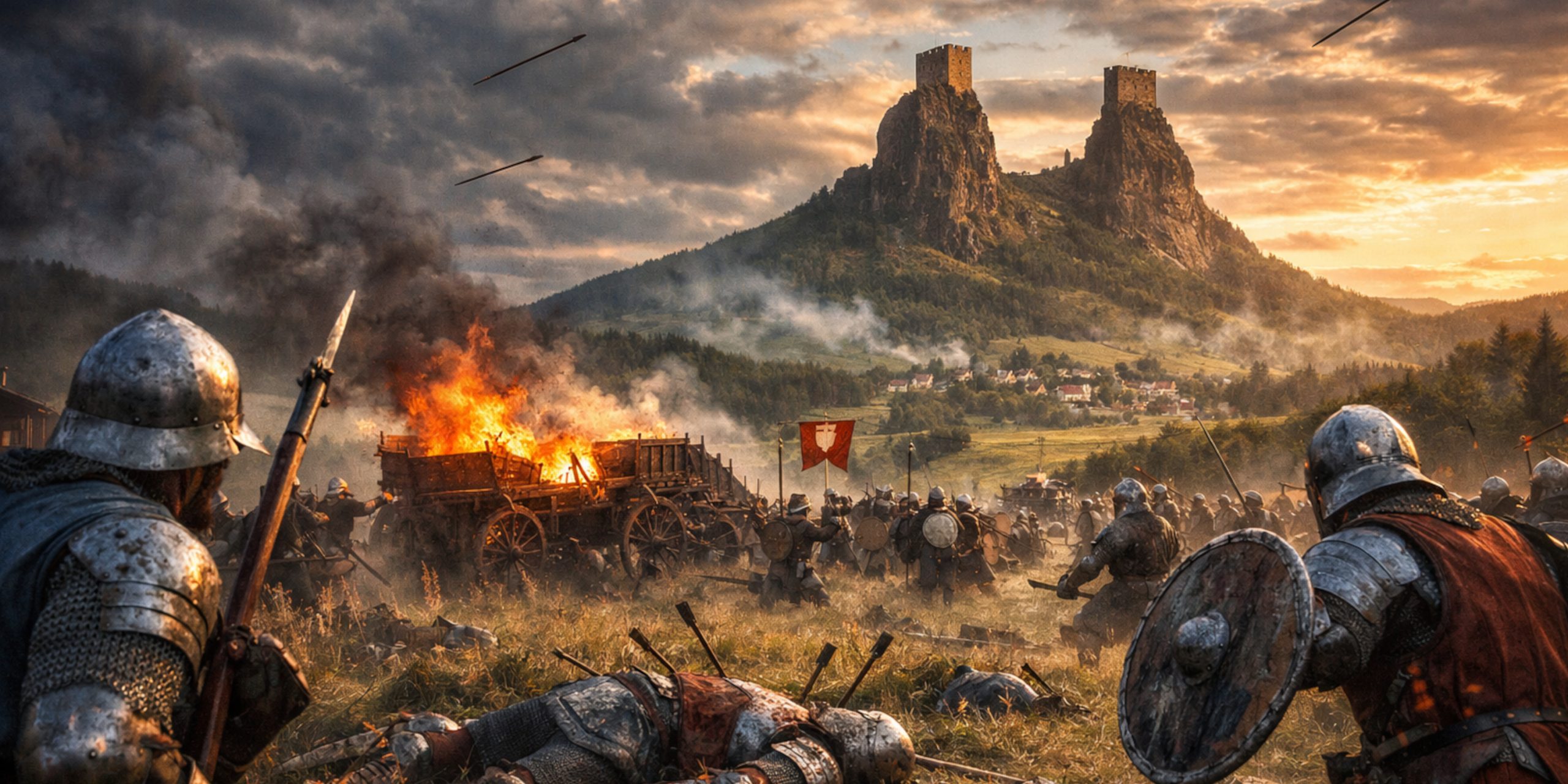
Few castles look as dramatic as Trosky Castle. Built atop twin volcanic rock towers, it looks like someone tried to design a fortress on hard mode.
Trosky dates to the late fourteenth century and was constructed during a time of political fragmentation. Its placement is not about comfort. It is about dominance and visibility.
While KCD2 does not replicate every structure brick by brick, the aesthetic influence is clear. That sense of looming, slightly menacing stone on the horizon is very Bohemian.
Standing there today, wind cutting across the rocks, you realise medieval warfare was not just about blades. It was about position, supply and psychological impact. A castle like Trosky announces itself long before you reach its gates.
The Hussite Shadow
Even when the game focuses on the years before open religious war, the shadow of the Hussite movement hangs over everything.
The execution of Jan Hus in 1415 triggered uprisings that reshaped Central Europe. Commanders like Jan Žižka introduced innovative tactics, including fortified wagon formations that stunned traditional knights.
This context matters because KCD2 is not just telling a personal story. It is placing you in a society on the brink. The armour, the shifting loyalties, the uneasy nobility, all of it builds toward that explosion.
When you fight bandits in a forest clearing, you are not just grinding experience points. You are participating in a world that historically slid into full scale religious and civil conflict within a generation.
Bohemian Warfare, Without the Fantasy Filter
One of the boldest decisions of the series is its refusal to romanticise medieval combat. There are no glowing swords. No magical bloodlines. Just steel, sweat and poor decision making.
That restraint mirrors the real battlefields of Bohemia. Conflicts here were often local, messy and politically tangled. Noble feuds blurred into royal disputes. Mercenaries drifted from one banner to another. Towns fortified themselves not out of heroism but survival.
When you stand in a real Bohemian field today, it looks peaceful. Rolling hills, farmland, quiet woods. It takes effort to imagine armoured men clashing where cows now graze. Yet archaeology keeps uncovering arrowheads, weapon fragments and fortification remains that confirm how violent this region once was.
History rarely announces itself loudly. It lingers in the soil.
Visiting the Real Locations
The best part is that these places are accessible. Kutná Hora is a day trip from Prague. Rataje is small but open to visitors. Trosky’s ruins can be climbed, provided you are comfortable with heights and questionable medieval staircases.
Walking these landscapes changes how you see the game. The forests feel denser. The distances feel longer. Suddenly you understand why travelling with armour was exhausting.
And yes, you will probably start judging your in game navigation skills once you see how disorienting real medieval terrain can be.
Why It Works
The success of KCD2’s setting lies in restraint. It trusts history to be interesting on its own terms. Bohemia does not need dragons to feel dangerous. It only needs ambition, silver mines and a fragile king.
There is something refreshing about playing a game that treats the past seriously. It invites curiosity rather than spectacle.
As someone who grew up thinking medieval Europe was just castles and tournaments, discovering the layered politics of Bohemia feels oddly grounding. It reminds you that history is not distant myth. It is human, flawed and occasionally chaotic in ways that feel very modern.
If you have played the game, visit the sites. If you have visited the sites, replay the game. The connection between digital and physical Bohemia makes both richer.
And you might just find yourself looking at a quiet Czech hillside and thinking, this would be a terrible place to fight.