Isildur is one of those characters who makes a single decision that echoes for thousands of years. He cuts the One Ring from Sauron’s hand, saves Middle-earth from immediate ruin, and then keeps the Ring instead of destroying it. Hero or cautionary tale? Honestly, a bit of both.
Let’s untangle who he really was, what happened on the slopes of Mount Doom, and why his choice shaped everything that follows in The Lord of the Rings.
Who Was Isildur?
Isildur was a Númenórean prince, son of Elendil and brother of Anárion. He belonged to the line of the Faithful, those Númenóreans who rejected the worship of Sauron when the Dark Lord corrupted their island kingdom.
After the catastrophic downfall of Númenor, Isildur escaped with his father and founded the realms in exile, Arnor in the north and Gondor in the south. He ruled Gondor jointly with Anárion, establishing cities such as Minas Ithil.
He was not just a warrior. He was a statesman, a survivor of a drowned civilisation, and a man trying to hold together a fragile new world.
The Last Alliance and the Fall of Sauron
The defining moment of Isildur’s life came during the War of the Last Alliance. Elves and Men united under Elendil and Gil-galad to confront Sauron in Mordor.
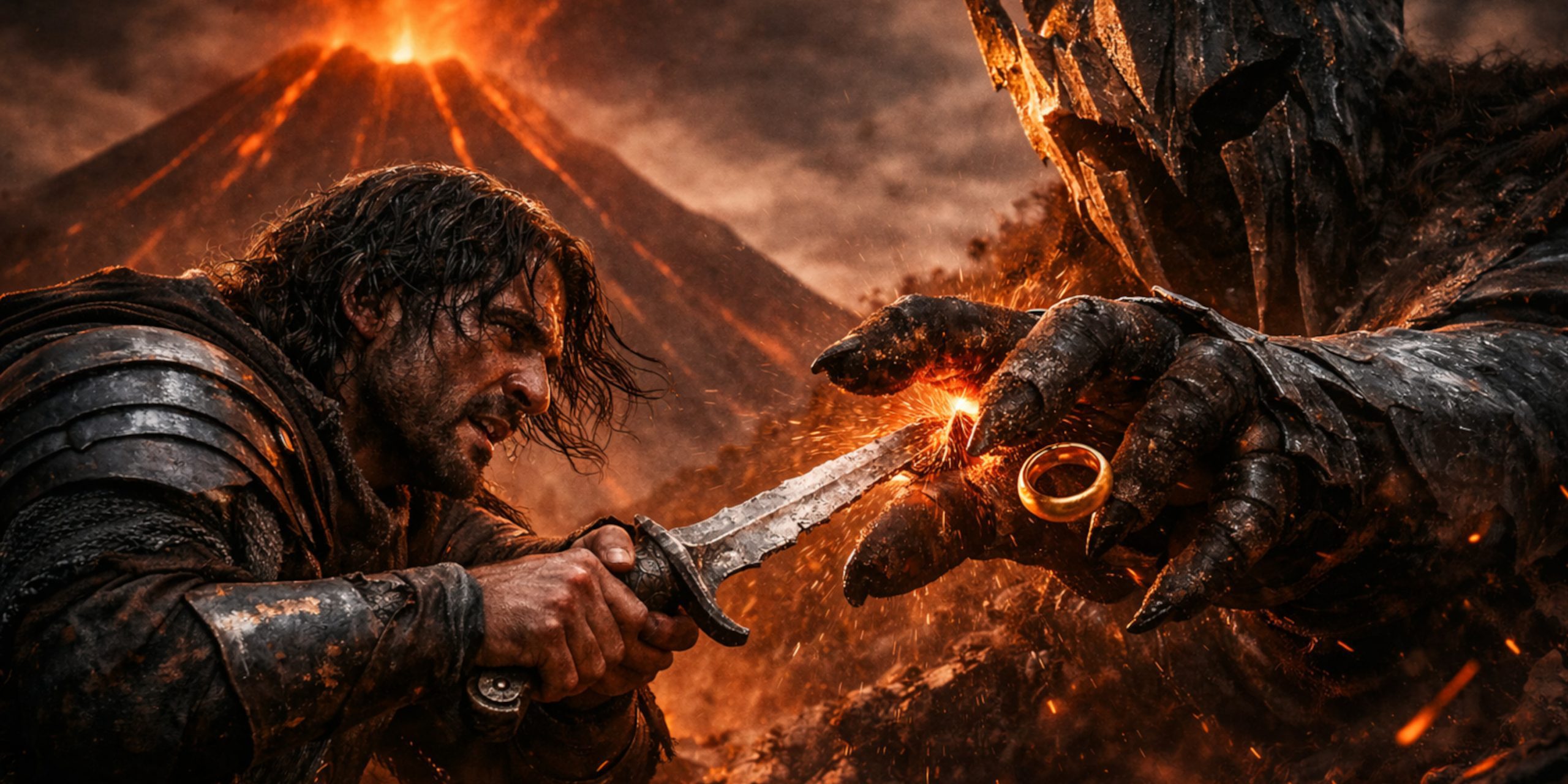
In the final battle on the slopes of Orodruin, both Elendil and Gil-galad were slain. Sauron’s physical form was cast down. Isildur took up the broken sword of his father and cut the One Ring from Sauron’s hand.
That act broke Sauron’s power, at least temporarily. It was an extraordinary moment. A prince of a fallen kingdom stood over the Dark Lord and seized the very instrument of his tyranny.
Then came the fateful choice.
Instead of destroying the Ring in the fires of Mount Doom, Isildur claimed it as weregild for his father and brother. Compensation for their deaths. It sounds almost legalistic, as if he were settling a family dispute rather than holding the fate of the world.
Why Didn’t He Destroy the Ring?
This is where modern readers, and especially film viewers, tend to judge him harshly.
In the books by J. R. R. Tolkien, the situation is more nuanced. Isildur did not fully understand the Ring’s nature. He knew it was powerful and evil, but not that it could only be destroyed in Mount Doom. The knowledge that Elrond possessed in hindsight was not common fact in that moment of victory and exhaustion.
More importantly, the Ring exerts a corrupting influence. It tempts. It persuades. Isildur, proud and grieving, was exactly the kind of man it could ensnare.
It is easy to say, destroy it. It is harder when you are standing in the aftermath of war, your father dead, holding a weapon that feels like both justice and inheritance.
The Disaster at the Gladden Fields
Two years later, Isildur marched north to take up rule in Arnor. On the way, his company was ambushed by Orcs near the Gladden Fields.
Realising the battle was lost, he put on the Ring to escape. It betrayed him. The Ring slipped from his finger as he swam across the Anduin, and he was struck down by Orc arrows.
The Ring lay in the riverbed for centuries, waiting.
There is something bleakly ironic about it. The artefact he claimed as compensation abandoned him without ceremony. No grand speech, no redemption arc. Just cold water and arrows in the dark.
Isildur in the Films vs the Books
In The Lord of the Rings: The Fellowship of the Ring, Isildur appears briefly. He cuts the Ring from Sauron’s hand and refuses to destroy it despite Elrond’s urging. The moment is framed as immediate failure.
The books give him more depth. He is brave, capable, and even reflective. Shortly before his death, he wrote that the Ring was “precious to me, though I buy it with great pain.” That line alone hints at internal conflict.
He was not a moustache-twirling villain. He was a flawed hero, caught at a hinge point in history.
The Sword That Broke and the Line That Endured
The broken blade of Elendil, Narsil, became a symbol of both loss and continuity. It was eventually reforged as Andúril for Aragorn, Isildur’s distant heir.
Aragorn’s quest to destroy the Ring can be seen as a long-delayed correction of Isildur’s choice. The line of kings failed once, but it did not end.
That generational thread is important. Tolkien was deeply interested in legacy, inheritance, and the weight of the past. Isildur’s failure does not erase his courage. It simply complicates it.
Was Isildur a Villain?
No. And yes, in a way.
He saved Middle-earth by cutting the Ring from Sauron’s hand. Without him, the Last Alliance would likely have failed.
He also allowed the Ring to endure. His decision prolonged Sauron’s shadow.
The tension between those two truths is what makes him compelling. He embodies a theme that runs through Tolkien’s work: even the greatest can falter, and even a small weakness can reshape history.
If you are looking for a clean moral verdict, you will not find one. Isildur is not there to be easily categorised. He stands at the edge of myth and tragedy, equal parts triumph and warning.
Isildur’s Legacy in Middle-earth
By the time of The Lord of the Rings: The Return of the King, the consequences of his choice are clear. The Ring must finally be destroyed, and the kingship of Men must be restored.
Isildur’s bloodline survives through Aragorn. His failure becomes part of a larger story about redemption and perseverance.
There is something oddly comforting in that. History does not end with one mistake. It moves on, shaped by it.
And if we are being honest, most of us would probably not have done any better on the slopes of Mount Doom. Holding ultimate power while grieving and exhausted is not an ideal decision-making environment.
Isildur was a man of his age, brave, proud, flawed. He cut the Ring from Sauron’s hand and changed the world. That alone ensures he will never be a footnote in the history of Middle-earth.