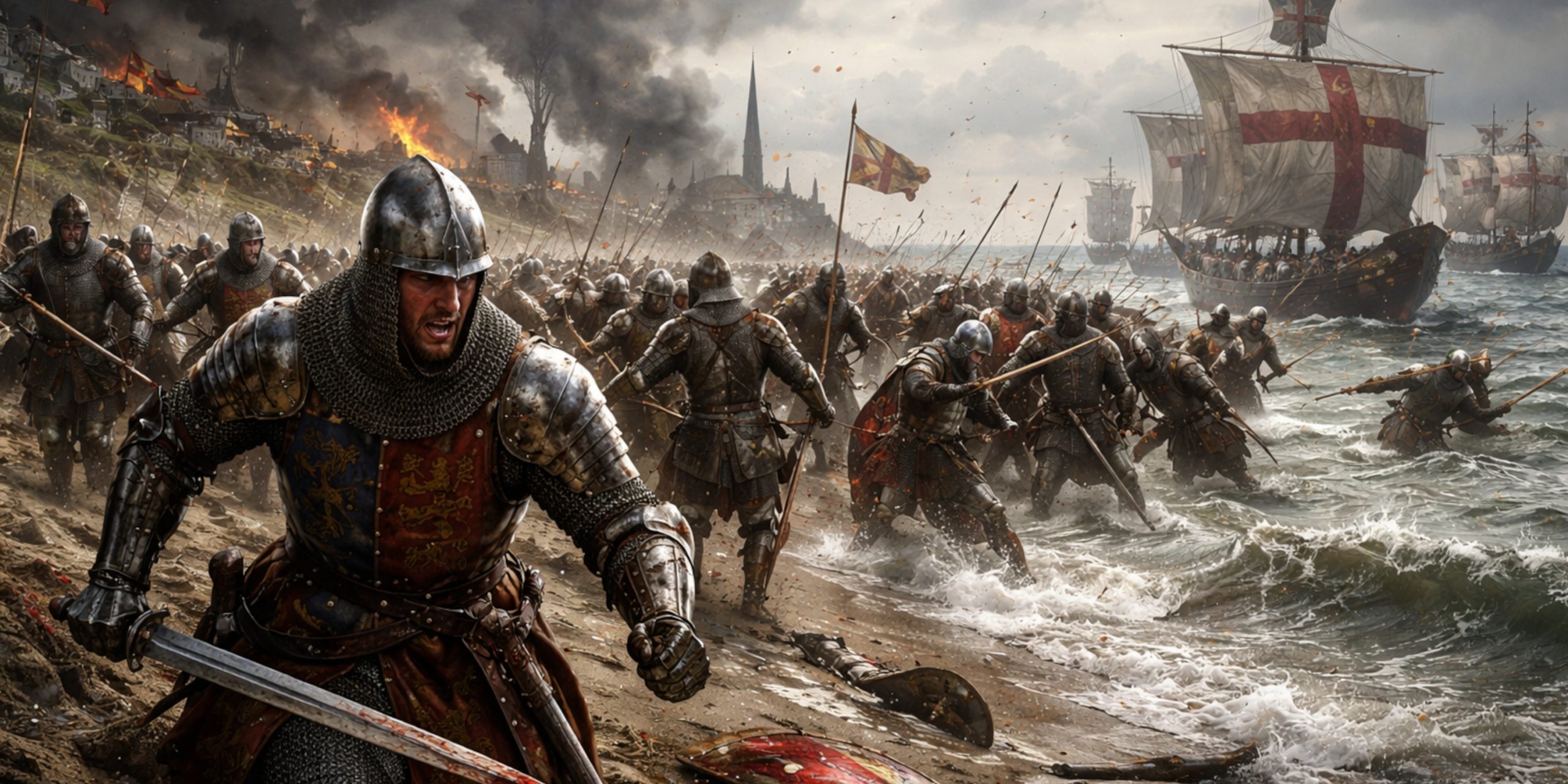
The Battle of Cadsand, fought in late 1337 on the island of Cadsand off the coast of Flanders, was a small action with outsized intent. It did not decide the Hundred Years’ War, but it announced England’s seriousness with steel and salt water. For Edward III, this was a calculated provocation. For Flanders, already nervy about its loyalties, it was an unpleasant reminder that England could reach out and touch the coastline whenever it pleased.
As a historian, I like Cadsand because it is honest about medieval war. It is messy, coastal, opportunistic and driven by logistics as much as chivalry. No banners neatly arranged. Just ships, mud, and sharp intentions.
Forces
English Expeditionary Force
| Element | Estimate |
|---|---|
| Total strength | c. 2,000 to 3,000 |
| Core troops | Men at arms, archers |
| Transport | Chartered merchant vessels and warships |
| Commander | Sir Walter Manny |
Franco Flemish Defenders
| Element | Estimate |
|---|---|
| Total strength | c. 4,000 to 5,000 |
| Core troops | Feudal levies, local militia |
| Command | Local Flemish lords loyal to France |
The English were outnumbered, which makes the result interesting rather than inevitable.
Leaders and Command
Sir Walter Manny deserves the spotlight. A Hainault knight in English pay, he was energetic, ruthless when needed, and entirely comfortable fighting on foreign sand. Manny would later become one of the most reliable captains of Edward III’s early campaigns, and Cadsand reads like a job interview he absolutely nailed.
Opposing him were Flemish nobles tied to the French interest. Their problem was not courage but coordination. Coastal defence works best when everyone agrees who is in charge. They did not.
Arms and Armour
English Equipment
- Swords
- Knightly arming swords of Oakeshott Type XII and XIII
- Early hand and a half swords among wealthier men at arms
- Missile weapons
- Longbows used aggressively during the landing and pursuit
- Armour
- Mail hauberks with emerging plate elements
- Bascinets with mail aventails
- Shields increasingly smaller and more practical for shipboard fighting
Franco Flemish Equipment
- Swords
- Broad arming swords, largely Type XII
- Falchions among infantry and militia
- Polearms
- Spears, bills and early guisarmes
- Armour
- Mail dominant, with limited plate reinforcement
- Open faced helmets more common among militia
Cadsand is a reminder that this is a transitional moment. Plate is arriving, but mail still does the heavy lifting, especially when men are climbing out of boats under fire.
The Battle Timeline
- Landing phase
English ships make landfall on Cadsand with minimal resistance. Archers secure the beaches quickly. - Initial clash
Flemish forces attempt to contain the landing, but their response is fragmented. - Main engagement
Manny pushes inland, forcing a pitched fight. English cohesion and archery take control of the field. - Rout and pursuit
The defenders break. English troops pursue aggressively, capturing prisoners and stripping the area of supplies. - Withdrawal
The English re embark with prisoners, plunder, and a clear political message delivered.
Short, sharp, and very intentional.
Archaeology and Landscape
Cadsand itself has been reshaped by centuries of flooding and land reclamation, which makes archaeology frustrating. There is no neat battlefield park. What survives are scattered finds, weapon fragments recovered from dredging, and documentary archaeology in the form of port records and ransom accounts.
The landscape still matters. Wide tidal flats, soft ground, and limited roads explain why the defenders struggled to respond in force. Geography did more damage than heroics.
Contemporary Voices
Jean Froissart, writing with his usual enthusiasm for colour and drama, praised the boldness of the English landing and the confidence of Manny’s command. While Froissart always needs handling with care, his admiration here aligns with the outcomes.
From the English side, the raid was framed as proof that God favoured Edward’s cause. Medieval chroniclers loved a good moral angle, especially when it involved captured knights and healthy ransoms.
Why Cadsand is important
Cadsand did not win the war, but it set the tone. It demonstrated England’s naval reach, unsettled Flanders, and gave Edward III a successful opening act. It also cemented Walter Manny’s reputation as a commander who could be trusted with real responsibility.
There is a dry irony here. The battle is often skipped in summaries because it is small. Yet wars are built on moments like this. Confidence grows. Allies reconsider. Enemies start sleeping badly.
As openings go, Cadsand was a firm knock on the door, delivered with a sword in hand and a ship waiting offshore.
Legacy
Within a year, England would commit far more heavily to continental campaigning. Cadsand became a reference point, a proof of concept rather than a legend. For historians, that makes it valuable. It shows how the Hundred Years’ War actually began, not with grand speeches, but with a wet landing and a decisive shove inland.