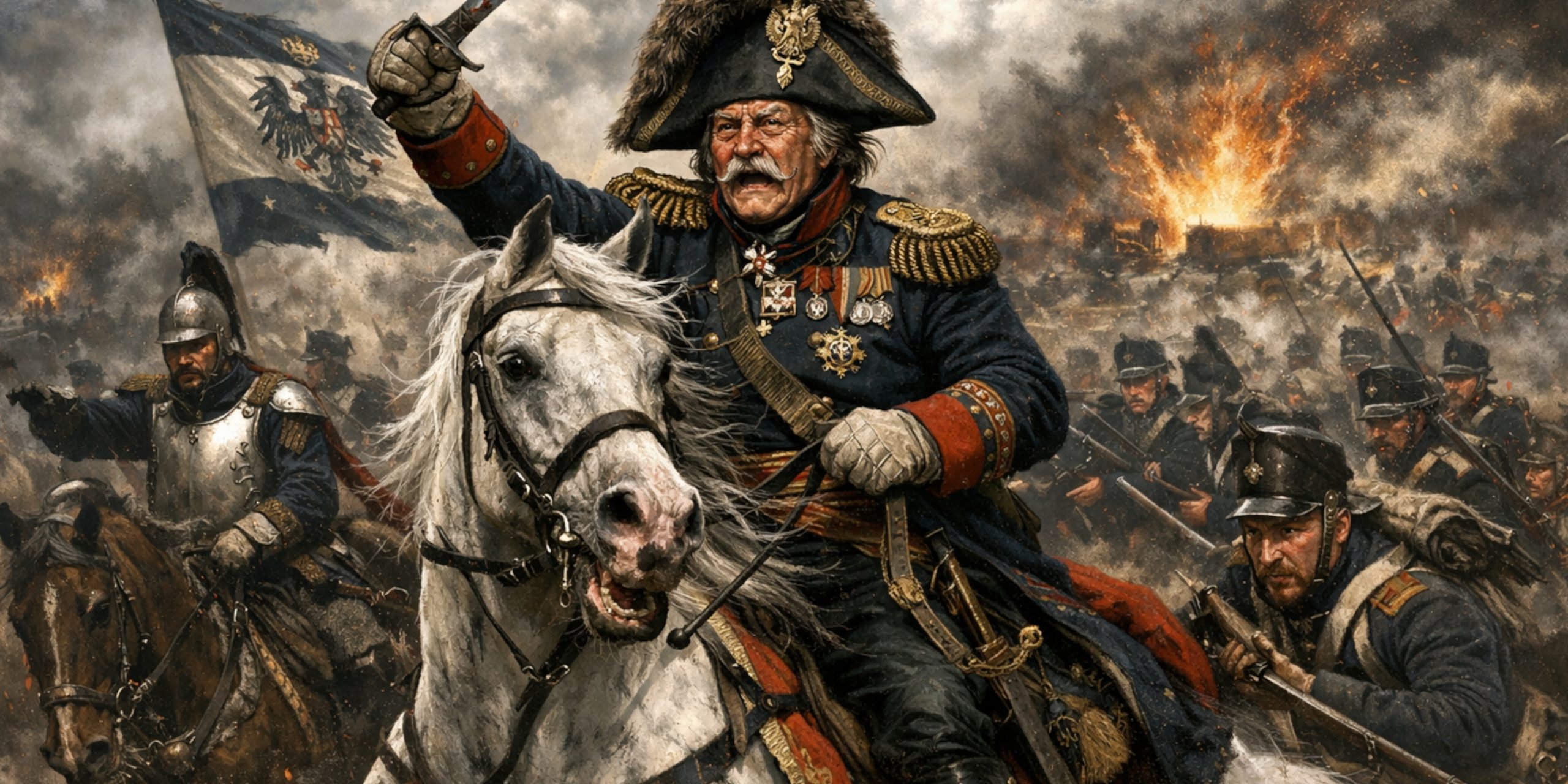
Few generals earn a nickname that sticks for two centuries. Gebhard Leberecht von Blücher did exactly that. To his soldiers he was Marshal Vorwärts, always forward, always pushing, sometimes to the brink of recklessness. To Napoleon, he was the enemy who simply refused to stay beaten.
As a historian, I find Blücher endlessly human. He was impulsive, loud, occasionally wrong, and utterly determined. He did not win wars through elegant manoeuvre or polished theory. He won them by momentum, stamina, and a stubborn belief that if you keep marching, history will eventually blink first.
Early Life and Rise Through the Ranks
Blücher was born in 1742 in Rostock, then part of Swedish Pomerania. His early military career was anything but smooth. He began service under the Swedes, was captured by Prussia, and promptly switched sides. That alone tells you something about the man. Loyalty, for Blücher, was practical rather than sentimental.
His Prussian career was marked by clashes with authority. Frederick the Great once dismissed him as a troublesome hussar officer, and for years Blücher was sidelined. When he returned to active service during the Revolutionary and Napoleonic Wars, age had not dulled him. If anything, it removed his patience for caution.
Arms and Armour
By the time Blücher reached senior command, he was rarely seen fighting hand to hand, but his identity was inseparable from the cavalry culture that shaped him.
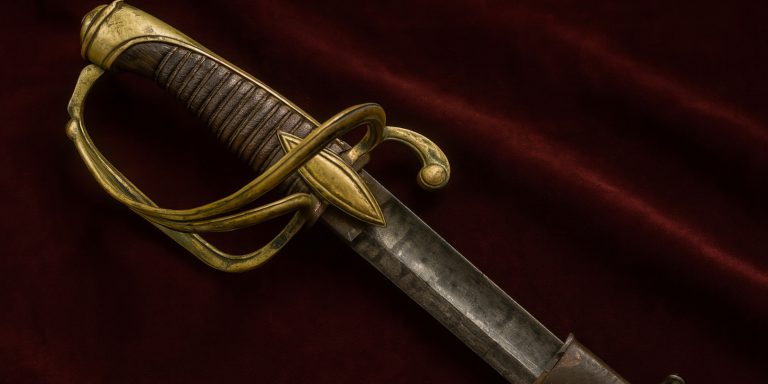
Prussian officers of his era typically carried a straight-bladed sabre, often with a brass hilt and knuckle guard. These were designed for thrusting from horseback rather than elegant fencing. Blücher himself favoured practicality over display, and contemporary descriptions suggest his equipment was serviceable rather than ornate.
His uniform followed late Napoleonic Prussian reforms. Dark blue coats, simple facings, and restrained decoration replaced the flamboyance of earlier decades. The look suited Blücher. There was nothing theatrical about him. Even his decorations, including the Iron Cross, were worn as marks of endurance rather than vanity.
Military Accumen and Command Style
Blücher was not a careful planner. That role fell to his chief of staff, August von Gneisenau, who provided the structure that Blücher often ignored. Their partnership worked because each compensated for the other’s flaws.
Blücher believed in aggressive action, even after defeat. After being beaten at Ligny in 1815, many generals would have retreated east to regroup. Blücher instead marched north to rejoin Wellington, a decision that directly led to Napoleon’s final defeat. This was not luck. It was instinct shaped by decades of war.
From a modern perspective, Blücher’s style looks dangerous. He accepted high casualties and pressed exhausted troops forward. Yet his soldiers followed him because they trusted his clarity of purpose. They always knew what he wanted. Advance.
Major Battles
Blücher’s reputation rests on a handful of defining campaigns.
At Auerstedt in 1806, he commanded cavalry during Prussia’s catastrophic defeat by Napoleon. Blücher fought stubbornly, even as the wider Prussian army collapsed. His resistance became symbolic of Prussian resilience.
During the 1813 campaign, he emerged as the driving force behind the Sixth Coalition’s field armies. His leadership at Katzbach showed how effective aggressive manoeuvre could be when combined with terrain and weather.
His final and most famous contribution came at Waterloo. Blücher’s Prussians arrived late, bloodied, and exhausted, yet their pressure on Napoleon’s right flank shattered French hopes. Wellington held the line. Blücher broke it open.
Where to See Artefacts Today
Blücher’s material legacy survives better than many realise.
Personal items and uniforms associated with him are held at the German Historical Museum in Berlin, where Prussian military culture of the Napoleonic era is well represented. Rostock also commemorates him with statues and civic memorials, reflecting local pride in their most famous soldier.
Battlefield artefacts linked to Blücher’s campaigns, including weapons, buttons, and equipment fragments, appear in regional museums near Leipzig and Waterloo. These objects are modest, often damaged, and deeply moving. They remind us that Blücher’s wars were fought by ordinary men carrying ordinary gear into extraordinary danger.
Archaeology and Modern Research
Napoleonic archaeology has grown quietly over the last two decades. Excavations around Leipzig and Waterloo continue to recover musket balls, uniform fittings, and personal items that help refine our understanding of troop movements and casualty patterns.
While no excavation can be tied directly to Blücher as an individual, the Prussian positions identified at Waterloo confirm the timing and intensity of his late arrival. Soil layers, ammunition scatter, and mass grave studies support contemporary accounts of ferocious close-range fighting in the evening hours. Blücher’s forward push was not symbolic. It was physical, brutal, and decisive.
Legacy
Blücher did not reshape military theory. He left that to others. His legacy lies in something more elemental. He embodied the idea that defeat is not final unless you accept it.
As a historian, I admire him not for elegance but for refusal. He marched when retreat made sense. He attacked when caution whispered otherwise. And in doing so, he helped end an era that had consumed Europe for a generation.
Napoleon had brilliance. Blücher had grit. In 1815, grit won.