Heraclius came to power in a moment when the Roman world looked genuinely finished. Provinces were gone, the treasury was hollow, and the eastern empire was bleeding from every border. When he died three decades later, the map had changed again, though not always in ways he intended. Persia was broken, the True Cross had been recovered, and Constantinople still stood. At the same time, a new force had erupted from Arabia and reshaped the eastern Mediterranean forever.
As a historian, I find Heraclius endlessly uncomfortable. He is clever, resilient, deeply religious, and strategically daring. He is also unlucky, often reactive, and occasionally blinded by his own success. He feels like the last emperor trying to run Rome as a classical state while the world quietly moved on.
The Road to the Throne
Heraclius was born around 575, the son of the exarch of Africa. His revolt against the emperor Phocas in 610 was not ideological, it was necessary. Phocas had alienated the army, the church, and most of the provinces. Persia used the chaos as an invitation, seizing Syria, Egypt, and much of Anatolia.
When Heraclius entered Constantinople, the empire he inherited was already half dismantled. What followed was not immediate recovery but a decade of defensive survival, reorganisation, and financial triage. He stripped the church of plate, cut salaries, and delayed decisive action until the state could afford it.
Battles and Military Acumen
Heraclius’ reputation rests on one extraordinary military gamble. Rather than fighting Persia defensively in Anatolia, he invaded the Persian heartland itself.
Key campaigns and battles include:
- Campaigns in Anatolia (622–624)
Heraclius rebuilt army morale through movement and success. These early victories restored confidence rather than territory. - Caucasus and Armenia operations
He deliberately fought in regions hostile to Persian supply lines, forcing the enemy into constant reaction. - Siege of Constantinople (626)
While Heraclius campaigned in the east, Avars and Persians attempted a coordinated assault on the capital. The city held, largely thanks to its walls, navy, and internal organisation. - Battle of Nineveh (627)
A risky winter engagement fought deep in enemy territory. Heraclius personally led charges, defeated the Persian field army, and triggered a political collapse inside Persia itself.
What impresses me most is not tactical brilliance but nerve. Heraclius accepted risk levels most emperors avoided. He understood that slow defeat was still defeat, and chose to bet everything on movement, speed, and surprise.
Arms and Armour of Heraclius’ Army
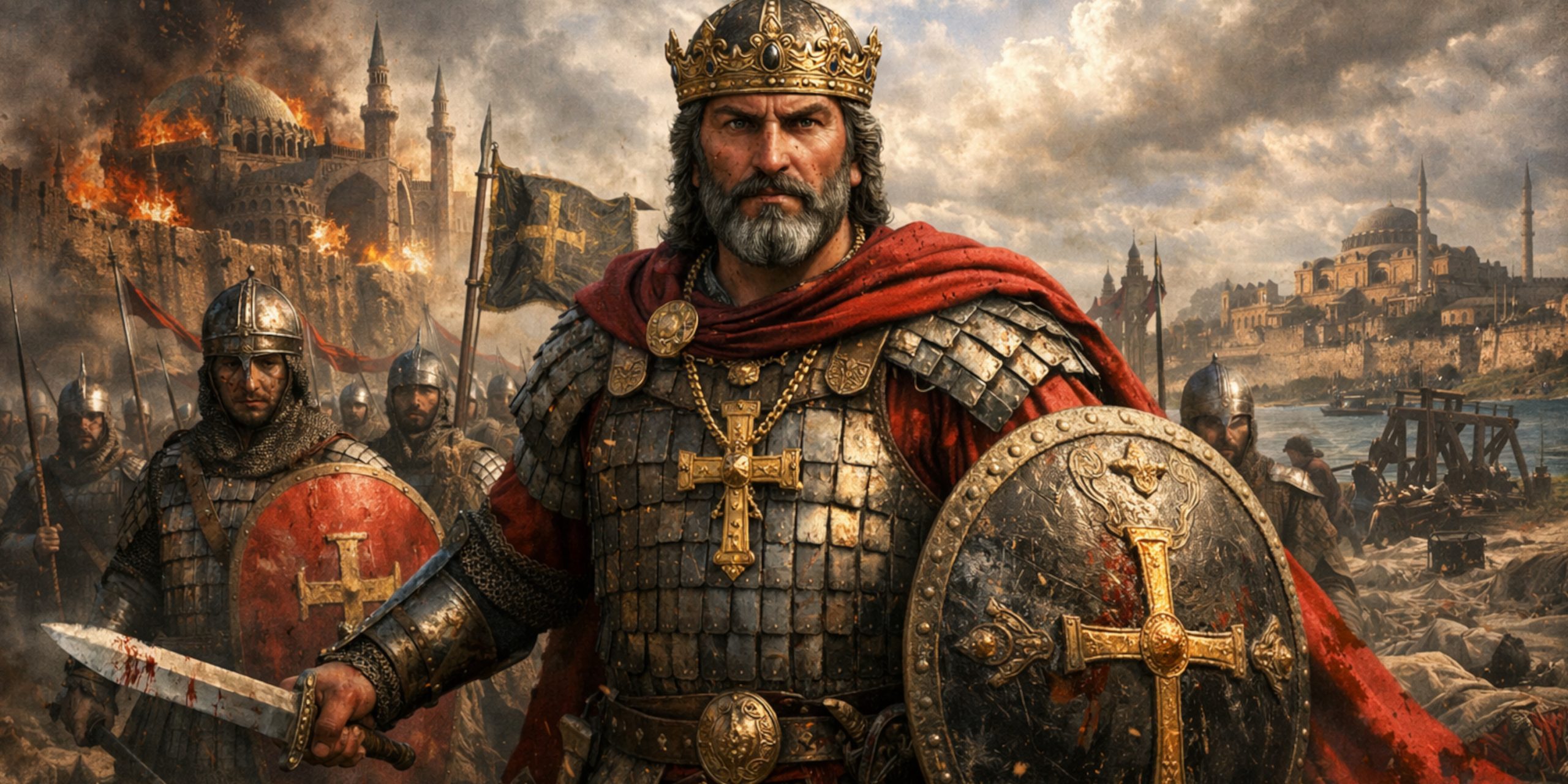
The armies of Heraclius sit at the crossroads between Roman tradition and medieval practice.
Infantry and cavalry equipment included:
- Lamellar cuirasses made from iron or hardened leather, offering flexibility and protection
- Spangenhelm helmets with nasal guards, often worn with padded caps
- Round or oval shields, still Roman in spirit but increasingly regional in style
- Spatha swords, long and straight, paired with spears for close formation fighting
- Composite bows, especially among cavalry, reflecting eastern tactical influence
Heraclius’ forces were not uniformly equipped. Regional levies, federate troops, and elite tagmata all looked different on the field. That diversity was a strength, not a weakness, and Heraclius understood how to use it.
Faith, Ideology, and the Emperor at War
Heraclius fought as a Christian emperor in a way few before him had attempted. The Persian war became framed as a religious struggle, especially after the capture of Jerusalem and the removal of the True Cross.
When Heraclius returned the relic to Jerusalem in 630, barefoot and in ceremonial humility, it was political theatre with deep emotional resonance. It worked. For a brief moment, the empire believed itself restored by divine favour.
As a historian, I suspect this moment mattered less militarily than psychologically. It unified a battered population and reinforced loyalty at a time when new storms were already gathering.
The Islamic Conquests and Strategic Limits
No account of Heraclius is complete without addressing what followed. Within a few years of his greatest victory, Byzantine armies were defeated at Yarmouk. Syria and Egypt fell rapidly.
This was not simply military failure. The empire was exhausted, depopulated, and financially drained. Heraclius had won the last war at the cost of being unprepared for the next.
His later years were marked by illness, withdrawal, and the quiet recognition that the world he saved no longer existed in its old form.
Artefacts from the Reign of Heraclius
Material evidence from Heraclius’ reign is sparse but evocative.
Notable artefacts include:
- Gold solidi bearing Heraclius’ image, held by institutions such as the British Museum and the Dumbarton Oaks Collection
- Military fittings and armour fragments from Anatolia and the Balkans, often dated stylistically to the early seventh century
- Church objects and reliquaries linked to the post-war restoration period
Coins from his reign are particularly telling. The imagery shifts from classical imperial confidence to overt Christian symbolism, reflecting a changing ideological world.
Latest Archaeology and Research
Recent archaeological work has reshaped how we understand Heraclius’ era.
- Anatolian fortifications show hurried reinforcement and adaptation rather than abandonment
- Coin hoards buried during Persian and early Islamic invasions suggest rapid population displacement
- Battlefield archaeology in Armenia and northern Mesopotamia continues to refine our understanding of troop movement and logistics
What stands out is continuity. The empire did not collapse in Heraclius’ lifetime. It adapted, shrank, and hardened, setting the foundations for medieval Byzantium.
Legacy and Final Thoughts
Heraclius is often called the last Roman emperor and the first Byzantine one. Both labels are slightly wrong, but emotionally accurate.
He saved the empire through audacity and belief. He also pushed it to the edge of exhaustion. I admire his courage, question some of his judgement, and respect the scale of the problems he faced. Few rulers have carried so much weight for so long, with such mixed rewards.
If history is a relay race, Heraclius ran his leg at full sprint, handed over the baton battered but intact, and collapsed just beyond the line.