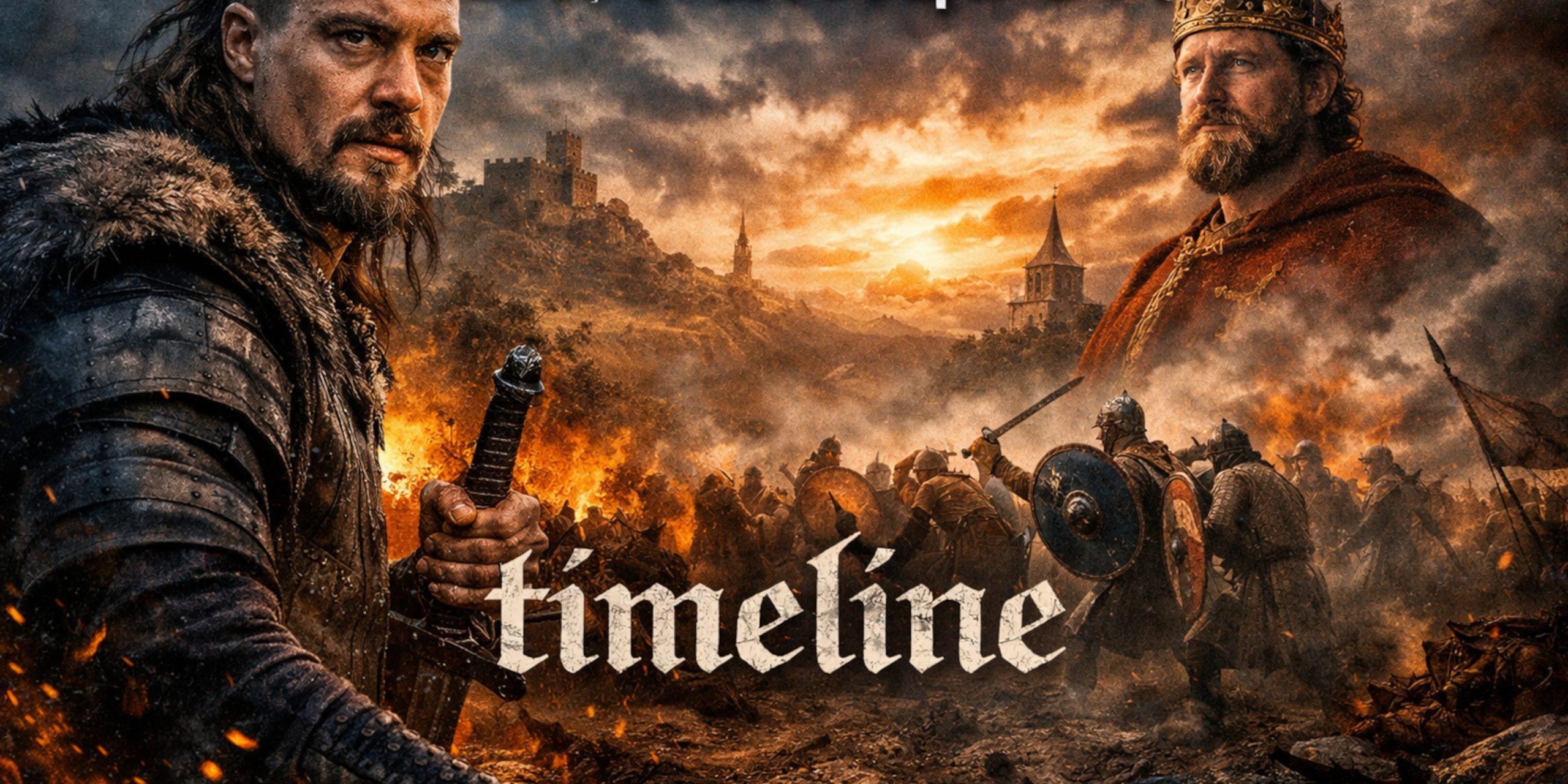
If you have ever wondered how many years pass, which kings come and go, and why Uhtred never seems to age quite as much as the politics around him, this is the clean timeline. No lore fog, no waffle, just a clear run from the chaos of season one to the Netflix finale.
This follows the on screen chronology of The Last Kingdom, not the full book timeline, though the two mostly shake hands and nod politely at each other.
Season one, 866 to 878
Wessex on the brink
Season one opens in 866 with the Great Heathen Army landing in England and promptly ruining everyone’s plans. Northumbria collapses early, setting the tone. This is where Uhtred is captured, raised by Danes, and ends up permanently conflicted, culturally bilingual, and emotionally allergic to authority.
Alfred is not yet king, just a sickly prince with ideas far ahead of his military budget. By the end of the season, following the Battle of Edington in 878, Alfred secures Wessex’s survival and the foundations of a future England are poured, slowly, with gritted teeth.
Uhtred at this point is young, reckless, and still believes honour and loyalty might be rewarded. This phase cures him of that idea.
Season two, 878 to 886
The slow grind of unification
Season two tracks the uneasy peace after Edington. Alfred consolidates Wessex while Danish factions splinter and feud. Mercia becomes the key battleground, both politically and militarily.
Uhtred spends much of this season as Alfred’s most useful liability. He wins battles, loses patience, and gains enemies at court. The season closes around 886 with Alfred recognised as ruler of London, a huge symbolic step towards unifying England.
This is where the show really settles into its rhythm. Fewer surprise invasions, more long term consequences. Everyone is tired, poorer, and sharper for it.
Season three, 892 to 900
Alfred’s final years
The Danes return in force, led by fresh warlords and old grudges. Alfred, now visibly declining, plays a longer game, relying on alliances, strategy, and Uhtred’s inconvenient competence.
This season is anchored by Alfred’s death in 899, one of the series’ emotional high points. It marks the end of vision and restraint and the beginning of a much messier political era.
Edward takes the throne of Wessex in 899, untested and already under pressure. Uhtred, naturally, is blamed for several things he did not do and a few he absolutely did.
Season four, 901 to 910
Edward, Æthelflæd, and the fracture years
With Alfred gone, the careful balance fractures. Edward rules Wessex with less patience and more steel. Æthelflæd rises in Mercia as a leader in her own right, not just a political accessory.
This season sprawls geographically and emotionally. Bebbanburg returns as Uhtred’s obsession, Mercia becomes semi independent, and the Danes shift from conquerors to entrenched rivals.
By around 910, England exists more clearly as an idea, though not yet as a single state. Everyone agrees on the destination. Nobody agrees on the route.
Season five, 912 to 918
The road to England
Season five is about endings. Æthelflæd’s rule peaks and ends in 918, closing one of the show’s strongest arcs. Edward pushes harder for unification, sometimes brutally so. The Danes are still dangerous but increasingly outmatched by coordination and resources.
Uhtred finally circles back to Bebbanburg, not as a boy chasing a birthright but as a seasoned war leader choosing which fights still matter.
This season ends in 918, with England closer than ever to unity, though still not quite there. The work is almost done. The cost is already paid.
Seven Kings Must Die, 919 to 937
The final reckoning
The feature length finale jumps ahead to the final push. Edward dies in 924, leaving succession chaos. Æthelstan emerges as the unlikely architect of a united England.
The timeline concludes at the Battle of Brunanburh in 937, the moment historians generally accept England becomes England. Uhtred, now visibly older and finally reflective, stands slightly apart from history, having shaped it without ever fully belonging to it.
It is a restrained ending, by the show’s standards. No grand victory lap. Just a sense that the world has moved on, and that is the point.
A quick timeline snapshot
- 866: Danish invasion begins
- 878: Alfred defeats Guthrum at Edington
- 886: Alfred takes London
- 899: Alfred dies, Edward becomes king
- 910: Power struggles across Mercia and Wessex
- 918: Death of Æthelflæd
- 937: Battle of Brunanburh and the birth of England
The Seven Swords Takeaway
What makes this timeline work is its patience. The show resists turning history into a sprint. Kingdoms rise slowly, people age unevenly, and progress is uncomfortable. Uhtred’s long life lets the audience feel the weight of decades, not just seasons.
It also explains why the finale lands the way it does. This was never a story about one man winning everything. It was about surviving long enough to see the world change around you.
And occasionally getting stabbed for your trouble.