Atalanta stands slightly apart from the usual parade of Greek heroes. She is not a king, not a demi god obsessed with founding cities, and not especially interested in pleasing the gods. Instead, she runs, hunts, and refuses to marry on anyone else’s terms. That alone makes her memorable. Add a lethal spear arm, divine speed, and a myth that ends with an argument over apples, and you have one of the most distinctive figures in Greek mythology.
What follows is everything we can reasonably say about Atalanta, drawn from ancient sources, later retellings, and the quiet gaps where myth refuses to be tidy.
Origins and Early Life
Atalanta’s parentage shifts depending on the source, which is very on brand for Greek myth. She is usually described as the daughter of either Iasus or Schoeneus, both Arcadian figures. What matters more than the name of her father is what he does next. Wanting a son, he abandons her on a mountainside.
This rarely ends well for infants, but Atalanta is rescued by a she bear and suckled until hunters find her and raise her. Ancient writers clearly enjoyed this detail. It gives her an origin story that explains her independence, her affinity with the wild, and her total lack of patience for polite society.
From an early age she trains as a hunter, devoting herself to Artemis. This devotion is important. Artemis is not a goddess who tolerates half measures, and Atalanta’s skills suggest serious commitment rather than casual worship.
Atalanta the Huntress
Atalanta’s reputation rests first on her prowess as a hunter. She is fast, precise, and entirely comfortable in dangerous terrain. Unlike many heroic women in Greek myth, her competence is not framed as surprising. It is treated as a fact that occasionally irritates men around her.
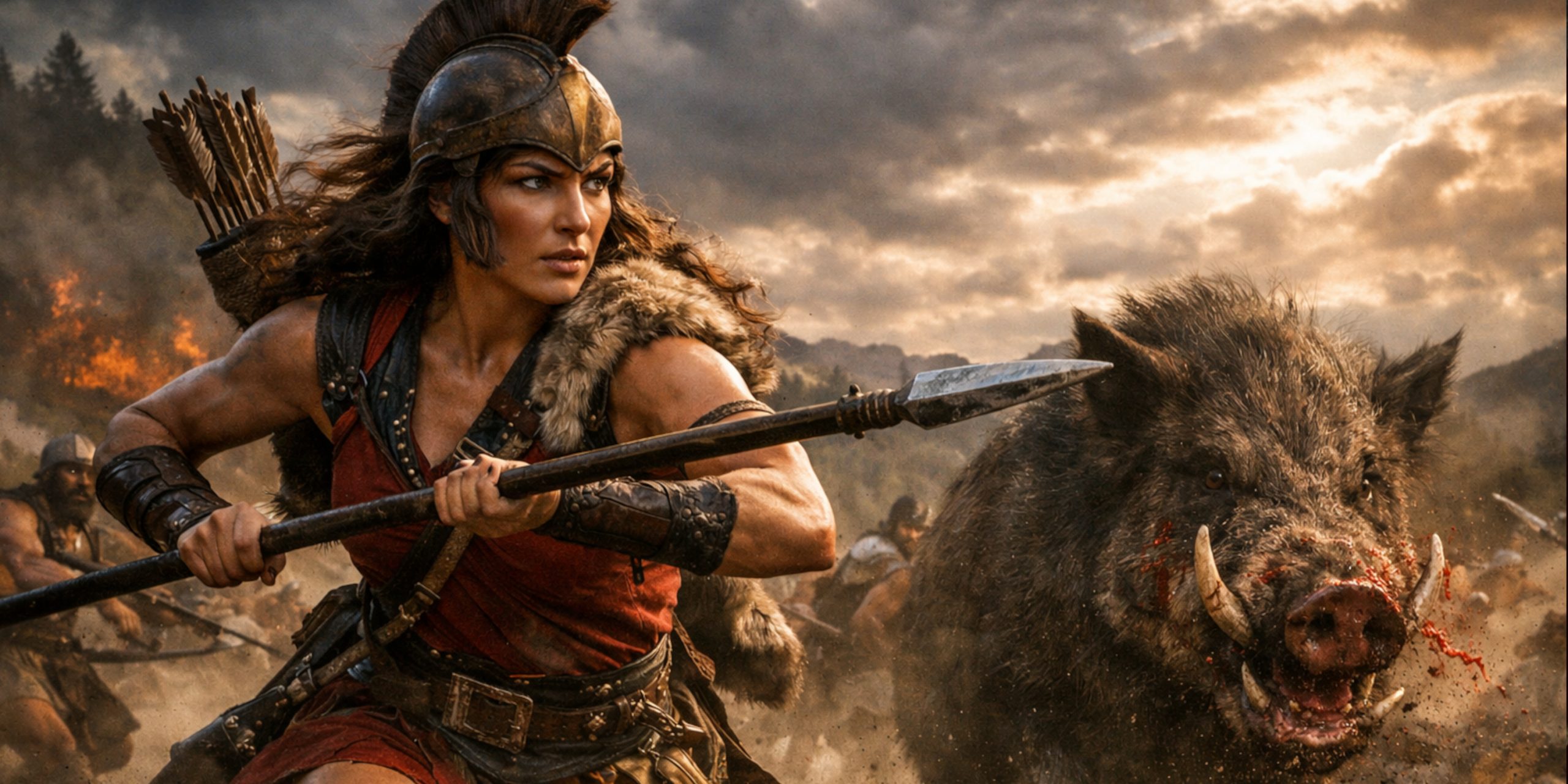
Her most famous exploit is her role in the Calydonian Boar Hunt. When King Oeneus neglects Artemis, the goddess sends a monstrous boar to ravage Calydon. A hunting party of Greek heroes assembles, including Meleager, Castor, Pollux, and several others who tend to dominate myths.
Atalanta draws first blood, striking the boar with an arrow. This matters. In heroic storytelling, the first wound is a marker of excellence. Meleager eventually kills the beast, but he awards the hide to Atalanta, recognising her contribution. This decision causes predictable outrage among the male hunters and leads directly to bloodshed.
It is a neat example of how Atalanta’s presence destabilises heroic norms. She does the job properly, and that creates a problem.
The Vow of Virginity
Atalanta vows to remain unmarried, a promise closely tied to her devotion to Artemis. In myth, vows like this are rarely negotiable. They tend to end in tragedy or transformation, sometimes both.
Her father eventually attempts to force the issue by arranging a contest. Any man who wishes to marry Atalanta must beat her in a footrace. Those who lose are killed.
This is not subtle. It is also very effective. Atalanta is faster than any of her suitors, and the pile of bodies grows accordingly. Ancient audiences would have recognised this as a darkly comic escalation. The rules are clear. The men keep running anyway.
Hippomenes and the Golden Apples
Enter Hippomenes, sometimes called Melanion depending on the source. He is sensible enough to realise that outrunning Atalanta is unlikely. Instead, he asks Aphrodite for help.
The goddess provides three golden apples from the Garden of the Hesperides. During the race, Hippomenes drops them one by one. Atalanta, curious and momentarily distracted, stops to pick them up. That brief hesitation costs her the race.
This episode is often told as a clever trick or a romantic victory. From a historian’s perspective, it reads more like a warning about divine interference. Atalanta loses not because she is slower, but because the rules of the world shift beneath her feet.
Transformation and Aftermath
The ending of Atalanta’s story is uncomfortable, which is again typical. In some versions, Hippomenes forgets to thank Aphrodite, and the goddess punishes both of them by inflaming their desire. They consummate their relationship in a sacred space, often a temple of Zeus or Cybele.
For this transgression, they are transformed into lions. The symbolism is debated, but the punishment is clear. Even when Atalanta is defeated, the cost is severe and oddly disproportionate.
It is worth noting that Atalanta’s agency all but disappears at this point. Her story, which begins with autonomy and skill, ends with divine retribution and metamorphosis. Greek myth is not especially kind to women who remain independent for too long.
Weapons and Skills
Atalanta is consistently associated with a small number of weapons and abilities:
- A hunting spear or javelin, used with speed rather than brute force
- A bow, particularly in the Calydonian Boar episode
- Exceptional running speed, sometimes described as almost supernatural
- Wilderness skills including tracking, endurance, and survival
She is not portrayed as a battlefield commander or armoured warrior. Her strength lies in mobility and precision. In modern terms, she would be light infantry, and very effective.
Atalanta in Ancient Sources
Atalanta appears in several classical works, though never as the central focus of a surviving epic. Key references include:
- Apollodorus, Bibliotheca
- Ovid, Metamorphoses
- Pausanias, Description of Greece
Each source tweaks the details slightly. Names change, motivations blur, and the tone shifts. What remains consistent is her speed, her independence, and the sense that the world struggles to contain her.
Interpretation and Legacy
Atalanta has often been read as a challenge to traditional gender roles in Greek myth. She competes directly with men and wins, repeatedly. When she loses, it requires divine cheating rather than honest defeat.
Later writers and artists were clearly fascinated by her. Renaissance painters loved the visual contrast of the footrace. Modern retellings tend to emphasise her autonomy and resistance to marriage, sometimes softening the harsher elements of her ending.
As a historian, I find her compelling precisely because her myth never quite settles. She does what heroes do, but the narrative seems uncomfortable rewarding her for it.
Takeaway
Atalanta endures because she exposes the limits of heroic storytelling. Greek myth has room for powerful women, but only up to a point. When they move too fast, hunt too well, or refuse the expected ending, the gods intervene.
She is not a symbol so much as a problem the myth never fully solves. That, I suspect, is why we keep coming back to her.