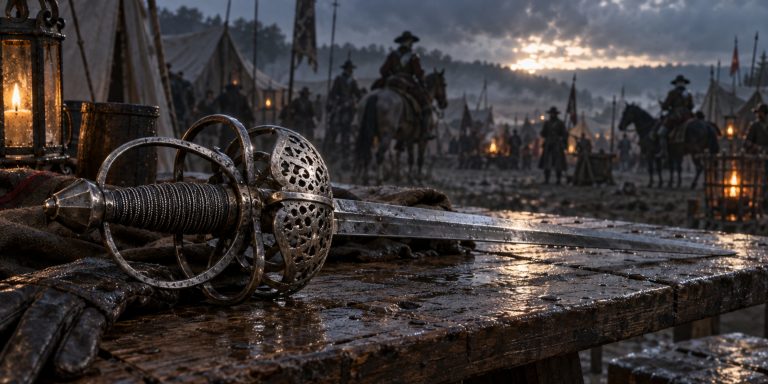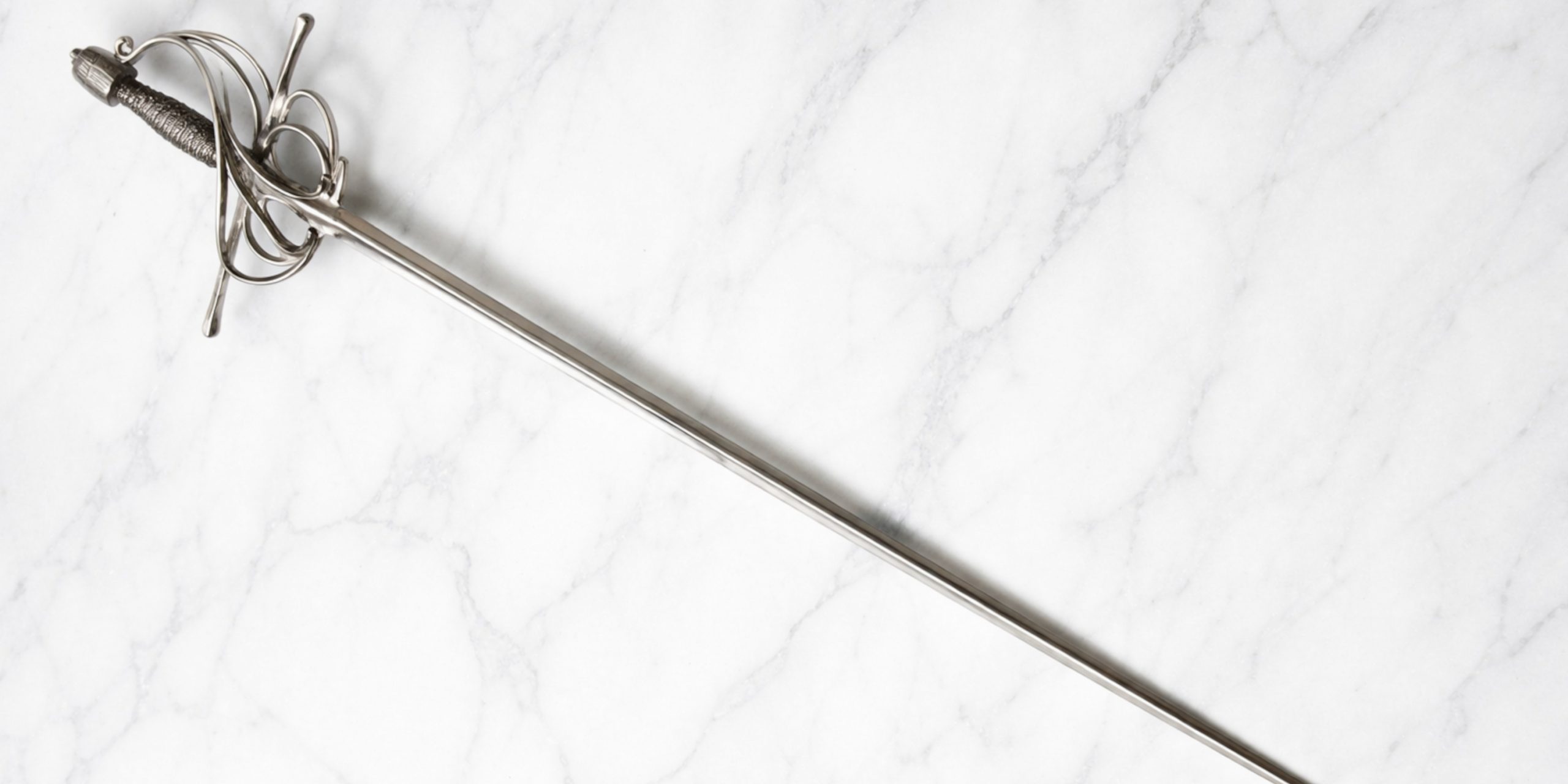
The Ferrara rapier sits at the refined end of Renaissance sword culture. It reflects a city that valued display, fencing theory, and technical precision as much as raw violence. Associated with northern Italy in the late sixteenth century, this type is defined less by a single workshop and more by a recognisable style that travelled well beyond Ferrara’s walls.
Ferrara was one of Italy’s great Renaissance courts, wealthy, competitive, and deeply invested in martial fashion. The rapier that emerged from this environment was long, narrow, and unapologetically sophisticated. It was built for civilian self defence and formal fencing rather than the chaos of the battlefield. Owners expected elegance, balance, and a blade that rewarded training.
Specifications
Typical surviving examples vary, but most Ferrara rapiers fall within a tight and recognisable range.
| Feature | Typical Range |
|---|---|
| Overall length | 115 to 130 cm |
| Blade length | 95 to 110 cm |
| Weight | 1.1 to 1.4 kg |
| Blade profile | Long, narrow, diamond or flattened diamond |
| Point of balance | 6 to 10 cm from guard |
| Hilt type | Swept hilt or early cup influence |
| Grip | Wood core with cord and leather |
Key construction traits often include ricassos for finger placement and complex guard bars designed to catch or control an opponent’s blade.
History and Evolution
Ferrara’s fencing culture flourished during the later sixteenth century, influenced by Italian masters who emphasised thrusting over cutting. Early Ferrara rapiers retained relatively open swept hilts. As fencing styles formalised, guards became denser and more protective.
By the early seventeenth century, Ferrara style blades and hilts were being exported or copied across Europe. Spanish and French tastes soon diverged, but the Italian emphasis on balance and point control remained influential. The Ferrara rapier represents a midpoint between the open medieval side sword and the enclosed cup hilt that followed.
Advantages and Disadvantages
Advantages
• Excellent reach and point control
• Balanced for precise thrusting techniques
• Guards provide good hand protection without excessive weight
• Strong association with Italian fencing treatises
Disadvantages
• Poor cutting performance compared to broader blades
• Less durable in battlefield conditions
• Requires training to use effectively
• Complex hilts are vulnerable to damage or bending
This is a sword that rewards education. In untrained hands it offers little forgiveness.
Comparison with Similar Weapons
| Weapon | Key Difference |
|---|---|
| Bolognese side sword | Shorter blade, better cutting ability |
| Spanish cup hilt rapier | Heavier guard, more enclosed hand protection |
| French smallsword | Much lighter, optimised for duelling |
| Pappenheimer rapier | Bulkier guard, later military crossover |
The Ferrara rapier sits closest to the classical Italian fencing ideal, before national styles began to harden into stereotypes.
Legacy
The Ferrara rapier helped shape the European idea of the rapier as a gentleman’s weapon. Its emphasis on geometry, timing, and restraint fed directly into later duelling swords. While it never achieved the visual dominance of the Spanish cup hilt, its influence is clearer in fencing manuals than in parade portraits.
Modern historical fencing practitioners often favour Italian style replicas for the same reasons Renaissance fencers did. They are honest swords that expose sloppy technique.
Where to See Original Examples
Authentic Ferrara rapiers and closely related Italian examples can be found in several major collections.
• The Wallace Collection
• The Museo Nazionale del Bargello
• The Royal Armouries
Most examples are attributed by style rather than signed makers, which keeps curators busy and collectors cautious.
Collector’s Guide and Auction Prices
Collectors value Ferrara rapiers for elegance and condition rather than sheer rarity.
What to look for
• Straight blade with crisp edges and point
• Symmetrical guard with minimal repairs
• Original grip or historically correct restoration
• Clear Italian stylistic features rather than later hybrids
Indicative auction prices
| Condition | Typical Price Range |
|---|---|
| Poor or incomplete | £2,000 to £4,000 |
| Good, honest condition | £6,000 to £10,000 |
| Exceptional, museum quality | £15,000 to £30,000+ |
Prices fluctuate sharply based on provenance and attribution. Anything confidently linked to a documented Italian workshop commands a premium.