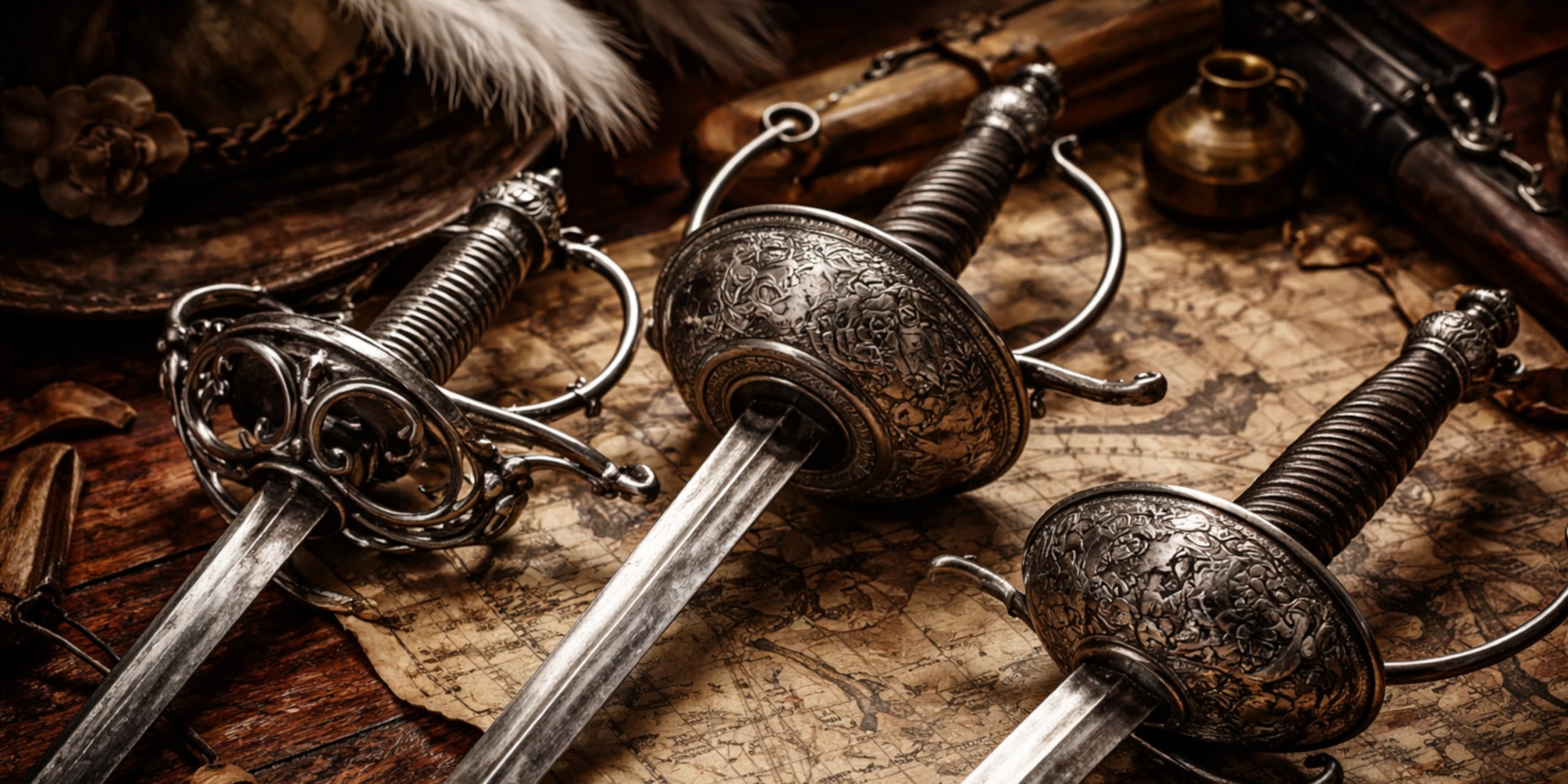
The musketeer sword sits at the crossroads of battlefield practicality and civilian fashion. Carried by the famous French musketeers of the seventeenth century, it was less a single standard pattern and more a family of rapiers and transitional side swords suited to a soldier who might fight on foot, guard a court, or settle matters of honour after dark. Light enough to wear all day, long enough to command distance, and elegant enough to signal status, it became an emblem of the age.
Musketeers were not defined by their swords alone. Firearms gave them their name, but the sword remained their constant companion. When powder was wet or formations broke, steel mattered. The musketeer sword reflects that reality. It favoured reach, control, and a hand-protecting hilt, often paired with civilian dress rather than heavy armour. Think practical refinement rather than brute force.
Specifications
Typical examples vary by region and decade, but common characteristics appear again and again.
| Feature | Typical Range |
|---|---|
| Overall length | 105 to 120 cm |
| Blade length | 85 to 100 cm |
| Blade type | Narrow, straight, double-edged |
| Point of balance | 8 to 12 cm from the guard |
| Weight | 1.0 to 1.3 kg |
| Hilt styles | Swept hilt, cup hilt, shell guard |
| Grip | Wood core with leather or wire wrap |
Notes that matter in use.
- Optimised for thrusting, with enough edge to cut if needed
- Long ricasso on some examples for finger placement
- Guards designed to protect the hand in close civilian-style fencing
History and Evolution
The musketeer sword developed during a period when heavy battlefield swords were fading. Armour was thinning, firearms were dominant, and personal defence was as important as formation fighting.
Early seventeenth century examples closely resemble late sixteenth century rapiers, with complex swept hilts and long, stiff blades. As the century progressed, hilts became more enclosed. Cup hilts and shell guards gained favour, offering better hand protection with cleaner lines.
By the late seventeenth century, the musketeer sword begins to overlap with early smallswords. Blades shorten slightly, weight drops, and the weapon becomes increasingly civilian. At that point, the classic musketeer era is already ending.
Advantages and Disadvantages
Advantages
- Excellent reach and point control
- Light enough for prolonged wear
- Effective in duelling and close personal defence
- Hand protection superior to earlier side swords
Disadvantages
- Limited cutting power against heavy clothing
- Less effective against armoured opponents
- Requires fencing skill rather than raw strength
- Narrow blades are more vulnerable to bending if poorly made
Comparison with Similar Weapons
| Weapon | Key Difference | Practical Impact |
|---|---|---|
| Rapier | Often longer and more specialised | Superior reach but less versatile |
| Side sword | Broader blade and stronger edge | Better cutting, heavier to carry |
| Smallsword | Shorter, lighter, thrust-only | Ideal for duels, poor for military use |
| Infantry hanger | Short, robust blade | Durable but lacks reach |
The musketeer sword sits comfortably between battlefield utility and civilian refinement, which explains its wide adoption.
Legacy
The musketeer sword helped bridge two worlds. It closed the chapter on medieval-style arming swords and paved the way for the smallsword and later dress swords. Its influence is visible in fencing systems, court etiquette, and popular culture, where musketeers remain inseparable from long blades and guarded hilts.
Modern historical fencing groups still study musketeer-era rapiers, partly because they reward precision and timing over force. That alone keeps the tradition alive.
Where to See Original Examples
Well-preserved musketeer swords can be found in several major collections.
- Royal Armouries, Leeds
- The Wallace Collection, London
- Metropolitan Museum of Art, New York
These institutions hold multiple seventeenth century rapiers closely associated with military and court use.
Collector’s Guide and Auction Prices
Original musketeer swords are collectable but condition and provenance matter greatly.
What collectors look for
- Seventeenth century blade with clear maker’s marks
- Period hilt with minimal restoration
- Consistent wear rather than aggressive polishing
- Provenance linked to France, Spain, or Italy
Indicative auction prices
| Condition and Type | Typical Price Range |
|---|---|
| Incomplete or heavily restored | £1,500 to £3,000 |
| Honest condition, period hilt | £3,500 to £7,000 |
| High-quality cup hilt with provenance | £8,000 to £15,000+ |
Reproductions from reputable makers are widely available and far more practical for handling. Originals deserve careful conservation rather than weekend sparring.