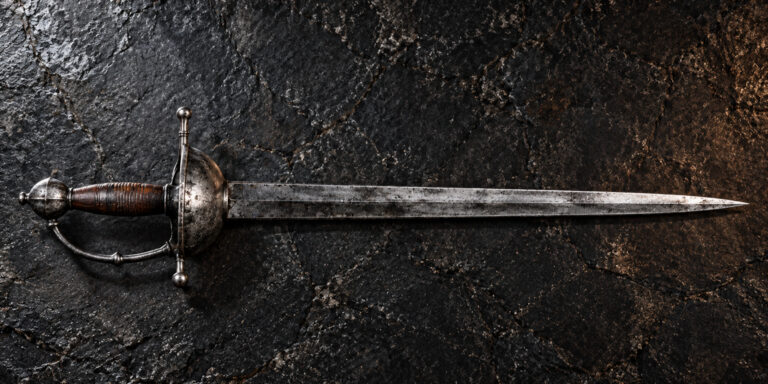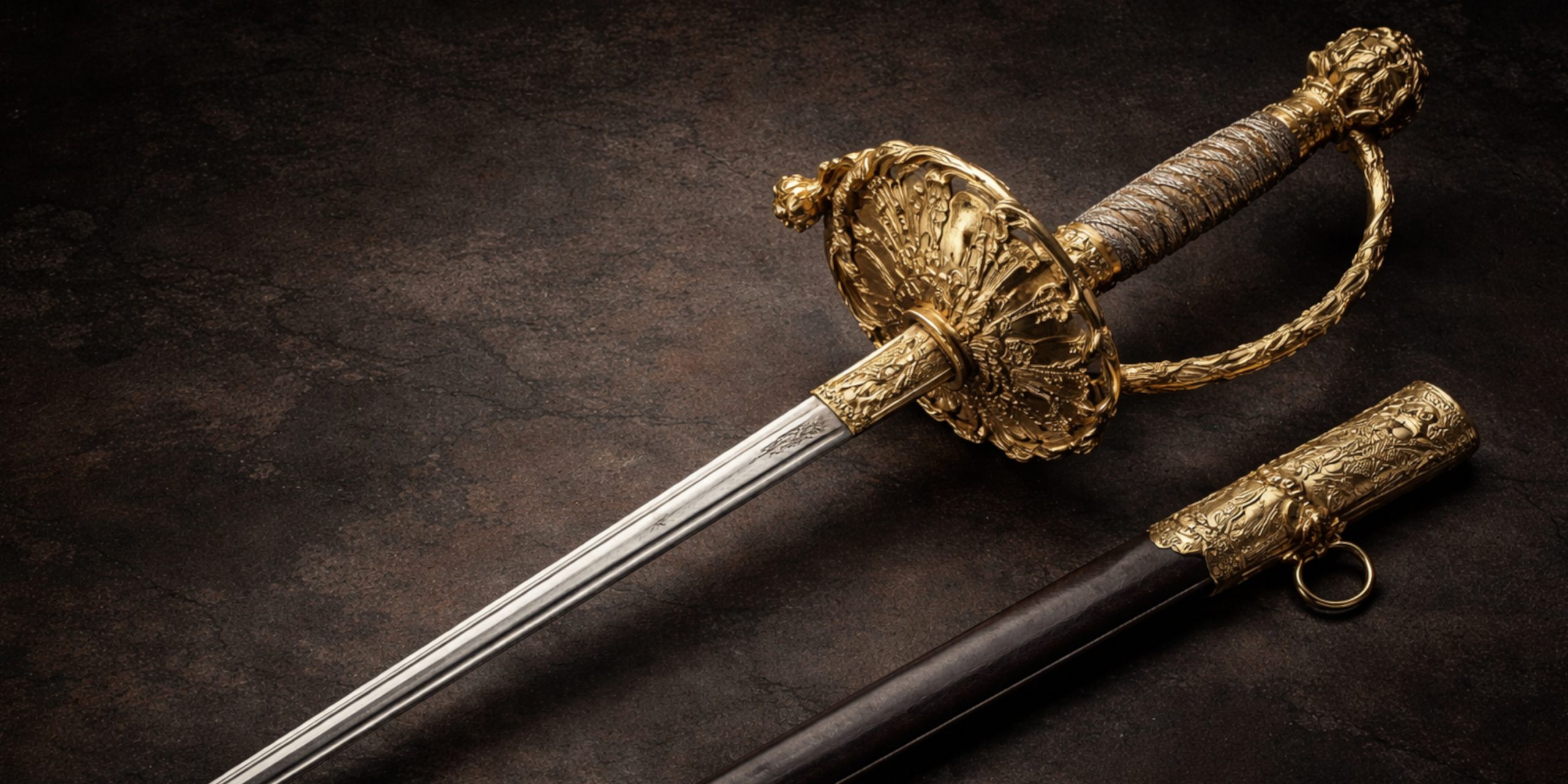
The court sword associated with the reign of Louis XV is a refined smallsword rather than a battlefield weapon. It belongs to a world of salons, ceremony, and controlled violence where reputation mattered as much as technique. By the mid eighteenth century the sword had become a mark of breeding and education, carried by officers, courtiers, and professionals who understood that steel was now a social language as well as a practical tool.
Specifications
| Feature | Typical Characteristics |
|---|---|
| Type | Smallsword, court sword |
| Date | c. 1720 to 1770 |
| Overall length | 90 to 100 cm |
| Blade length | 75 to 85 cm |
| Blade form | Narrow, hollow ground or triangular |
| Blade edges | Primarily thrusting, short false edge near tip |
| Hilt | Small shell guard or oval guard with knuckle bow |
| Materials | Steel blade, gilt bronze or silver hilt |
| Grip | Wood core, wire wrapped, often silk underlay |
| Weight | Approx. 500 to 800 g |
History and Evolution
The smallsword developed from late seventeenth century rapiers as civilian dress replaced armour and battlefield swords grew heavier. By the time Louis XV came to the throne, the smallsword had already shed most cutting ability. Precision, speed, and control mattered more than reach.
Under Louis XV, French taste shifted toward Rococo elegance. Hilts became lighter and more sculptural, often pierced, gilded, or engraved with floral motifs. Blades were shorter and stiffer, optimised for fencing schools that emphasised point control and measured footwork. Carrying a sword at court was expected, but drawing it was rare. Duels still occurred, yet increasingly they followed formal rules rather than impulsive violence.
Advantages and Disadvantages
Advantages
- Excellent point control and balance
- Lightweight, comfortable for daily wear
- Ideal for formal fencing and civilian defence
- Highly decorative, reinforcing social status
Disadvantages
- Minimal cutting ability
- Poor performance against heavy clothing or armour
- Limited reach compared to earlier rapiers
- Ineffective for battlefield use
Comparison with Similar Weapons
| Weapon | Key Difference | Practical Use |
|---|---|---|
| Late rapier | Longer and heavier, some cutting ability | Transitional civilian and military |
| Transitional smallsword | Slightly broader blade | Early eighteenth century duelling |
| Épée de combat | Later fencing evolution, sport focused | Training and competition |
| Military smallsword | Plainer hilt, stronger blade | Officer sidearm |
The Louis XV court sword sits at the most refined end of this spectrum. It prioritises elegance and technique over versatility.
Legacy
The Louis XV smallsword represents the final stage of the sword as a universal gentleman’s accessory. Its influence carried into modern fencing, especially the épée, which preserves the thrust focused logic of the smallsword. As pistols and law courts replaced blades in personal disputes, the court sword quietly faded into ceremony and fashion.
Where to See Authentic Examples
- Musée de l’Armée
Several eighteenth century French smallswords with court provenance. - Wallace Collection
Outstanding examples of Rococo hilts and French blades. - Metropolitan Museum of Art
Decorative smallswords showing continental styles.
Collector’s Guide
What to Look For
- Crisp blade geometry with visible hollow grinding
- Original wire wrap and grip core
- Gilding or silvering with natural wear rather than modern polish
- French blade inscriptions or Solingen export marks
Common Issues
- Replaced grips or over restored hilts
- Shortened blades
- Modern reproduction scabbards paired with originals
Auction Prices
| Condition and Provenance | Typical Price Range |
|---|---|
| Plain hilt, honest wear | £1,200 to £2,500 |
| Gilt or silver hilt, good condition | £3,000 to £6,000 |
| High quality Rococo hilt, attributed maker | £7,000 to £15,000 |
| Royal or documented court provenance | £20,000 plus |
Prices vary sharply based on originality and documentation. Decorative appeal often drives value more than blade condition.