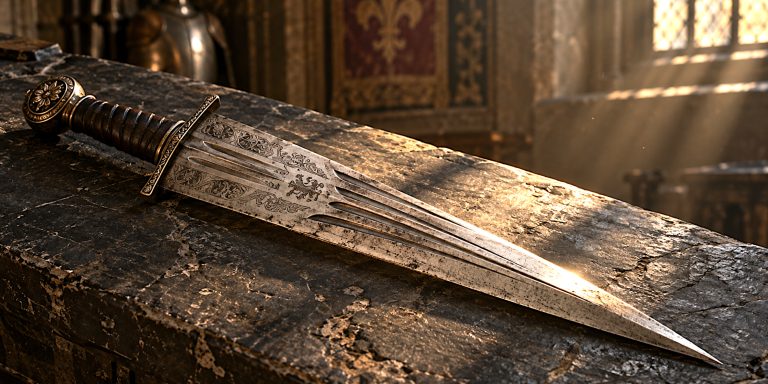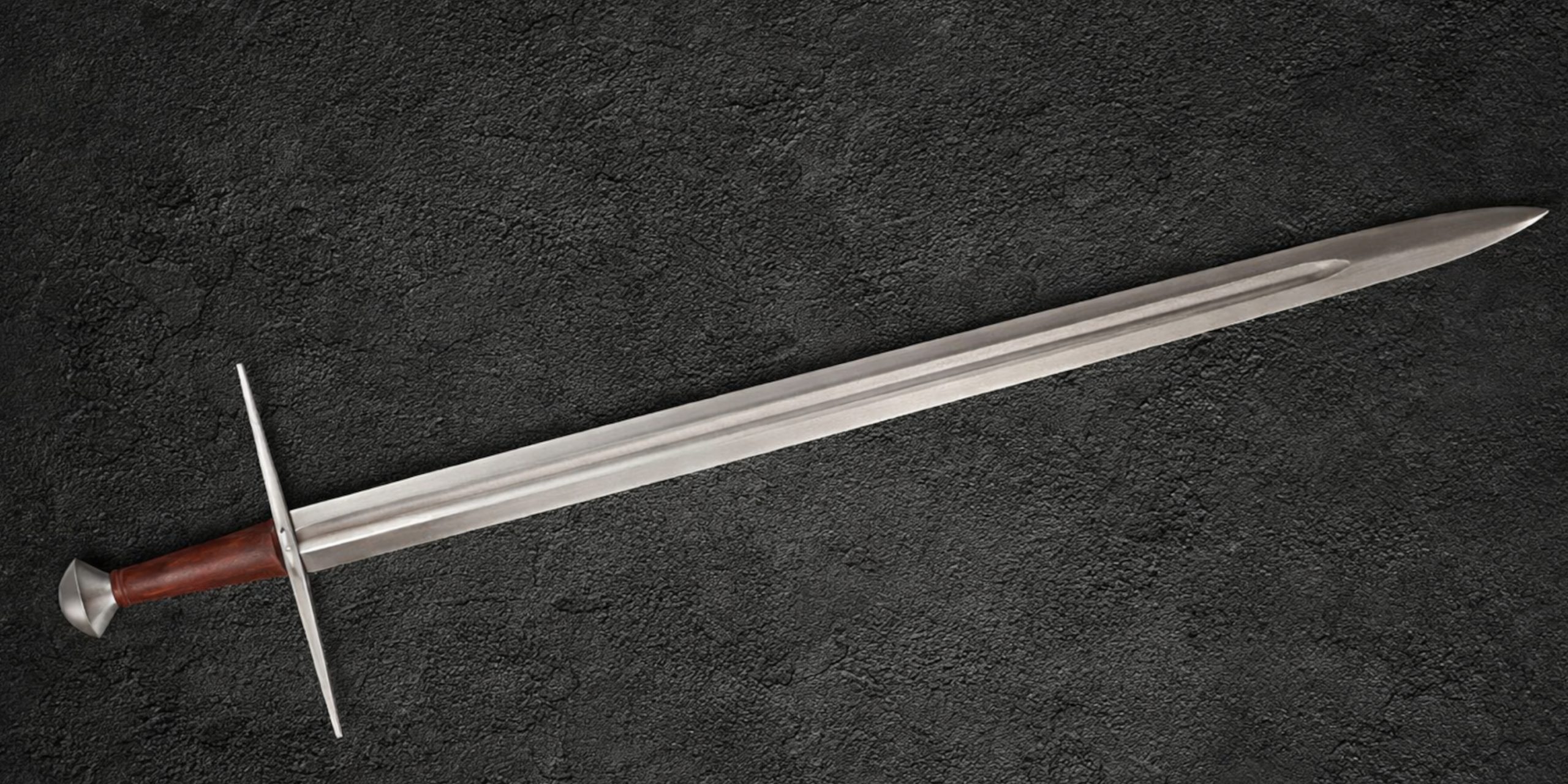
The Oakeshott Type XI is a product of the High Medieval battlefield, built for speed, reach, and decisive cutting. It sits firmly in the late 11th to early 13th century, a period shaped by mail armour, kite shields, and mounted warfare. This is not a refined duelling blade. It is a cavalryman’s sword, long, light, and eager to bite.
The classification comes from the work of Ewart Oakeshott, whose typology remains the standard framework for European medieval swords.
Specifications
| Feature | Typical Range |
|---|---|
| Overall length | 90 to 100 cm |
| Blade length | 75 to 85 cm |
| Blade profile | Long and narrow |
| Fuller | Very broad, usually running nearly full length |
| Blade cross section | Lenticular |
| Point | Acute but optimised for cut |
| Weight | 1.1 to 1.3 kg |
| Grip length | Short, single handed |
| Pommel types | Brazil nut, early disc |
| Guard style | Straight, simple quillons |
Key physical traits
- Blade emphasis on cutting momentum
- Minimal distal taper compared to later knightly swords
- Balance forward of the guard, favouring mounted strikes
History and Evolution
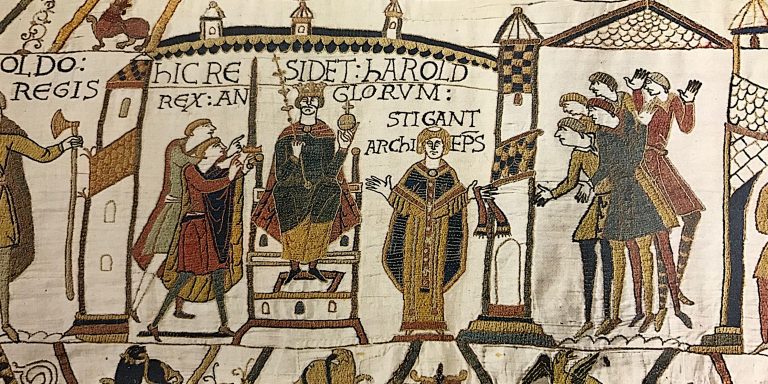
Type XI swords emerge in the late 11th century and reach their height during the 12th century. This places them alongside the Norman Conquest, the early Crusades, and the consolidation of feudal heavy cavalry.
Their design reflects tactical reality. Mail was common, plate was rare, and shields dominated defence. A long, narrow blade with a wide fuller delivered powerful shearing blows capable of disabling limbs or cutting through lighter protection.
By the early 13th century, armour technology began to shift. Thicker mail, reinforced padding, and the first steps toward plate made pure cutting swords less effective. This pushed development toward more tapered blades, leading directly into Type XII and Type XIII forms.
Advantages and Disadvantages
Advantages
- Excellent cutting ability against lightly armoured opponents
- Long reach relative to weight
- Fast recovery in mounted combat
- Simple, robust construction
Disadvantages
- Limited thrusting effectiveness against reinforced armour
- Less versatile in close infantry formations
- Short grip restricts leverage compared to later swords
Comparison With Similar Sword Types
| Type | Key Difference | Practical Effect |
|---|---|---|
| Type X | Shorter and broader blade | Better cutting, less reach |
| Type XI | Long, narrow blade | Maximum reach and speed |
| Type XII | More tapered point | Improved thrusting ability |
| Type XIII | Broader blade, longer grip | Better against armour, slower |
Type XI stands apart as the most specialised cutting sword of its immediate family. Later designs sacrificed some cutting power to gain versatility.
Legacy and Influence
The Type XI helped define the classic image of the early knightly sword. Its proportions influenced later arming swords, even as battlefield needs evolved. While it faded as armour improved, its DNA remained visible in transitional designs that followed.
Modern reproductions often highlight Type XI as an example of pure medieval efficiency, before fencing theory and armour science complicated the equation.
Where to See Original Examples
Authentic Type XI swords and close contemporaries can be found in major European collections:
- British Museum, London
- Wallace Collection, London
- Royal Armouries, Leeds
- Musée de l’Armée, Paris
Condition varies, with many showing later rehilting or conservation work.
Collector’s Guide and Auction Prices
Original Type XI swords are rare and highly sought after.
What collectors look for
- Intact blade with visible broad fuller
- Consistent corrosion patterns
- Period appropriate pommel and guard
- Provenance or collection history
Indicative auction prices
| Condition | Typical Price Range |
|---|---|
| Fragmentary blade | £8,000 to £15,000 |
| Complete but restored | £18,000 to £35,000 |
| Exceptional condition with provenance | £45,000 to £80,000+ |
High quality modern reproductions from respected smiths usually range from £900 to £2,500 depending on materials and finish.