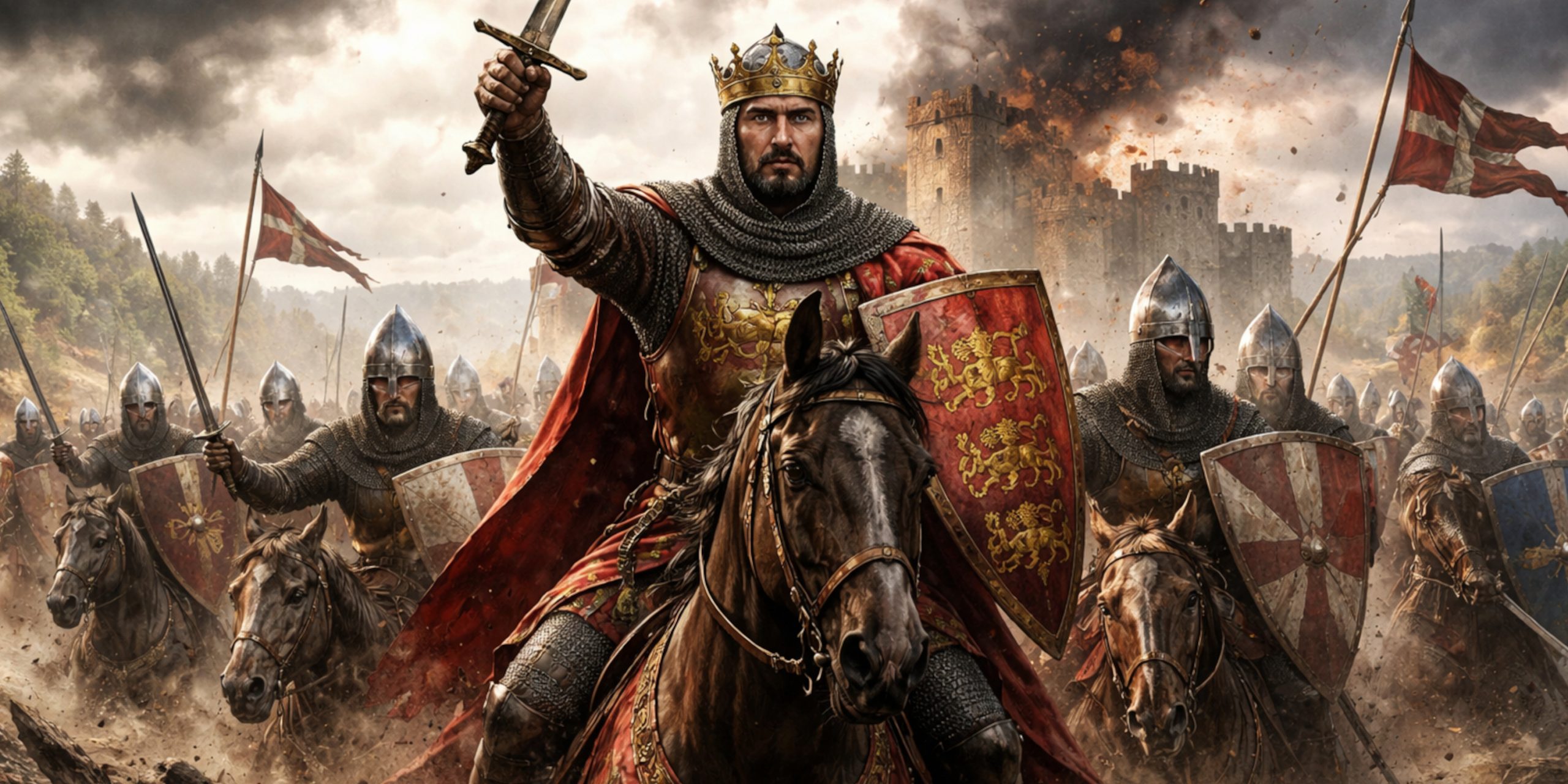
Henry I of England is often remembered as the quiet administrator of the Norman kings, the man of laws rather than legends. That reputation sells him short. Henry ruled in a dangerous world where authority depended on steel as much as parchment. He seized the crown in a moment of crisis, held it through force and calculation, and shaped England’s medieval state with a firm hand. From a historian’s point of view, Henry is fascinating precisely because he combined patience with brutality, learning with ruthless pragmatism.
The World Henry Inherited
Henry came to the throne in 1100 after the sudden death of his brother William II. The Norman realm was fractured, restless, and split between England and Normandy. Barons expected rewards, rival claimants watched closely, and the memory of conquest was still fresh. Henry understood that survival meant balance. He needed legitimacy through law, loyalty through reward, and fear through decisive military action. Unlike his father, William the Conqueror, Henry ruled a second-generation Norman kingdom that could fall apart if mishandled.
Arms and Armour of Henry’s Reign
Henry lived and ruled in an age before plate armour and heraldic splendour. Warfare was brutal, personal, and fast.
Norman knights of Henry’s time typically wore mail hauberks reaching the knee, often with long sleeves and integrated coifs. Helmets were conical with nasal guards, offering limited protection but good visibility. Shields were the classic kite shape, ideal for mounted combat and overlapping infantry formations. Weapons centred on the straight, double-edged knightly sword, supported by spears and lances for shock cavalry. Axes and maces remained common, especially among retainers and household troops.
Henry himself was well educated but no armchair ruler. Contemporary accounts suggest he rode frequently with his armies and understood the practical limits of equipment and terrain. He favoured disciplined forces over flashy numbers, a preference that shows repeatedly in his campaigns.
Battles and Military Acumen
Henry’s greatest military test came not against foreign enemies, but against family and rebellious nobles.
His defining moment was the Battle of Tinchebray in 1106. There, Henry faced his elder brother Robert Curthose for control of Normandy. Henry’s forces were well organised, with infantry used effectively to support cavalry rather than treated as expendable. The victory was decisive. Robert was captured and would spend the rest of his life in captivity. With one battle, Henry secured both England and Normandy and eliminated the most serious dynastic threat to his rule.
Beyond set battles, Henry excelled at siege warfare and suppression. He understood castles as instruments of power rather than symbols. Rebellious barons found their fortresses confiscated or dismantled. Henry was methodical and often unforgiving. From a military standpoint, he displayed a modern instinct for control, logistics, and timing rather than heroic risk-taking.
Law as a Weapon of Rule
Henry’s legal reforms were not separate from his military thinking. Law was another way to disarm opposition. His coronation charter promised restraint and order, aimed squarely at winning support from church and nobility. The development of royal courts, itinerant justices, and written records strengthened the crown’s reach into every shire.
As a historian, this is where Henry becomes especially interesting. He used justice strategically. Fines funded the crown. Legal precedent reinforced authority. The threat of royal punishment often mattered more than battlefield victory. Henry did not abolish violence. He systematised it.
Artefacts from Henry I’s Reign
Physical objects from Henry’s reign are scattered but revealing.
Coins issued under Henry are among the most important survivals. Silver pennies bearing his name and image show the expanding reach of royal administration and minting control. These can be seen in collections at the British Museum and regional museums across England.
Royal charters and seals survive in archives rather than display cases. Wax seals attributed to Henry reveal the growing sophistication of royal symbolism and bureaucracy. Arms and armour directly linked to Henry are rare, but contemporary Norman swords, mail fragments, and equestrian fittings from the early 12th century provide strong contextual evidence of the equipment used by his household and armies.
Archaeology and Recent Findings
Archaeology has quietly reshaped our understanding of Henry’s England. Excavations in Winchester, one of Henry’s key administrative centres, continue to uncover evidence of royal infrastructure, workshops, and coin production tied to his reign. Castle archaeology has been particularly important. Studies of sites such as Windsor and other royal strongholds show phases of reinforcement and rebuilding that align closely with Henry’s efforts to consolidate power.
Recent reassessments of coin hoards from the period also reveal economic strain and reform. Frequent recoinage under Henry was not mere bureaucracy. It was a mechanism to control wealth and loyalty, with archaeology confirming how deeply this system penetrated everyday life.
Death, Legacy, and a Kingdom Unravelled
Henry died in 1135, reportedly after eating lampreys, a suitably strange end for a king who defied simple characterisation. His real failure was succession. Despite efforts to secure his daughter Matilda’s inheritance, his death plunged England into civil war. The Anarchy that followed stands as a harsh reminder that even the strongest systems depend on continuity.
Yet Henry’s legacy endured. His legal structures outlived the chaos. His model of kingship shaped the English crown for generations. From a historian’s view, Henry I feels less romantic than other medieval rulers, but far more consequential. He ruled with a clear eye, a hard hand, and an understanding that power rests not just on the sword, but on who controls it, pays for it, and decides when it is used.
Watch the documentary: