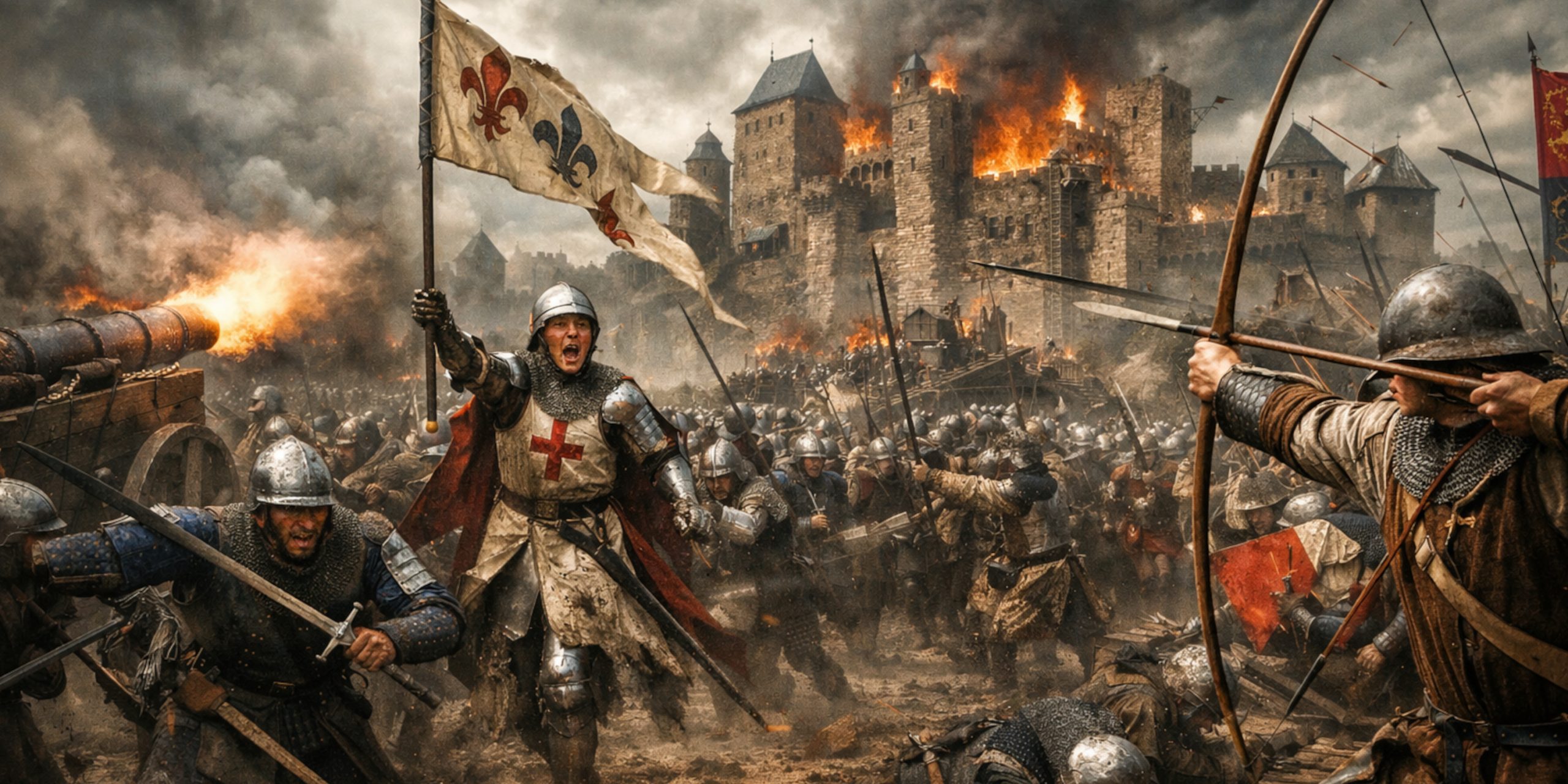
The Hundred Years’ War is usually flattened into a neat timeline of kings, battles, and victories. In reality it was messier, slower, and far more intrusive to everyday life than popular history suggests. The deeper you go into letters, tax records, and city accounts, the clearer it becomes that this conflict was not just fought by armies. It was lived by entire societies.
It unfolded in distinct phases that felt like separate wars
From a medieval perspective, the war did not feel continuous. The Edwardian phase, the Caroline phase, the Lancastrian phase, each had different aims, leaders, and levels of intensity. A merchant operating in Bordeaux in 1380 would have experienced a very different political reality from one in 1420. Treaties such as Brétigny were not seen as pauses but as genuine endings, until circumstances dragged everyone back in.
The English claim to France was legally stronger than it sounds
Edward III’s claim to the French throne was not invented out of ambition alone. Through his mother Isabella, he had a credible dynastic argument under certain interpretations of feudal law. The French reliance on Salic Law was not universally accepted at the time. This legal ambiguity mattered because medieval war needed justification, not just force, and both sides spent years arguing their case in charters and courts as much as on battlefields.
Warfare targeted civilians as a deliberate strategy
The chevauchée was economic warfare in its purest form. Villages were burned not out of cruelty alone but to deny tax revenue and manpower to the enemy crown. English raids through Normandy and the Loire valley were calculated to provoke rebellion against French authority. Chroniclers sometimes moralised about destruction, but military planners were brutally clear about its purpose.
Sieges mattered far more than famous battles
While battles like Battle of Agincourt dominate memory, sieges decided control. Towns such as Calais, Rouen, and Bordeaux mattered because they controlled trade routes, taxation, and supply lines. A single captured port could be more valuable than winning an open battle, which explains why commanders often avoided pitched fighting unless conditions were perfect.
France’s internal civil war nearly ensured English victory
The Armagnac Burgundian conflict was catastrophic. French resources were spent fighting fellow Frenchmen while the English consolidated territory. Paris changed hands through intrigue rather than conquest. When Burgundy allied with England after the murder of John the Fearless, it almost destroyed the Valois cause. Without reconciliation, France may well have ceased to exist as a unified kingdom.
Joan of Arc’s impact was psychological but still decisive
Joan of Arc arrived at a moment when defeat felt inevitable. Her importance lies less in tactical brilliance and more in narrative power. She reframed the war as sacred and national rather than feudal and dynastic. French soldiers began to believe that victory was possible again, and belief can be as lethal as steel when morale has collapsed.
English armies were not as unified as legend suggests
English forces were patchworks of retinues raised through contracts. Captains were entrepreneurs of war, motivated by profit, ransoms, and land grants. Discipline varied wildly. When pay failed, desertion and banditry followed. This system worked well during expansion but collapsed when fortunes turned, leaving garrisons isolated and vulnerable.
Gunpowder quietly tipped the balance
By the 1440s, French artillery had become systematic rather than experimental. Charles VII invested in trained gunners and standardised cannon production. Fortifications designed to resist ladders and rams crumbled under sustained bombardment. English strongholds that had held for decades fell in weeks, not because of poor defence but because the nature of siege warfare had changed.
The war reshaped taxation and government
Funding a century long conflict required innovation. Permanent taxes such as the taille in France and parliamentary grants in England expanded state power dramatically. Record keeping improved, administration grew more centralised, and royal authority reached further into daily life. Many structures associated with the early modern state emerged directly from the need to sustain war.
England’s defeat altered its future path
Losing France was traumatic, yet it forced a reckoning. England abandoned continental ambitions and gradually developed a more insular political identity. Resources once spent abroad were redirected inward, for better and worse. In that sense, the end of the Hundred Years’ War marks the beginning of a different England.
Seen up close, the Hundred Years’ War feels less heroic and more exhausting. It endured because stopping it required political imagination that few leaders possessed. Each generation inherited the grievances, debts, and ambitions of the last. That continuity of conflict, rather than any single battle, is what gives the war its unsettling weight.
Watch the documentary: