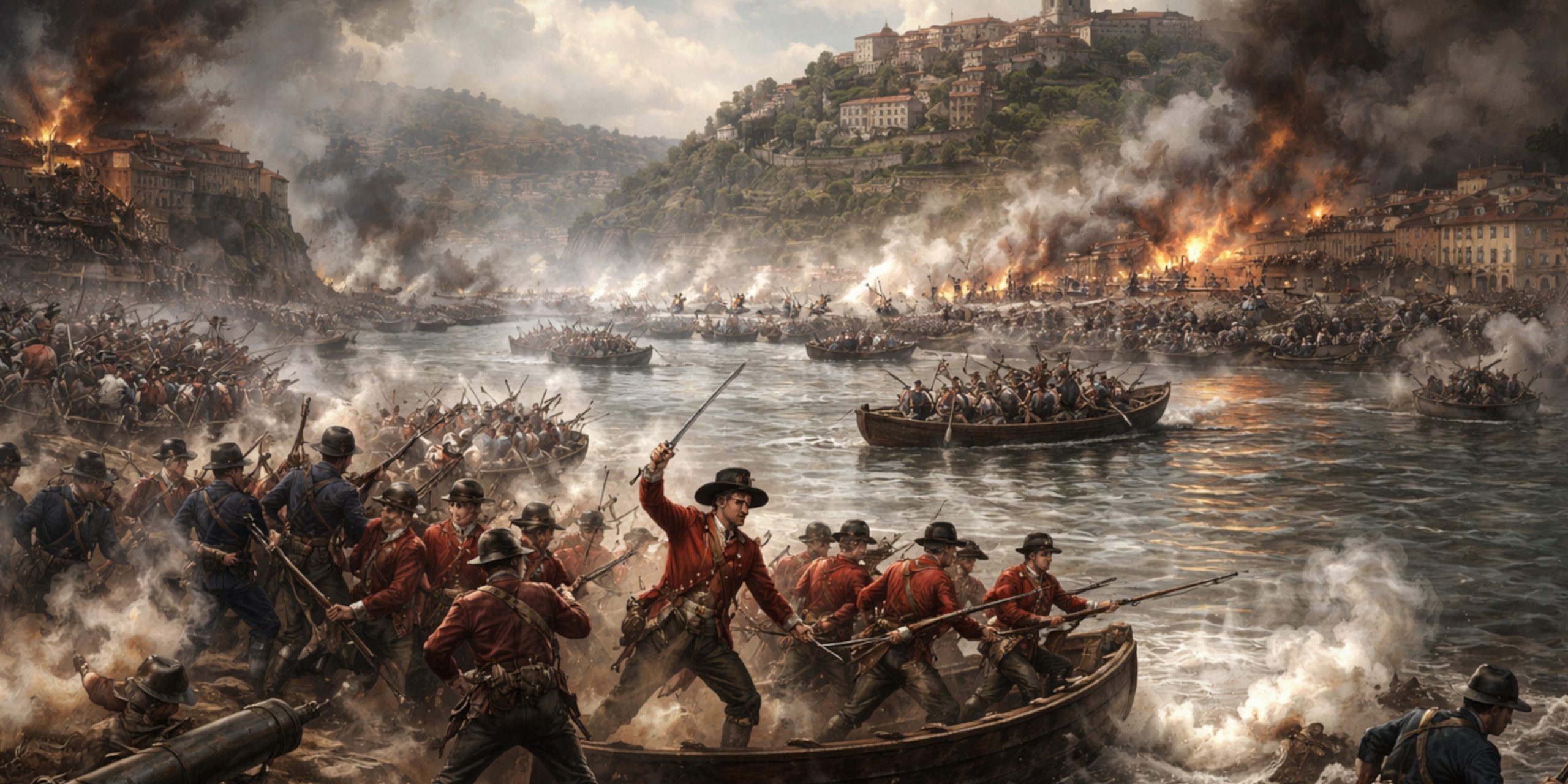
The Battle of Oporto, fought on 12 May 1809, sits among the sharpest reversals of fortune in the Peninsular War. Marshal Soult believed the River Douro made his position unassailable. Arthur Wellesley disagreed, quietly, decisively, and with a talent for unpleasant surprises. As a historian, I have always admired this battle for its economy. No grand speech, no theatrical set piece, just speed, nerve, and a deep understanding of human hesitation.
Strategic Background
Portugal had already endured one French invasion and Oporto paid dearly for it. Soult’s occupation was harsh and increasingly fragile. Wellesley returned to command British forces with a simple aim, drive the French out before they could stabilise or receive support from Spain. The Douro was wide, fast, and stripped of boats by the French. Soult assumed this was enough.
It was not.
Forces
Commanders
| Side | Commander |
|---|---|
| Allied | Arthur Wellesley |
| French | Jean-de-Dieu Soult |
Troop Strength
| Side | Estimated Strength |
|---|---|
| British and Portuguese | 18,000 to 20,000 |
| French | 17,000 to 18,000 |
Soult’s troops were experienced but scattered, foraging aggressively and guarding crossings lazily. Wellesley’s force was smaller in cavalry and artillery, but far more tightly handled.
Arms and Armour
Infantry Weapons
• British infantry carried the Brown Bess musket, backed by bayonet drill that rewarded discipline over enthusiasm
• Portuguese line infantry used similar smoothbore muskets supplied by Britain
• French infantry relied on the Charleville musket, lighter and quicker to handle
Sword Types in Use
| Unit | Sword Type |
|---|---|
| British infantry officers | 1796 Infantry Officer’s Spadroon |
| British cavalry | 1796 Heavy Cavalry Sword |
| French infantry officers | Sabre briquet |
| French cavalry | AN XI heavy cavalry sabre |
These swords mattered less in the crossing itself but became very relevant once French formations began to break. A retreating column meets steel very quickly.
The Battle Timeline
Early morning
Wellesley advances rapidly toward Oporto, masking his intentions and pressing his troops hard.
Mid morning
Local civilians reveal hidden boats and river access points. This is the moment that wins the battle.
Late morning
British troops cross the Douro at the Seminary of Serra do Pilar, achieving total surprise.
Early afternoon
Soult realises too late that his rear is compromised. French units attempt to regroup but panic spreads.
Late afternoon
French retreat degenerates into flight. Equipment, artillery, and baggage are abandoned.
Archaeology and Physical Evidence
The battlefield itself has been reshaped by the modern city, but traces remain. Artefacts recovered over the years include musket balls from both sides, uniform buttons, and fragments of French equipment discarded during the retreat. The Serra do Pilar area remains the most tangible location for understanding how the crossing worked.
Standing there today, overlooking the Douro, it becomes obvious how catastrophic Soult’s assumptions were. Rivers defend you only if you control both banks.
Contemporary Voices
A British officer wrote shortly after the battle that the French were “more astonished than beaten,” which feels brutally accurate.
Soult later admitted that the sudden crossing “changed everything in an instant.” That is as close as a marshal ever comes to saying, I misjudged him.
Outcome and Significance
The French army escaped Portugal but lost most of its artillery and prestige. Oporto restored Allied momentum and confirmed Wellesley’s reputation for calculated audacity. This was not luck. It was preparation meeting opportunity, aided by civilians who had suffered enough and were ready to help tip the balance.
If there is a lesson here, it is that arrogance is heavier than armour and far more difficult to shed once it starts pulling you under.
Watch the docuemntary: