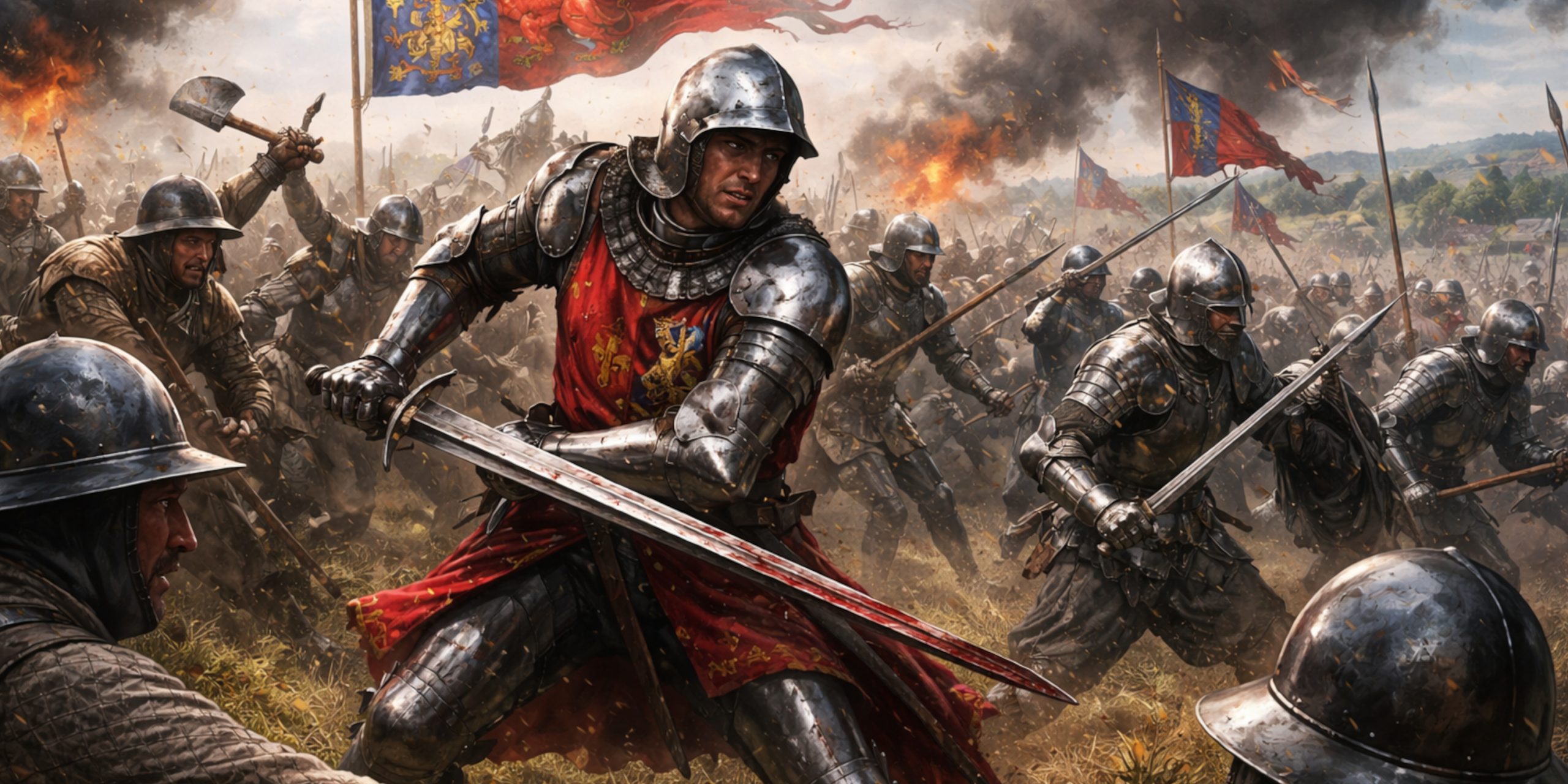
The Battle of Stoke Field, fought on 16 June 1487 near the village of Stoke in Nottinghamshire, is often described as the final clash of the Wars of the Roses. That description is broadly fair, although history rarely ends as neatly as textbooks would like. What makes Stoke compelling is not just its position at the tail end of a dynastic conflict, but the uneasy sense that England in 1487 was still deciding whether the Tudor experiment was going to work at all.
Henry VII was barely two years into his reign. His crown rested on victory at Bosworth, not on deep roots or universal affection. Stoke Field tested whether that crown would stay put.
Background and Causes
The battle arose from a Yorkist attempt to unseat Henry VII using a familiar and audacious tactic. A pretender.
Lambert Simnel, a boy of about ten, was presented as Edward, Earl of Warwick, the imprisoned nephew of Edward IV. The real Warwick was safely locked in the Tower of London, but distance and rumour did most of the heavy lifting for the conspiracy.
The rebellion was driven by seasoned Yorkist loyalists, most notably John de la Pole, Earl of Lincoln. Lincoln had once been named Richard III’s heir and had little interest in bending the knee to a Tudor with a thin claim and a Welsh accent.
With backing from Margaret of Burgundy and a force of German mercenaries, the rebels landed in Ireland, where Yorkist sympathy remained strong. From there, they crossed to Lancashire and marched east, hoping to gather support as they went. They did not gather enough.
Henry VII met them with an army that was larger, better supplied, and crucially more united than his enemies expected.
Forces
Royal Army (Tudor)
| Element | Details |
|---|---|
| Commander | Henry VII |
| Estimated Strength | 12,000 to 15,000 |
| Core Troops | English billmen and archers |
| Specialists | Royal household troops, light cavalry |
| Key Advantage | Numerical superiority and cohesion |
Yorkist-Rebel Army
| Element | Details |
|---|---|
| Commander | John de la Pole, Earl of Lincoln |
| Figurehead | Lambert Simnel |
| Estimated Strength | 8,000 to 9,000 |
| Core Troops | Irish kerns, English Yorkists |
| Specialists | German mercenaries under Martin Schwartz |
| Key Weakness | Poor armour among Irish troops, limited reserves |
Arms and Armour
Leadership and Equipment
- Henry VII
- Armour: Full late fifteenth century plate harness with sallet helmet
- Primary weapon: Arming sword of Oakeshott Type XV
- Secondary weapons: Dagger, mace
- John de la Pole, Earl of Lincoln
- Armour: Plate harness with brigandine elements
- Primary weapon: Arming sword, likely Type XV or early XVI
- Secondary weapons: Poleaxe
- Martin Schwartz
- Armour: German Gothic style plate
- Primary weapon: Longsword, Type XVa
- Secondary weapons: Two handed sword or polearm
Troop Weapons
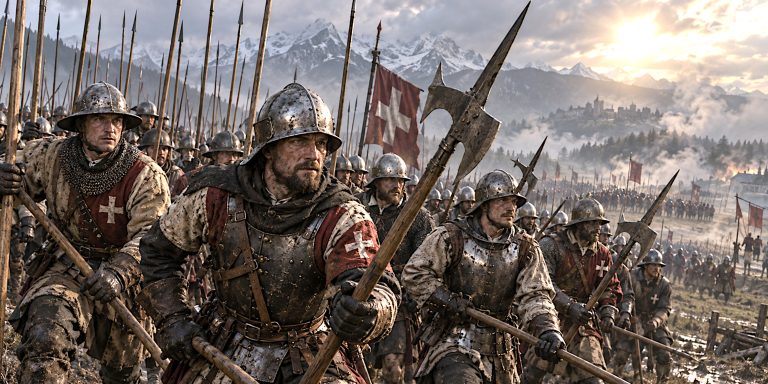
- Bills and halberds used by English infantry
- Longbows, still effective though no longer battle deciding on their own
- German mercenary pikes and longswords
- Irish kerns armed lightly with darts, short swords, and axes
The contrast in equipment mattered. The Irish troops fought bravely but were dangerously exposed against armoured English bills. Courage does not stop steel.
The Battle Timeline
- Early morning
Rebel forces take position on high ground near Stoke Field, anchored by the River Trent. - Late morning
Henry’s army advances in ordered divisions. Artillery plays little role due to terrain. - Midday
The Yorkists launch a determined downhill attack, initially pushing back the Tudor vanguard. - Early afternoon
Superior Tudor numbers begin to tell. The lightly armoured Irish troops suffer severe losses. - Late afternoon
Yorkist command collapses. Lincoln, Schwartz, and other leaders are killed in the fighting. - Evening
Henry VII holds the field. The rebellion is effectively destroyed.
The fighting was hard and personal. Chroniclers suggest it lasted several hours, long enough to exhaust even professional soldiers. This was not a rout. It was a grinding finish.
Archaeology
Unlike some medieval battles, Stoke Field has left only a faint archaeological footprint.
- Limited finds of arrowheads and edged weapon fragments in the Trent valley
- Landscape studies confirm the likelihood of combat on sloping ground near the river
- No mass graves conclusively identified, suggesting the dead were buried locally or removed
The lack of material evidence is frustrating, though typical. Medieval armies were efficient scavengers, especially after a fight that produced a clear winner.
Contemporary Accounts and Quotes
The Tudor chronicler Polydore Vergil wrote with satisfaction about the outcome:
“The field was fought with great cruelty on both sides, but at length the rebels were utterly overthrown.”
The Crowland Chronicle, more restrained, noted the unusual composition of the rebel army and its grim fate:
“Many Irish, almost naked, were slain, whose rash courage availed them little.”
It is difficult not to read these lines without sensing a mixture of relief and quiet horror.
Aftermath and Legacy
Stoke Field ended the last serious Yorkist military challenge to Henry VII. Lambert Simnel was spared and put to work in the royal kitchens, a decision that combined mercy with a sharp sense of theatre.
More importantly, Henry emerged as something he had not quite been before. Secure.
The Tudor dynasty would still face plots, pretenders, and plenty of anxiety, but never again an army of this scale raised openly against it. Stoke Field did not end ambition or discontent. It ended the idea that the Wars of the Roses could simply start up again with another banner and another boy king.
For a battle so often overlooked, it did a remarkable amount of historical tidying.
Watch the documentary: