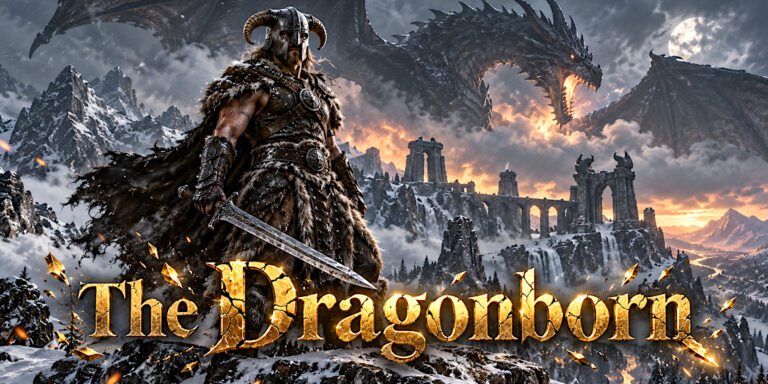
Alduin is one of those Skyrim characters everyone thinks they understand until you actually read the lore. He is called the World-Eater, worshipped as a god by ancient Nords, and somehow still manages to feel like a dragon who misunderstood the assignment.
This is not a hype piece and not another recap of the main quest. This is about who Alduin really was, where he came from, and why his defeat was less about brute force and more about cosmic correction.
Alduin’s Origins in the Elder Scrolls Mythos
Alduin is not just a big angry dragon. He is tied directly to Akatosh, the Dragon God of Time. In most traditions, Alduin is either a firstborn aspect of Akatosh or a reflection of time’s destructive side.
In simple terms, Alduin was created to end the world. Not conquer it, not rule it, and definitely not set himself up as a god-king in Skyrim with a dragon cult.
His purpose was cyclical. The world reaches its end, Alduin consumes it, time resets, and existence starts again. No throne. No worshippers. No long-term plans.
This is where things started to go wrong.
How Alduin Became a Tyrant Instead of a World-Ender
Ancient Nordic legends describe Alduin as a ruler long before he was a destroyer. Dragons dominated Skyrim, mortals were enslaved, and temples rose in his name.
This was not destiny. This was deviation.
Rather than fulfilling his cosmic role, Alduin chose to linger. He demanded worship and ruled through fear. In doing so, he delayed the end of the world rather than bringing it about.
From a lore perspective, this is huge. Alduin was not too evil. He was too selfish. He wanted power instead of purpose.
The Dragon War and Alduin’s First Defeat
Eventually, humans pushed back. The Dragon War was not just a rebellion but a rejection of Alduin’s false divinity.
With help from Paarthurnax and the newly discovered power of the Thu’um, mortals turned Alduin’s own language against him. They could not kill him, because time itself would not allow it, but they could remove him from the board.
Using an Elder Scroll, Alduin was cast forward in time. Not destroyed. Not defeated in the traditional sense. Just delayed.
It is quietly funny that the World-Eater was beaten by a scheduling problem.
Alduin in Skyrim’s Main Story
When Alduin returns in Skyrim, he does not arrive as a cosmic force of renewal. He shows up like a ruler trying to reclaim lost territory.
He resurrects dragons, reasserts dominance, and targets Sovngarde, not to end existence but to feed himself power. This alone tells you he has drifted even further from his original purpose.
By this point, Alduin is no longer fulfilling the will of Akatosh. He is acting independently, and badly.
The Dragonborn’s role is not just heroic. It is corrective. Alduin is removed because he failed to do his job.
Alduin vs Akatosh: Clearing Up the Confusion
Alduin is not Akatosh. This matters.
Akatosh represents linear time and stability. Alduin represents the end of time. One sustains the cycle, the other closes it.
Nordic myth blurred this distinction, which allowed Alduin to claim godhood. Imperial tradition is clearer, and that clarity explains why Alduin’s actions are treated as heresy rather than destiny.
If Alduin had truly been acting as Akatosh’s will, the Dragonborn would never have existed.
Was Alduin Ever Meant to Win?
Here is the uncomfortable truth. Alduin was never meant to rule, but he was meant to return eventually.
His defeat in Skyrim does not necessarily end him forever. It simply removes him again. Whether he is destroyed, dispersed, or waiting for another turning of the wheel is left deliberately vague.
Elder Scrolls lore loves unfinished endings. Alduin’s story is less about victory and more about postponement.
Why Alduin Is One of Skyrim’s Most Tragic Figures
Alduin is not tragic because he was misunderstood. He is tragic because he understood his role and rejected it.
He chose domination over balance. He chose worship over renewal. In doing so, he became something smaller than what he was meant to be.
That is why his final defeat feels oddly quiet. No cosmic collapse. No rebirth of reality. Just the removal of a force that refused to move on.
In a series obsessed with fate, Alduin’s greatest failure was free will.
Seven Swords Takeaway
Alduin is not just Skyrim’s final boss. He is a warning baked into the universe.
Even gods can lose their way. Even destiny can be derailed. And sometimes the end of the world does not come because the one meant to bring it could not let go of power.
Which, honestly, feels very Elder Scrolls.