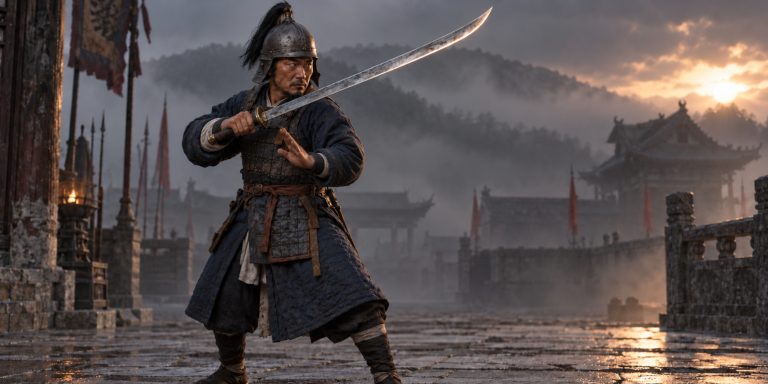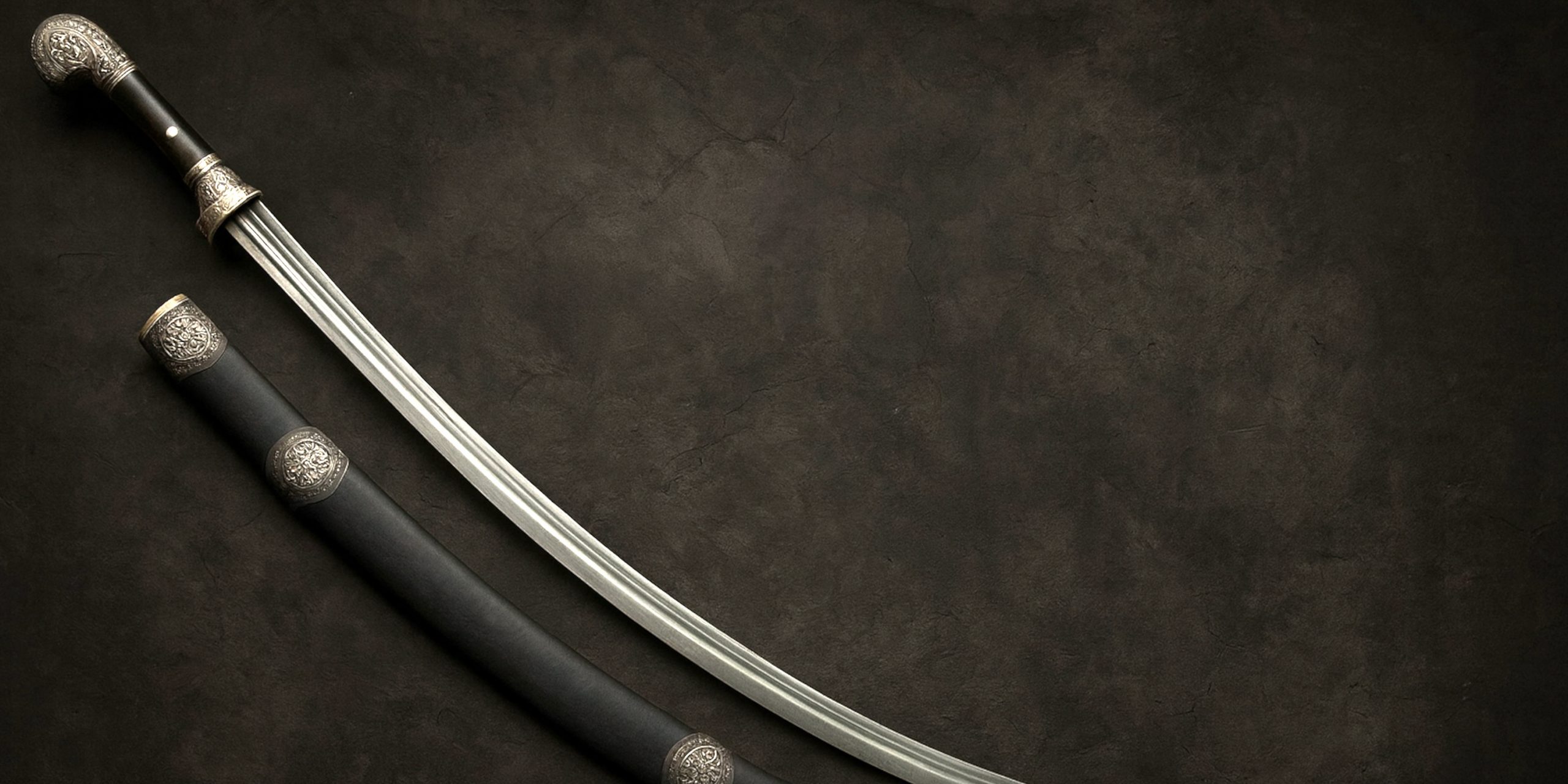
The shashka grew out of the fighting traditions of the Caucasus and later became a signature cavalry weapon for Cossack and Russian forces. It sits somewhere between sabre and backsword, although its defining traits give it a character of its own. There is no guard, the blade flows straight into a grip with a subtle forward curve, and the handling is quick enough for swift close combat on horseback. While it looks deceptively plain, the weapon demands skill to use properly and carries a long military and cultural presence across the steppe regions.
Specification
Typical Measurements
| Feature | Measurement or Description |
|---|---|
| Overall length | 85 to 105 cm |
| Blade length | 70 to 85 cm |
| Blade curvature | Gentle curve, often 10 to 25 mm along length |
| Blade type | Single edged, fullered variants common |
| Weight | 800 to 1100 g |
| Balance | Forward weighted for cutting power |
| Hilt construction | One piece grip without guard, often with flared pommel |
| Scabbard | Wood and leather, often worn with edge upward |
Key Characteristics
- Guardless grip that encourages flowing cuts.
- Slight curve suited to slashing from horseback.
- Often features decorative silverwork in high status Caucasian pieces.
- Military issue shashkas tend to be simpler and more robust.
History and Evolution
The earliest forms appeared among Circassian and other North Caucasian peoples in the seventeenth century. Their grip design removed the need for a crossguard, allowing the weapon to be drawn swiftly in confined spaces or from horseback. Russian Cossack hosts adopted the pattern during the eighteenth century and it soon became a symbol of their identity.
By the nineteenth century the Russian Empire standardised versions for cavalry units. Models such as the 1834, 1881 and later the 1909 shashka brought regulation into what had been a broad regional style. These weapons served in the Russo Turkish conflicts, the Napoleonic aftermath, the First World War and even the early stages of the Second World War. Civilian and ceremonial types continued to evolve, often with ornate silver or niello decoration in the Caucasus.
Advantages and Disadvantages
Advantages
- Fast draw due to guardless design.
- Light and lively in the hand, good for fluid cutting.
- Strong enough for battlefield use, particularly in cavalry charges.
- The slight curve aids deep slashing without sacrificing thrust capability.
Disadvantages
- Lack of guard offers little hand protection.
- Takes practice to avoid slipping on the grip during powerful cuts.
- Less suitable for heavy parrying compared with broader hilted sabres.
- Military standardisation reduced some of the artisan quality found in regional versions.
Comparison with Similar Weapons
Shashka vs Sabre
| Element | Shashka | Conventional Sabre |
|---|---|---|
| Guard | None | Usually present, sometimes elaborate |
| Curve | Mild | Often stronger curve |
| Handling | Fluid, versatile | Strong in cutting, slightly less agile in confined spaces |
| Origin | Caucasus, Russia | Broad European tradition |
| Draw speed | Very fast | Moderate |
Shashka vs Kilij
- The kilij has a pronounced curve and a widened tip, favouring powerful draw cuts.
- The shashka is straighter, lighter and more balanced for combined cutting and thrusting.
- Kilij hilts often include quillons and knuckle guards, offering better hand defence.
Shashka vs Tulwar
- The tulwar is heavier and optimised for committed chopping strikes.
- The shashka offers softer handling and quicker recovery between blows.
- Tulwar disc pommels lock the wrist, while shashka grips allow freer blade angles.
Legacy
The weapon became a core part of Cossack culture and identity. It appears widely in literature, folk songs and military parade traditions. Even after the shift to firearms, officers continued to carry shashkas as symbols of service. Martial arts schools in the Caucasus still teach forms based on the weapon, while collectors prize both the ornate regional pieces and the famous Russian military models. Modern reproductions remain popular among reenactors and cavalry sport practitioners.
Where to See
- State Historical Museum, Moscow, houses several imperial period shashkas.
- The Hermitage Museum, Saint Petersburg, holds decorated Caucasian pieces with silver mounts.
- Tbilisi’s Georgian National Museum includes regional examples with distinctive grip shapes.
- The Royal Armouries, Leeds, displays a small but significant selection of Caucasian blades.
Collectors Guide
What Collectors Look For
- Authentic Caucasian workmanship with silver or niello decoration.
- Clear maker’s marks or workshop signatures.
- Russian military models with intact scabbards and matching serial numbers.
- Good condition blades with original fullers and curvature.
- Provenance linking a piece to a particular regiment or Cossack host.
Market Values
Prices vary widely due to age, workmanship and military relevance.
| Type | Typical Auction Range |
|---|---|
| Late nineteenth century Caucasian shashka with silverwork | 2,500 to 8,000 GBP |
| Russian model 1881 military shashka | 800 to 2,000 GBP |
| Russian model 1909 cavalry shashka | 1,200 to 3,500 GBP |
| High grade Circassian or Dagestani ceremonial example | 10,000 GBP and above |
Buying Tips
- Check the hilt construction, as genuine pieces show grip and tang continuity without modern screws.
- Confirm that the curvature and fullers match known period examples.
- Beware of modern Caucasian reproductions aged artificially.
- A complete set with original scabbard raises value significantly.
- Auction houses with strong arms and armour departments often provide reliable authentication.