Few cavalry formations have gathered quite so much myth around them as the Polish Winged Hussars. That is partly because they looked extraordinary, partly because they really did win battles that seemed almost rude in their improbability, and partly because posterity has always had a weakness for men on horses charging into gunfire with unnerving confidence.
The Winged Hussars were the elite heavy cavalry of the Polish-Lithuanian Commonwealth, reaching their peak between the late sixteenth and late seventeenth centuries. They were not medieval knights lingering past their time, nor were they simply flamboyant noblemen playing at war. They were a serious battlefield arm, expensive to maintain, tactically sophisticated, and often devastating in action. Their reputation was earned in clashes against Muscovy, Sweden, the Ottoman Empire, Tatars, Cossacks, and a depressing assortment of other enemies who discovered, at speed, what a disciplined shock charge could do.
What makes them so fascinating is that they sat at the crossroads of two military worlds. Europe was moving ever more firmly toward infantry, pike formations, and firearms. The hussars, by contrast, refined cavalry shock action to an almost absurd level of efficiency. They were not ignoring change. They were exploiting a narrow but potent opportunity within it.
Origins and development
The hussars in their famous Polish form emerged in the sixteenth century, though the wider hussar tradition had Balkan and Hungarian roots. Under Stephen Báthory, the Commonwealth’s cavalry was reorganised and the hussars evolved into the distinctive elite formation we now recognise: armoured riders armed with long lances, sabres, thrusting swords, and pistols, mounted on carefully selected horses and supported by retainers.
Over time they changed from lighter cavalry into a more heavily equipped shock force. Early shields faded from use, armour became more common, and the lance became the centrepiece of the charge. By the early seventeenth century, the Winged Hussar had become one of the Commonwealth’s most prestigious soldiers, drawn chiefly from the nobility and sustained at enormous private cost. This was not a budget service. If you wanted to become a hussar, you needed money, status, horses, equipment, servants, and a fairly healthy appetite for danger.
Their strongest period ran from the late sixteenth century into the later seventeenth. By the early eighteenth century, the battlefield had changed. Firearms improved, infantry fire discipline hardened, and anti-cavalry systems became more reliable. Even the finest cavalry in Europe could not charge history forever. The formation formally disappeared in 1776.
What made the Winged Hussars so effective
The simple answer is shock, discipline, and timing.
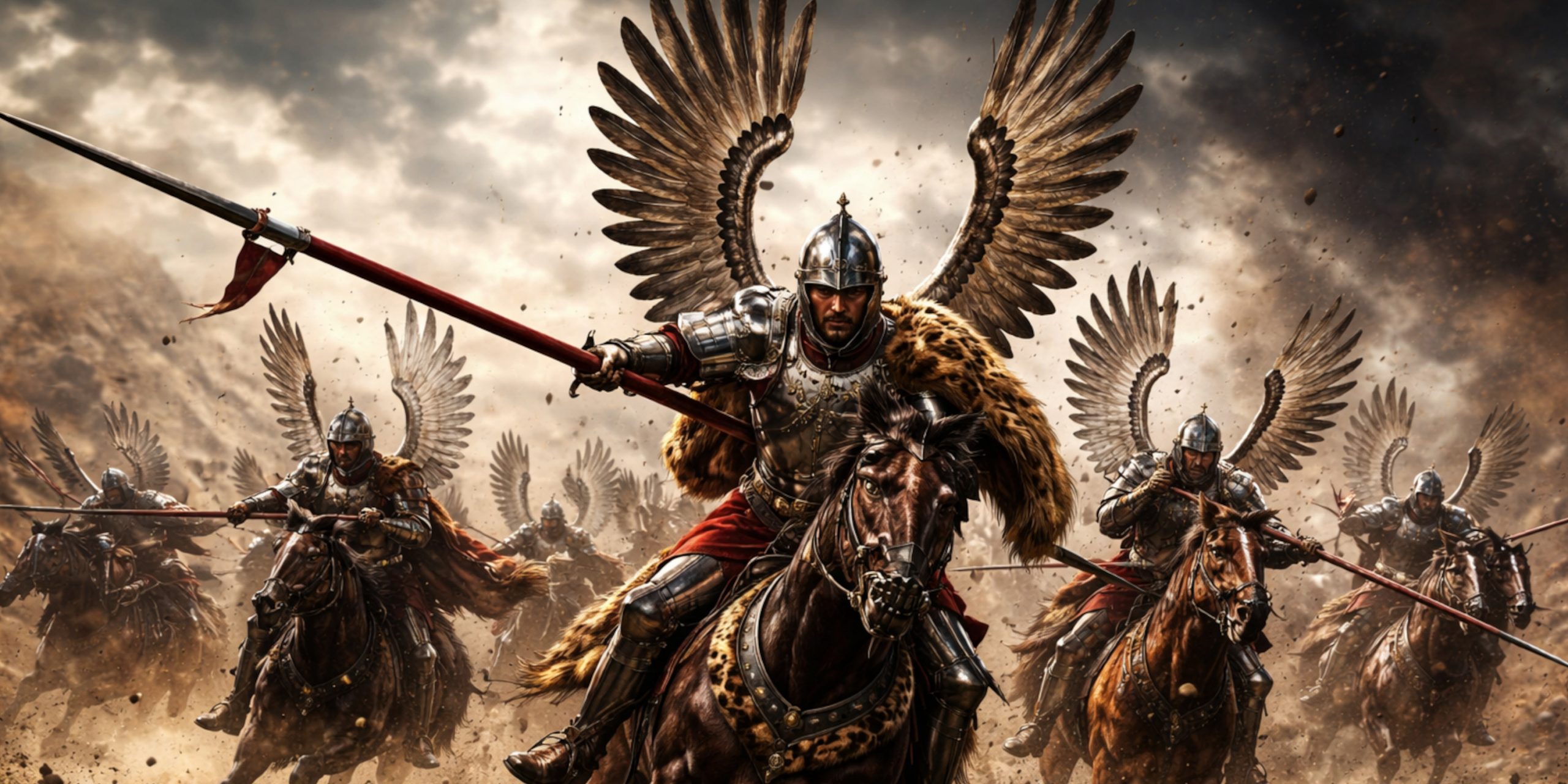
The less simple answer is that the Winged Hussars combined excellent horsemanship, strong morale, expensive equipment, tactical cohesion, and unusually effective offensive weapons. Their charge was not a wild gallop by men dressed for a painting. It was a controlled, building assault designed to hit an enemy formation at exactly the moment when momentum, reach, and morale could do the most damage.
Their famous lances were central to this. According to Culture.pl’s summary of the research tradition around the hussars, these lances were exceptionally long, sometimes over six metres, and made deliberately light through hollow construction. That gave hussars greater reach than many opposing infantry pikes while preserving the speed needed for a mounted charge.
The horses mattered just as much. Hussar mounts were bred and selected for speed, stamina, and manoeuvrability. A poor horse would have been as useful as an expensive teapot in a cavalry clash. A good one helped turn the charge into a weapon system rather than a mere brave idea.
Their battlefield success also depended on context. Hussars worked best when used against wavering infantry, enemy cavalry, exposed flanks, or formations already strained by terrain, morale, or supporting fire. They were formidable, not magical. History is kinder to nuance than legend, even if legend sells more prints.
The wings, and whether they were really used
The wings are the part everyone remembers. Fair enough. They are hard to ignore.
These frames, fitted with feathers, are often shown attached either to the backplate or the saddle. For years, historians debated whether the wings were mainly ceremonial or genuinely used in battle. Culture.pl notes that historical research supports the conclusion that wings were indeed used in combat at least in some cases, though not necessarily by every hussar in every engagement.
Their exact practical function remains debated. Popular theories include psychological intimidation, the startling of enemy horses, prestige, and visual identification. Some older claims, such as the idea that they created a terrifying whistle that panicked enemies on contact, are often repeated with more confidence than proof. That sort of thing happens whenever a military unit becomes half history, half national epic.
Whatever their exact function, the wings absolutely mattered as symbols. They made the hussars look larger, stranger, and more theatrical, which on a battlefield was not a disadvantage. Intimidation has always been cheaper than replacing dead men.
Arms and armour
Core weapons
The Polish Winged Hussar was not armed with one iconic weapon but with a carefully layered set of tools for different phases of combat.
Lance
The lance was the primary weapon in the charge and the defining arm of the hussars. It was long, light, and designed for maximum reach and impact. Against infantry and cavalry alike, it gave the first blow of the assault terrifying force. Contemporary and later descriptions stress just how destructive it could be.
Szabla
The szabla, or sabre, was one of the most characteristic sidearms of the Polish cavalry. Hussars commonly carried curved sabres suited to fast cuts from horseback, though skilled riders could also thrust effectively with them. The Polish-Hungarian sabre tradition influenced hussar warfare deeply, and over time the sabre became one of the clearest markers of Commonwealth martial culture.
Koncerz
The koncerz was a long thrusting sword, often narrow and estoc-like in character, designed especially for use from horseback once the lance had been lost or broken. It was effective against armoured opponents and gave the hussar a serious reach advantage in close mounted combat. Of all their blades, this is perhaps the one least appreciated outside specialist circles, which is a shame because it is gloriously purposeful.
Pallasz
Some hussars also used the pallasz, a straight backsword or broadsword type weapon better suited to powerful cuts and thrusts. This was not universal, but it appears in the broader armament culture of Commonwealth cavalry and is relevant when discussing hussar sidearms in the seventeenth century.
Firearms
Pistols were commonly carried, usually as secondary weapons. Carbines could also appear, though firearms were not the essence of hussar combat. Their battlefield role remained rooted in cold steel and shock action long after much of Europe had shifted emphasis elsewhere.
Armour and defensive equipment
Hussar armour was lighter and more practical than the full plate harness of earlier centuries, but it still offered serious protection.
Typical equipment could include:
- A cuirass with breastplate and backplate
- Arm defences or mail elements
- A helmet, often of the szyszak type with nasal and cheek protection
- Sometimes mail shirts or mail sleeves
- Leopard, tiger, or other exotic skins worn for display and intimidation
- The famous wings, in some cases, mounted to armour or saddle
This combination balanced protection with mobility. A hussar needed to survive pistol fire, sword blows, and the chaos of collision, while still being able to ride aggressively and maintain formation. There was no point dressing like a fortress if you then moved like a wardrobe.
Organisation and social character
The Winged Hussars were elite in every sense, including cost. A hussar served as a towarzysz, or companion, and was expected to provide his own equipment, horses, and retainers. Each noble cavalryman was accompanied by a small retinue, creating a larger fighting unit with its own internal hierarchy.
This social structure mattered. Hussars were not just trained fighters, they were members of a military culture tied to noble identity, honour, self-presentation, and the Commonwealth’s political world. Their battlefield role and their social status reinforced one another. To be a hussar was to belong to an ideal of martial nobility that the Commonwealth admired, exaggerated, celebrated, and occasionally romanticised beyond all reason.
Famous battles
Kircholm, 1605
At the Battle of Kircholm, Polish-Lithuanian forces under Jan Karol Chodkiewicz defeated a much larger Swedish army. Hussar charges played a decisive role, shattering Swedish formations and securing one of the most famous victories in Commonwealth military history. This battle is often cited as one of the clearest demonstrations of hussar effectiveness against western European infantry and cavalry.
Kłuszyn, 1610
At Kłuszyn, Commonwealth forces overcame a larger Muscovite and allied army. Again, hussar charges were central. The battle opened the way for Polish influence in Moscow and stands as one of the most dramatic examples of the Commonwealth punching above its apparent weight.
Chocim, 1621 and 1673
The campaigns around Chocim showed the hussars in prolonged conflict with Ottoman forces. These battles underlined their value not only in dramatic charges but in broader operational warfare against one of the great military powers of the age.
Vienna, 1683
No discussion can avoid Vienna. During the relief of Vienna in 1683, King Jan III Sobieski led the allied assault against the Ottoman army, and the image of the hussars descending in force became one of the most famous moments in European military memory. It is the sort of episode that later generations polish until it gleams, but the importance of the victory itself is beyond doubt.
Kliszów, 1702
Kliszów is useful because it reminds us the story does not end in uninterrupted splendour. The hussars fought bravely, but shifting battlefield conditions, stronger firearms, and changing military systems made old advantages harder to convert into victory. Culture.pl identifies the broader period around this defeat as part of their decline.
Contemporary quotes
The Winged Hussars inspired admiration, astonishment, and more than a little alarm.
François Paulin Dalerac, writing about the Polish hussars in the court of Jan III Sobieski, described them in terms that captured their relentless offensive character: he wrote that the hussars never halted and rode at full speed through whatever stood before them.
Fynes Moryson, the English traveller who visited the Commonwealth in the late sixteenth century, also recorded the distinctive appearance and equipment of Polish cavalry, helping confirm that these riders were already striking foreign observers as something remarkable.
One has to be a little careful with hussar quotations, because later patriotic writing has a bad habit of improving the original. Historians, alas, must spoil a perfectly good legend now and then.
Archaeology and material evidence
Archaeology does not often hand us a complete Winged Hussar standing obligingly in a trench. History is rarely that considerate. What it does provide is a body of material culture, battlefield evidence, surviving arms, armour, horse equipment, portraits, funerary sculpture, inventories, and preserved military objects that help reconstruct the world of the hussars.
Key forms of evidence include:
- Surviving sabres, koncerzes, helmets, cuirasses, and pistols in Polish museum collections
- Saddle and harness components
- Battle-related artefacts from seventeenth-century conflict zones in the former Commonwealth
- Portraits of nobles in hussar equipment
- Tomb sculpture and funerary monuments showing armour and status display
- Armouries and royal collections preserving Commonwealth cavalry equipment
Polish museums and heritage institutions continue to preserve and interpret this material culture, including collections tied to the military history of the Commonwealth and the age of Jan III Sobieski. Culture.pl also highlights the lasting museum afterlife of the hussars as major figures in Polish historical memory.
The most important caution is that archaeology and museum material show variation. Not every hussar was equipped identically, not every depiction is literal, and not every pair of wings in a museum case can be neatly mapped to a specific battlefield practice. Still, taken together, the evidence strongly confirms that the hussars were a real and evolving military formation, not a patriotic costume drama with horses attached.
Where to see Winged Hussar artefacts
For anyone wanting to move beyond paintings and patriotic souvenirs, Poland offers several strong places to begin:
Museum of the Polish Army, Warsaw
One of the key collections for Polish military history, with material relevant to early modern cavalry and Commonwealth warfare.
Wawel Royal Castle, Kraków
Important for royal, military, and ceremonial material linked to the Commonwealth’s elite culture.
Wilanów Palace Museum
Useful especially for the age of Jan III Sobieski and the memory of Vienna, where hussar imagery and associated martial culture loom very large.
National museums and regional collections in Poland
A number of institutions preserve arms, portraits, armour, and noble artefacts connected to the seventeenth-century military world.
Checking current exhibitions before travelling is wise, because museums enjoy rearranging displays just when you have finally chosen your train.
Decline and end
The decline of the Winged Hussars did not happen because they suddenly stopped being brave, or because modern warfare awoke one morning and banned style. It happened because warfare changed structurally.
Infantry firearms became more effective, field fortifications improved, linear tactics matured, and the relative value of expensive elite shock cavalry narrowed. The Commonwealth itself also faced economic and political strain, which affected recruitment, standards, and military reform. By the eighteenth century, the hussars were increasingly ceremonial shadows of their former selves. Their official abolition in 1776 simply recognised what the battlefield had already been saying for some time.
Legacy
The legacy of the Polish Winged Hussars is enormous. In Poland they became symbols of military excellence, noble courage, and national resilience. In wider European history they remain one of the clearest examples of cavalry shock action perfected almost to its limit.
They have also had a vigorous second life in painting, literature, reenactment, video games, nationalist mythology, military pageantry, and the internet’s endless appetite for dramatic cavalry charges. Some of that memory is sound, some of it is embroidered, and some of it has clearly had too much coffee. But the core truth survives all the same.
They were not invincible.
They were not merely decorative.
They were not relics.
They were one of the most formidable cavalry formations of the early modern world.
Takeaway
As a historian, I think the real appeal of the Winged Hussars lies in the tension between fact and spectacle. They looked theatrical enough to invite exaggeration, yet the sober record still leaves them impressive. That is a rare combination. Strip away the feathers, the legend, the patriotic thunder, and you still have a cavalry arm of startling quality.
Add the feathers back in, and admittedly, it becomes even harder to look away.