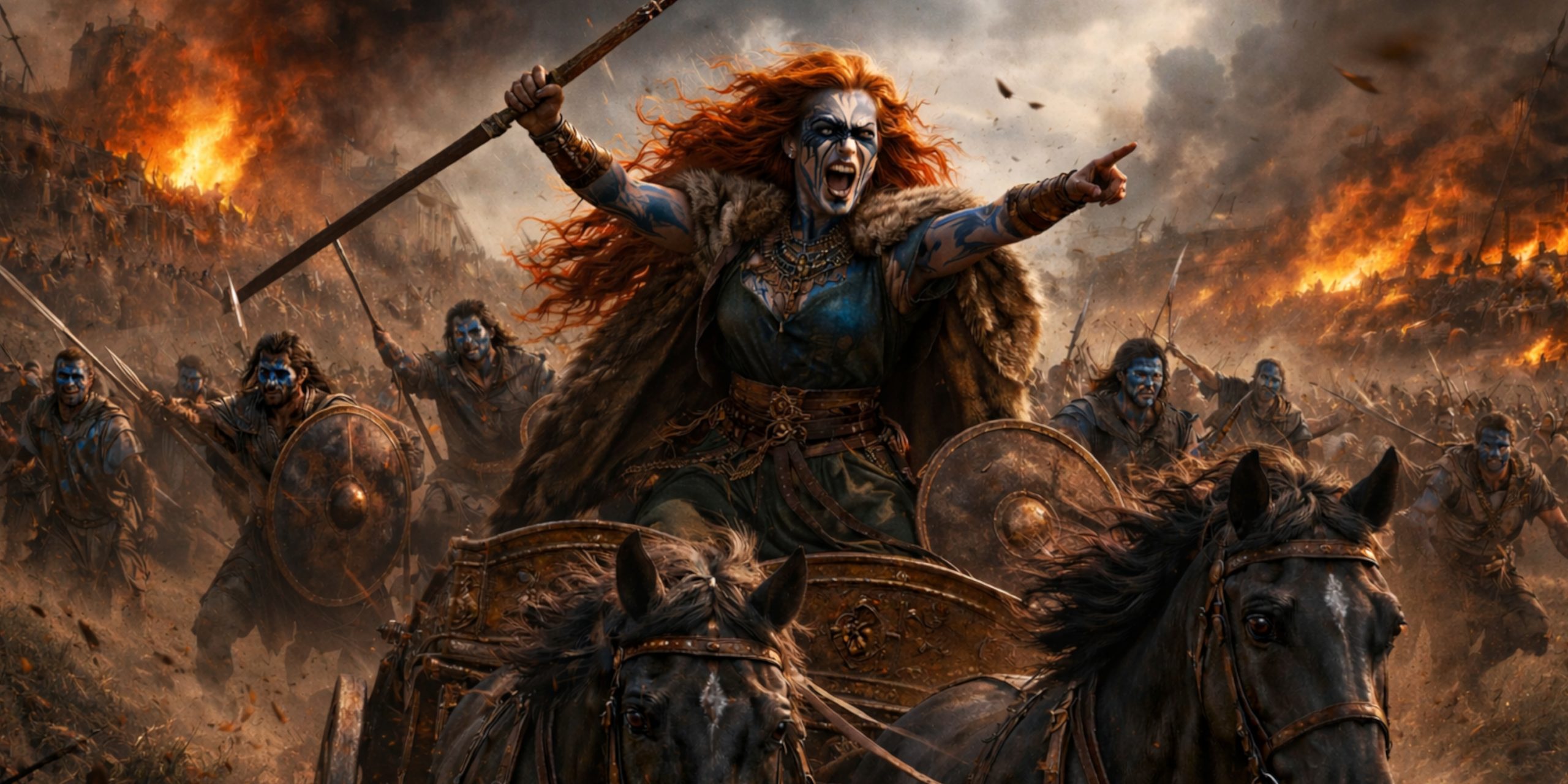
Boudicca has become one of the great figures of British history. She is the furious queen in a war chariot, the woman with streaming red hair, the ruler who turned Roman Britain into a landscape of smoke and panic. Yet the real Boudicca is harder to pin down than the bronze giant beside Westminster Bridge. Most of what we know comes from Roman writers, and Roman writers were not exactly known for being fair to people who had just burnt down three of their cities.
Still, through the gaps, exaggerations and occasional bouts of Roman melodrama, a vivid figure emerges. Boudicca was queen of the Iceni, a tribe in eastern Britain, probably in what is now Norfolk. In AD 60 or 61 she led the largest uprising ever mounted against Roman rule in Britain. For a brief moment she brought the province to the brink of collapse. Had events gone slightly differently, Britain might have slipped from Roman hands altogether.
Who Was Boudicca?
Boudicca was queen of the Iceni, a powerful tribe based in eastern Britain. She was married to Prasutagus, who ruled as a client king under Rome. The arrangement was typical Roman practice. Rome allowed local rulers to remain in power so long as they behaved themselves, paid taxes and did not develop any inconvenient ideas about independence.
When Prasutagus died, probably around AD 60, he left his kingdom jointly to his daughters and to the Roman emperor, presumably hoping to keep the peace. It was a sensible compromise. Unfortunately, Roman officials had the diplomatic subtlety of a runaway ox-cart.
According to the Roman historian Tacitus, Roman administrators ignored the will, seized Iceni lands, flogged Boudicca in public and assaulted her daughters. Whether every detail is exact is impossible to know, but the broad outline is plausible. Roman officials often behaved ruthlessly in conquered provinces, especially when money and land were involved.
Instead of cowing the Iceni into submission, they created the one thing Rome feared most, a united British revolt under a leader with a very personal reason for vengeance.
What Did Boudicca Look Like?
Our clearest description comes from the Roman writer Cassius Dio, writing more than a century later. He describes Boudicca as exceptionally tall, with long reddish hair falling to her hips, a fierce expression and a harsh voice. She wore a colourful tunic, a thick cloak fastened with a brooch and a golden torc around her neck.
There is probably some theatrical flourish in this. Roman writers loved a vivid barbarian queen. One suspects Dio was enjoying himself. Still, elements of the description fit what we know of elite British women in the Iron Age.
Elite women in Iron Age Britain could wield significant authority, own property and appear publicly in ways that shocked Roman observers. A gold torc, dyed clothing and a commanding presence would have signalled rank immediately.
The Iceni and Roman Britain
The Iceni lived in what is now Norfolk, Suffolk and parts of Cambridgeshire. Before the Roman conquest they were one of the stronger tribes in Britain, known for their horse culture and distinctive coinage.
Their kingdom survived the Roman invasion of Britain in AD 43 because Prasutagus agreed to cooperate with Rome. This gave the Iceni a degree of independence, although it was the sort of independence that comes with Roman tax collectors standing nearby and looking interested.
By AD 60 there was widespread resentment across Britain. Roman veterans had settled at Camulodunum, sacred land had been confiscated, taxes were rising and Roman officials were widely disliked. The governor, Gaius Suetonius Paulinus, was away campaigning in north Wales against the druids on Anglesey. It was, from the rebels’ point of view, almost suspiciously good timing.
Why Did Boudicca Revolt?

The revolt did not begin simply because Boudicca hated Rome. The Romans had ruled Britain for nearly two decades. Many tribes accepted the arrangement, grudgingly or otherwise.
The spark came from three overlapping grievances:
- The seizure of Iceni lands and property after Prasutagus’s death
- The mistreatment of Boudicca and her daughters
- Wider anger at Roman taxation, corruption and military occupation
The neighbouring Trinovantes quickly joined the rebellion, along with other tribes. Britain had seen revolts before, but usually one tribe rose and another watched from a safe distance while pretending to be shocked. Boudicca achieved something far more dangerous. She united several tribes behind a common cause.
The Burning of Camulodunum
The first target was Camulodunum, modern Colchester, the former capital of Roman Britain.
Camulodunum was packed with retired Roman soldiers and contained a grand temple dedicated to the emperor Claudius. To the Britons, it represented everything infuriating about Roman rule. It was expensive, arrogant and built in the middle of land that used to belong to somebody else.
The city had almost no defences. Roman officials had ignored repeated warnings that a revolt was coming. They seem to have assumed that angry Britons would politely remain angry at a manageable distance.
Boudicca’s forces stormed the city and destroyed it. The temple held out for two days before being overwhelmed. Archaeologists have found a thick burnt layer beneath modern Colchester dating to this period, one of the clearest physical traces of the revolt.
Londinium and Verulamium Destroyed
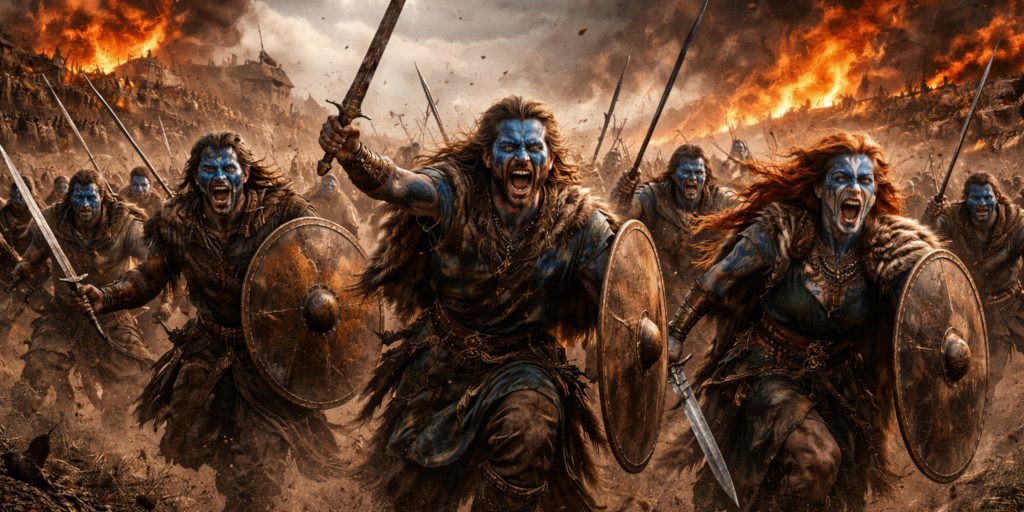
After Camulodunum, Boudicca turned south-west toward Londinium. At the time it was a young but prosperous trading town.
Suetonius Paulinus reached the town first, assessed the situation and decided he could not defend it. It was a cold calculation, but probably the correct one. He evacuated those he could and withdrew.
Boudicca entered Londinium and burnt it to the ground.
She then moved on to Verulamium, modern St Albans, which met the same fate.
Roman sources claim that around 70,000 to 80,000 people were killed across the three cities. That figure may be exaggerated, since Roman historians tended to inflate numbers with the same enthusiasm modern football supporters show when discussing attendance figures. Even so, the destruction was immense.
Archaeologists in London still refer to the distinctive red-black ash deposit from the revolt as the “Boudiccan destruction layer”. It remains one of the most dramatic archaeological signatures in Roman Britain.
Boudicca’s Army
No one knows exactly how many people fought for Boudicca. Roman writers suggest a vast host, perhaps over 100,000 strong. That is almost certainly too high, although her army was probably much larger than the Roman force facing it.
Boudicca’s warriors came from several tribes and would have fought in different ways. Many were infantry armed with:
- Spears
- Javelins
- Slings
- Shields
- Iron swords, often long slashing blades typical of late Iron Age Britain
Some nobles probably fought from chariots, which still had ceremonial and tactical value in Britain. Roman writers were fascinated by British war chariots, partly because they were unusual and partly because there is nothing quite like being charged by an angry queen in one to make a lasting impression.
Roman troops, by contrast, were disciplined, heavily armoured and professionally trained. The rebels had numbers and fury. The Romans had organisation, armour and a very unpleasant talent for remaining calm in situations where most people would sensibly run away.
The Final Battle

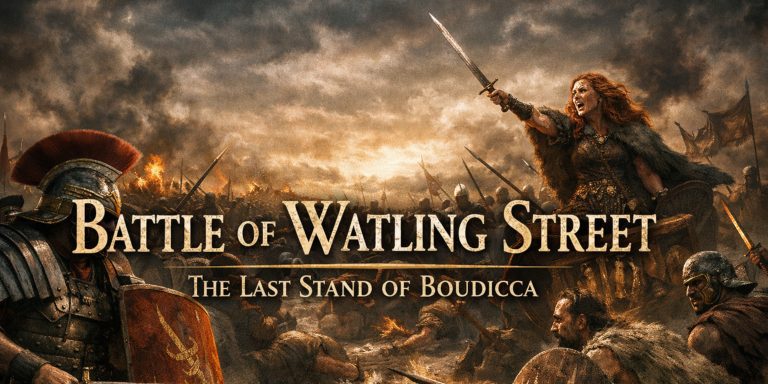
Eventually Suetonius Paulinus gathered around 10,000 Roman troops, including elements of the Legio XIV Gemina and parts of the Legio XX Valeria Victrix.
The decisive battle took place somewhere along the Roman road known as Watling Street, although the exact location remains unknown. Suggestions include sites in the Midlands, perhaps near Mancetter in Warwickshire.
Suetonius chose his ground carefully, placing his men in a narrow position with woodland behind them. This prevented Boudicca’s larger army from surrounding the Romans.
When the battle began, the Britons attacked in a mass. The Romans held formation, hurled their javelins and then advanced in a wedge. The British army collapsed.
Tacitus claims that Boudicca had placed wagons carrying families behind her lines so that spectators could watch the victory. If true, it was a disastrous mistake. When the Britons tried to retreat, the wagons trapped them.
Roman accounts claim that perhaps 80,000 Britons were killed, against only a few hundred Romans. Those figures are doubtful, but there is little doubt about the outcome. Boudicca’s revolt ended in catastrophe.
How Did Boudicca Die?
The ancient sources disagree.
Tacitus says Boudicca poisoned herself after the defeat. Cassius Dio says she fell ill and died shortly afterwards. Poison is perhaps the more widely accepted account, since elite figures in the ancient world sometimes chose suicide rather than capture.
No grave has ever been conclusively identified. Over the centuries people have claimed she lies beneath King’s Cross Station, under a field in the Midlands or in almost any place where someone fancied adding a little drama to the landscape.
The truth is that we do not know.
Was Boudicca a Hero?

This is where the story becomes complicated.
To later generations Boudicca became a symbol of resistance, liberty and British identity. During the Victorian period she was transformed into a patriotic heroine, partly because the British Empire rather liked the idea of fierce queens standing up to foreign invaders, provided the fierce queens were on their side.
Boadicea and Her Daughters beside the Houses of Parliament turned her into a national icon.
Yet Boudicca’s revolt also involved massacres and the destruction of civilian settlements. Roman accounts describe terrible scenes, although Roman historians had every reason to paint the rebels as terrifying savages.
As a historian, I have always found Boudicca fascinating because she resists tidy categories. She was neither saint nor monster. She was a ruler placed in an impossible situation, who responded with extraordinary courage and extraordinary violence. History is full of people who become symbols. Boudicca remains interesting because, beneath the symbol, she still feels very human.
What Archaeology Tells Us About Boudicca
Archaeology has confirmed much of the broad outline of the revolt.
Excavations at Colchester, London and St Albans have uncovered:
- Burnt destruction layers dating to AD 60 or 61
- Charred timbers and collapsed Roman buildings
- Human remains associated with violent destruction
- Evidence of rapid rebuilding after the revolt
You can see artefacts linked to the period in several museums, including:
- British Museum
- Colchester Castle Museum
- Museum of London
- Verulamium Museum
These museums contain Roman military equipment, Iceni coins, jewellery and material from the destruction of the revolt. They do not, sadly, contain Boudicca’s chariot. Archaeology has many strengths, but occasionally it has the irritating habit of refusing to provide exactly the object one wants most.
Boudicca in Popular Culture
Boudicca has appeared in novels, films, television and games for generations. Sometimes she is portrayed as a freedom fighter, sometimes as a tragic queen, occasionally as someone who appears to have wandered in from a fantasy film carrying an axe the size of a small horse.
Boudica is one recent interpretation, while earlier depictions often reflected the concerns of their own age more than the evidence of Iron Age Britain.
The challenge is that the historical Boudicca is elusive. We have no portrait, no letters, no voice of her own. Everything is filtered through Roman writers who disliked her and later generations who admired her rather too much.
That leaves a great deal of room for imagination, which is perhaps why she has endured for nearly two thousand years.
Watch documentary:
Boudicca’s chariot still races through Britain’s soul, a queen who turned despair into fire, and whose name echoes wherever defiance roars.