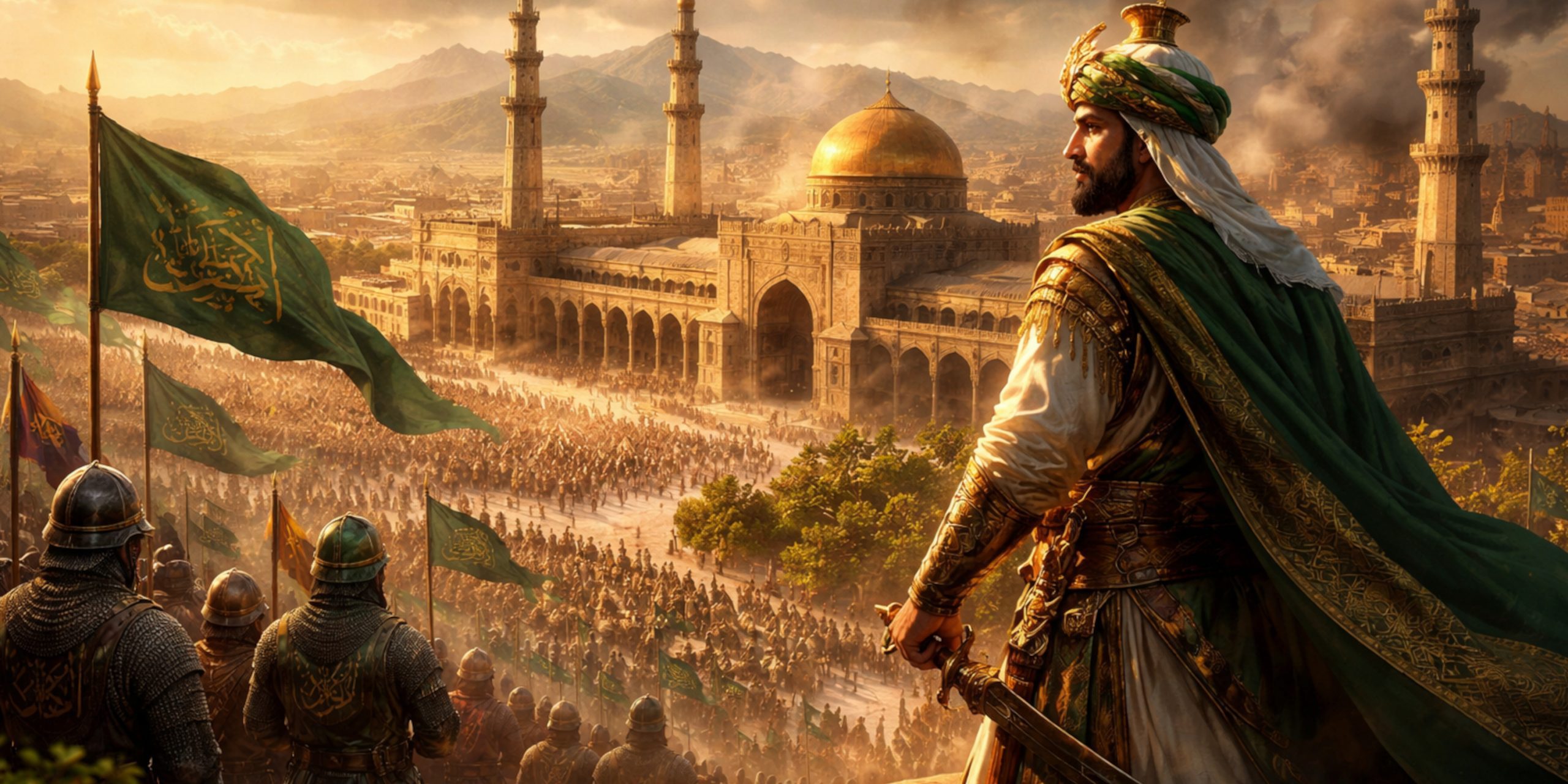
There is something quietly astonishing about the speed at which the Umayyad Dynasty rose. Within a few decades, a polity that began in the deserts of Arabia had stretched from the Atlantic coast of Iberia to the edges of Central Asia. It is the sort of transformation that makes historians pause, blink, and then reach for stronger coffee.
The Umayyads were not merely conquerors interested in war and glory for the sake of it. They were administrators, city builders, and, at times, rather pragmatic politicians. Yet they were also controversial, even in their own day. To study them is to sit with a dynasty that inspired loyalty, resentment, admiration, and rebellion, often all at once.
Origins and Rise to Power
The Umayyads emerged from the Quraysh tribe of Mecca, the same broader tribal network as the Prophet Muhammad. Their particular branch, the Banu Umayya, had been prominent merchants and political figures before Islam reshaped the region.
Their rise to power came in the aftermath of the First Fitna, the first major civil war within the Islamic community. It was a deeply unsettling period, one that exposed fractures that had been quietly present from the beginning.
- Muawiya ibn Abi Sufyan, governor of Syria, became the central figure
- He consolidated military and political support in Damascus
- In 661, he established himself as caliph after the death of Ali ibn Abi Talib
With that, the caliphate shifted from an elective model to something far closer to hereditary rule. One can almost hear the collective intake of breath from those who had hoped for a different future.
Political Structure and Governance
The Umayyads ruled from Damascus, a choice that proved both practical and symbolic. Syria offered stability, strong military backing, and proximity to key frontiers.
Their governance was shaped by a blend of inherited Byzantine and Sasanian administrative practices:
- Provincial governors held significant authority
- Arabic gradually became the administrative language
- Coinage was standardised, replacing earlier imperial currencies
- A standing army, particularly in Syria, formed the backbone of power
They were, in many ways, efficient. That efficiency, however, often came with a sharp edge. Non Arab converts, known as mawali, frequently found themselves treated as second class within the system. It is one of those decisions that looks administratively convenient in the short term and politically combustible in the long run.
Expansion and Military Campaigns
The scale of Umayyad expansion is difficult to overstate. Within roughly a century, they oversaw one of the largest empires the world had seen.
Key regions brought under Umayyad control included:
- North Africa, culminating in the crossing into Iberia in 711
- Much of the Iberian Peninsula, known as Al Andalus
- Central Asia, reaching into Transoxiana
- The Indus Valley in the east
Notable campaigns and moments:
- The advance into Gaul, halted at the Battle of Tours in 732
- Repeated confrontations with the Byzantine Empire
- Naval expansion in the Mediterranean
What strikes me, perhaps more than the victories themselves, is the logistical nerve required. Supplying armies across such distances without modern infrastructure borders on audacious.
Culture, Architecture, and Identity
The Umayyads left a visible and enduring cultural footprint. Their architecture alone would secure their place in history.
Highlights include:
- The Dome of the Rock in Jerusalem, a structure that still commands attention
- The Great Mosque of Damascus, both a religious and political statement
- Desert palaces such as Qasr Amra, blending leisure with authority
These buildings reveal a dynasty comfortable with grandeur. They also show a willingness to incorporate artistic traditions from conquered regions, which gives Umayyad art a layered and sometimes surprising character.
There is, I think, a quiet confidence in these projects. Not the anxious display of legitimacy, but something closer to certainty that they belonged at the centre of things.
Religion and Legitimacy
Religion under the Umayyads was both a guiding principle and a contested space.
- They positioned themselves as leaders of the Islamic community
- They supported the development of early Islamic institutions
- Yet they were criticised for perceived worldliness and dynastic ambition
Opposition movements, including those that would later align with Shi’a identity, often framed the Umayyads as having strayed from the ideals of early Islam.
It is one of those enduring historical tensions. The gap between governing a vast empire and maintaining spiritual purity is not easily bridged.
Decline and Fall
By the mid eighth century, the cracks had widened into something far more serious.
Key factors in their decline:
- Discontent among non Arabs, particularly mawali
- Tribal rivalries that never quite settled
- Religious opposition that questioned their legitimacy
- The rise of the Abbasid movement, which gathered support across regions
The decisive moment came in 750 at the Battle of the Zab. The Umayyad forces were defeated, and the Abbasids seized control.
Most of the Umayyad family was eliminated. One survivor, Abd al Rahman, escaped to Iberia and established a new Umayyad state in Cordoba. History, it seems, has a habit of leaving at least one thread uncut.
Legacy and Historical Significance
The Umayyad Dynasty shaped the early Islamic world in ways that are still visible today.
Their legacy includes:
- The transformation of the caliphate into a dynastic institution
- The creation of administrative systems that later empires would refine
- The spread of Islamic culture across three continents
- Architectural achievements that continue to define historic cities
They also left behind unresolved questions about authority, identity, and governance that would echo through subsequent centuries.
The Seven Swords Takeaway
I find the Umayyads both impressive and faintly exasperating. They built an empire with remarkable speed and competence, yet seemed perpetually surprised that not everyone appreciated the arrangement.
There is a lesson here, perhaps. Power acquired quickly must be handled with care, or it develops a habit of slipping away just as quickly.
Still, one cannot deny their impact. The world they helped shape did not vanish with their fall. It simply changed hands, and carried on.