Few rulers have shaped public imagination like Tutankhamun. He ruled briefly, died young, and left no grand monuments bearing his name. Yet his afterlife has eclipsed that of emperors who reigned for decades. As a historian, I have always found this uncomfortable and fascinating in equal measure. Tutankhamun matters not because of what he achieved, but because of what survived him almost intact. His tomb froze a moment of royal life in the late Eighteenth Dynasty, giving us an intimacy that Egyptian history rarely allows.
Origins and Accession
Tutankhamun was born around 1341 BC, likely the son of Akhenaten or a close royal relative. He ascended the throne at roughly nine years old during a period of deep instability. Egypt was still reeling from Akhenaten’s religious revolution, which had elevated the Aten and marginalised traditional gods.
The boy king was guided, or steered, by powerful elders. The court officials Ay and Horemheb effectively ran the state. Tutankhamun’s reign marks a deliberate retreat from Atenism and a cautious return to the cult of Amun. Temples were reopened, priesthoods restored, and Thebes regained its spiritual centrality. It was political repair work rather than visionary reform.
Rule and Governance
Tutankhamun ruled for about nine years. In administrative terms, his reign was conservative and corrective. Royal decrees restored traditional religious endowments and attempted to stabilise provincial governance after years of neglect.
There is no evidence of sweeping legal or economic innovation. What stands out is tone. Official inscriptions emphasise harmony, restoration, and divine balance. Egypt was being stitched back together, quietly and without theatrics. In that sense, Tutankhamun was exactly the king the moment required, even if the credit belongs largely to those around him.
Arms and Armour of the Young Pharaoh
Tutankhamun never marched at the head of an army, but his tomb shows how kingship and warfare were imagined.
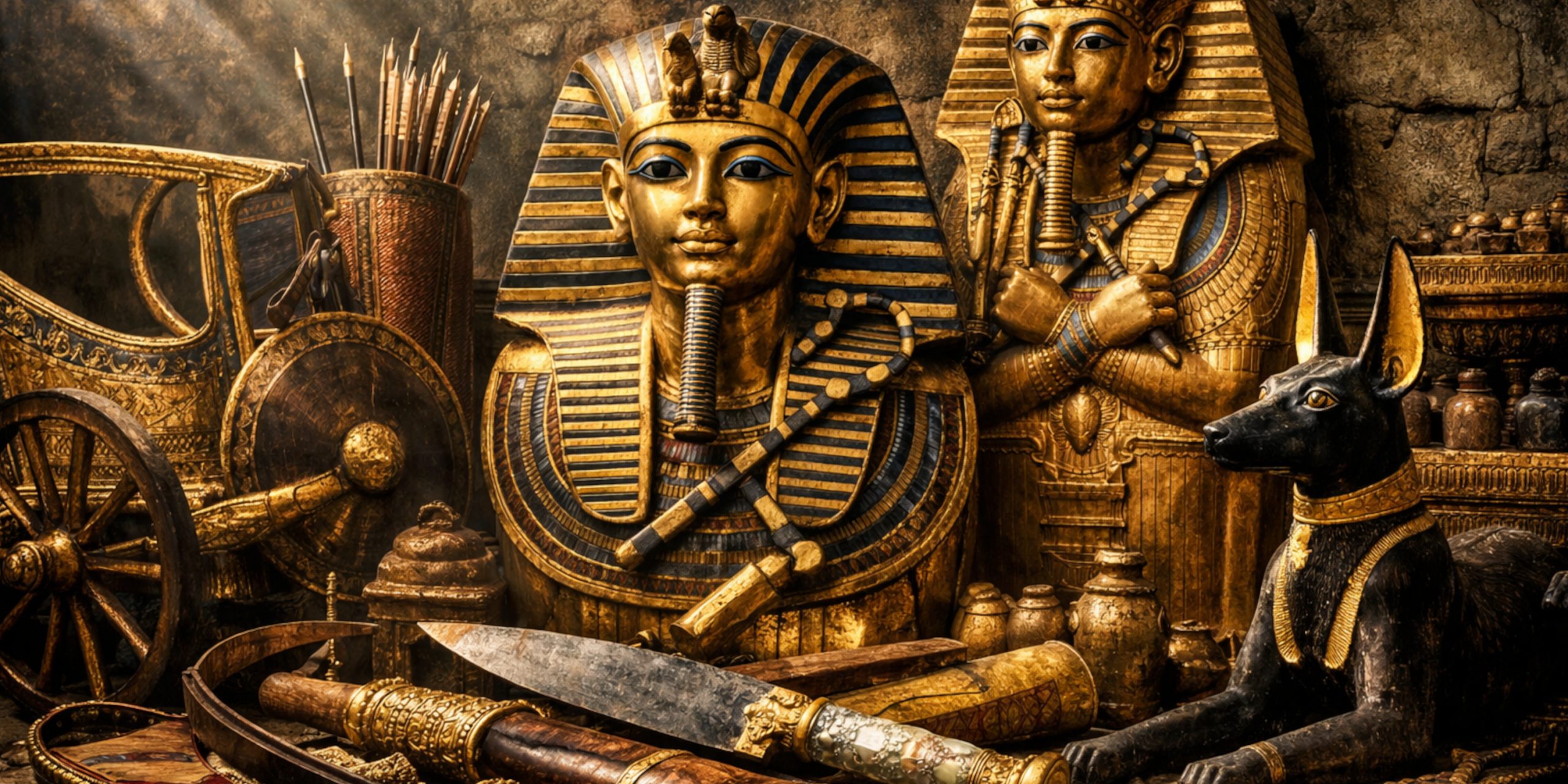
The burial assemblage included over 100 weapons, many ceremonial, some functional.
Swords found in the tomb include leaf shaped bronze blades, some with gold covered hilts. One iron dagger, likely meteoritic, stands out as a technological rarity for the period. This weapon was symbolic as much as practical, linking royal power with cosmic materials.
Composite bows, arrows, and quivers were present, alongside shields faced with hide and decorated with royal iconography. Chariots, at least six, were dismantled and placed within the tomb. They were lightweight and finely crafted, suitable for hunting, display, and potentially warfare.
As a historian, I read these objects less as tools of combat and more as statements. They project the image of a warrior king that Tutankhamun never became, but was expected to become had he lived.
Battles and Military Acumen
There is no solid evidence that Tutankhamun personally led military campaigns. Reliefs showing him in battle are formulaic and symbolic, part of the timeless language of kingship rather than historical records.
However, Egypt did engage in limited military activity during his reign, particularly in Nubia and possibly in the Levant. These operations were likely overseen by generals, with Horemheb playing a significant role.
Tutankhamun’s military acumen, such as it was, lay in restraint. Egypt did not overextend itself during a fragile recovery period. Stability was prioritised over conquest. That choice, while unglamorous, probably prevented further internal fracture.
Death and Burial
Tutankhamun died around 1323 BC, aged about nineteen. The cause of death remains debated. Modern analysis points to a combination of factors, including a leg fracture, malaria, and congenital health issues linked to royal inbreeding.
His burial was hurried. The tomb was small by royal standards, likely repurposed from a noble’s grave. This haste turned out to be history’s great accident. The tomb was sealed, forgotten, and escaped the systematic looting that stripped most royal burials bare.
The Tomb and Its Artefacts
Tutankhamun’s tomb, KV62, contained over 5,000 objects. It remains the richest single archaeological find from ancient Egypt.
Key artefacts include the iconic gold funerary mask, nested coffins, shrines, furniture, clothing, jewellery, food offerings, and ritual equipment. The craftsmanship is extraordinary, but what strikes me most is the human detail. His sandals, his linen garments, even children’s toys were placed beside him.
These were not abstractions of power. They were possessions.
Where to See Artefacts Today
Many of Tutankhamun’s treasures are on display in Egypt.
The Grand Egyptian Museum now houses the most comprehensive exhibition of objects from the tomb, presented with modern conservation standards and contextual interpretation.
Key items can also be seen at the Egyptian Museum, particularly during ongoing transitions of collections.
The tomb itself remains in the Valley of the Kings, where visitors can still enter KV62 and experience its modest scale firsthand. It is far smaller than people expect, and that surprise never fades.
Latest Archaeological Findings
Recent work has focused less on new chambers and more on understanding Tutankhamun as a person.
Advanced CT scans have clarified his physical condition, confirming a club foot and other skeletal issues. Textile studies have revealed how royal clothing was constructed and repaired, offering insights into daily court life. Analysis of oils and resins used in mummification has refined our understanding of late Eighteenth Dynasty funerary practices.
Speculation about hidden rooms within the tomb has largely cooled. What remains is more valuable. A clearer, quieter picture of a young man shaped by forces far larger than himself.
Legacy and Historical Judgment
Tutankhamun did not reshape Egypt. He did not conquer new lands or build monuments that dominated skylines. His importance lies in survival, not achievement.
As a historian, I find this oddly comforting. Tutankhamun reminds us that history is not only written by the powerful, but preserved by chance. His reign mattered in context. His tomb matters forever.
The boy king did his job. The afterlife did the rest.
Watch the documentary: