Sword Maker Marks – A Historian’s Guide to Bladesmith Identification
Every sword collector eventually stares at a faint symbol near the hilt and feels a rush of optimism. This, surely, is the key. A name, a place, perhaps even a famous smith waiting to be rediscovered. Experience tends to follow quickly behind and lower expectations.
Sword maker marks matter, but they rarely tell the whole story. At best, they narrow the field. At worst, they distract from far more reliable evidence. Learning to tell the difference is one of the quiet skills that separates study from speculation.
What Sword Maker Marks Really Represent
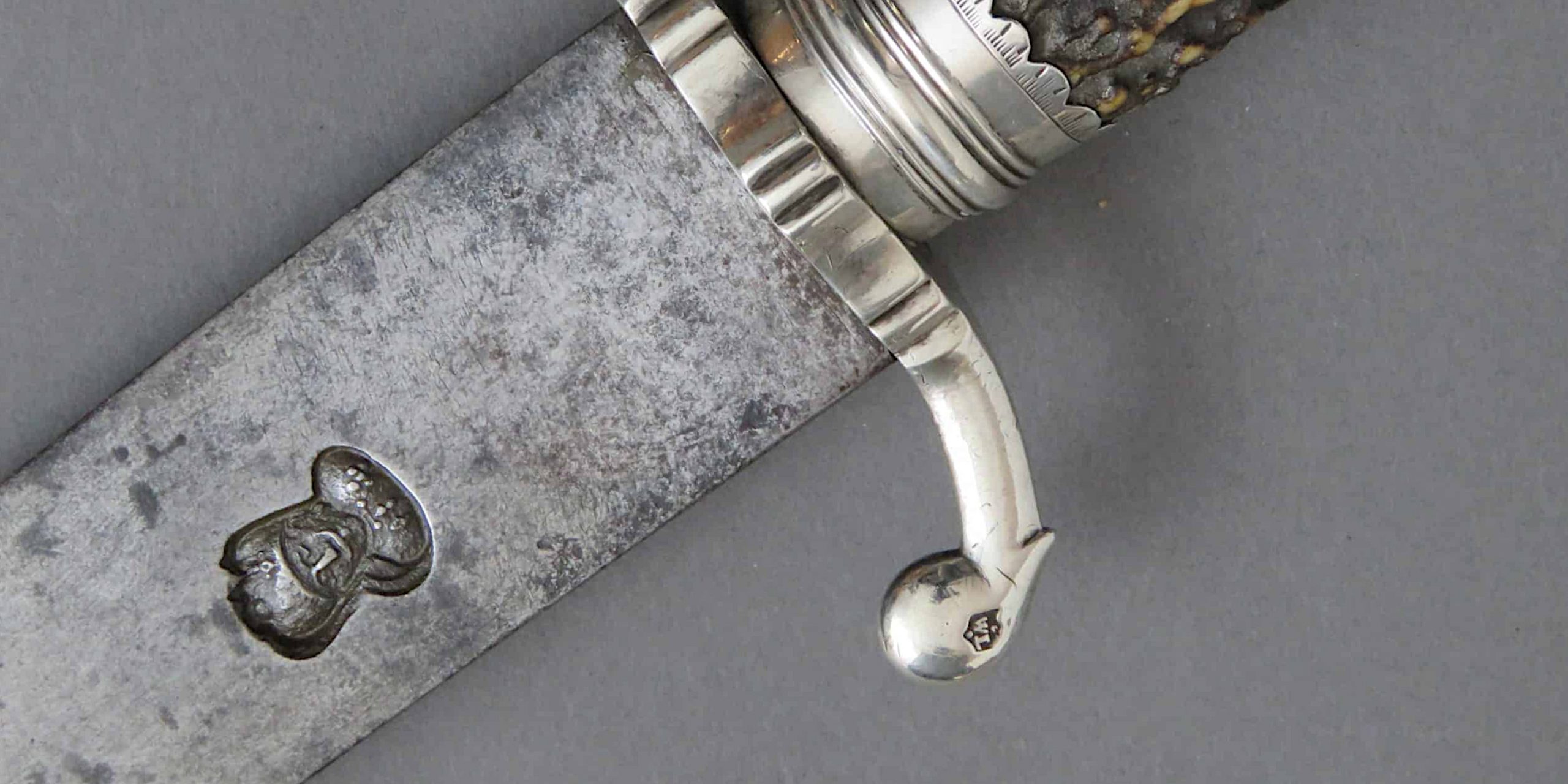
A sword maker mark is any symbol, letter, or inscription deliberately placed on a blade during manufacture or finishing. These marks served practical purposes rather than romantic ones. They could identify a workshop, indicate quality control, comply with guild regulations, or signal regional reputation.
What they usually did not do was identify a lone genius working in isolation. Medieval and early modern swordmaking was collaborative. One man forged the blade, another ground it, another fitted it, and a merchant sold it. The mark often represented the business, not the individual.
This is why the same mark can appear on blades of noticeably different quality. It is not fraud. It is industrial reality, medieval edition.
Where Marks Are Found and Why Placement Matters
Most European maker marks appear close to the guard, stamped near the forte where the blade is thickest and least likely to fail. This area survives wear better than the cutting edge, which is why many marks remain legible centuries later.
Fuller inscriptions are also common, particularly between the twelfth and fifteenth centuries. These can range from clear lettering to decorative sequences that only resemble language.
Japanese swords follow a different logic entirely. The signature, or mei, is usually cut into the tang beneath the hilt. It was never intended to be seen during use. This tradition prioritised lineage and authorship, though it also created fertile ground for later forgeries once names became valuable.
Common Categories of Sword Maker Marks
Symbol marks are the most widespread. Crosses, stars, wheels, crescents, animals, and abstract shapes appear across Europe for hundreds of years. Many were reused by multiple workshops, sometimes within the same city.
Letter marks came later and were more vulnerable to imitation. Initials, monograms, and short names appear more frequently as swordmaking became commercialised and competitive.
There are also devotional inscriptions, quality slogans, and pseudo-texts. The last category causes endless trouble. Rows of letters that look impressive but resolve into nonsense were often intended to evoke prestige rather than convey meaning. They worked then, and they still work now.
Regional Patterns Worth Recognising
Certain swordmaking centres developed distinctive marking habits. German blades from Passau and later Solingen are well known for stamped symbols that were reused, licensed, or copied across generations. The famous wolf mark is a textbook case of reputation outliving accuracy.
Spanish blades associated with Toledo often emphasise the city itself rather than the individual smith. The brand was geographic, not personal.
Japanese traditions are far more specific, sometimes including province, date, and lineage. This precision is invaluable when authentic, and deeply misleading when forged. Both scenarios occur with regularity.
Famous Names and the Danger of Familiarity
Some marks carry instant prestige. Names like Masamune or references to Toledo create immediate assumptions, most of them unhelpful.
Highly regarded marks were copied early and often, sometimes within the lifetime of the original smith. A famous mark is not rare by default. A verifiable example, supported by construction, metallurgy, and historical context, is another matter entirely.
If a blade seems too eager to impress, it usually is.
How Marks Are Altered, Added, or Misunderstood
Later-applied marks are common. Engraved symbols on finished blades, shallow acid etching, or stamps applied to cold steel all suggest interference. Authentic stamped marks typically displace metal slightly, a subtle detail that matters.
Corrosion adds another layer of confusion. Worn steel reshapes letters, merges lines, and invites interpretation. Optimism does the rest. I have watched collectors talk themselves into certainty on the basis of a shadow and a strong cup of coffee.
A mark must agree with the blade. When it does not, the mark is wrong, not the sword.
Using Maker Marks as Supporting Evidence
A sword maker mark should never be the starting point for identification. It belongs near the end of the process, confirming conclusions drawn from blade form, proportions, construction methods, and wear patterns.
Used properly, marks can narrow a date range, suggest a workshop tradition, or support a regional attribution. Used alone, they encourage confident mistakes.
Historians learn early that certainty is rare. The steel is patient. Our conclusions should be as well.
Reliable Websites and Reference Resources
Good information exists, but it rewards caution and cross-checking.
The long-running MyArmoury remains one of the most dependable general resources. Its articles on European swords are grounded in typology and material evidence, and its older forum discussions are particularly valuable. They reflect a time when people argued carefully rather than quickly.
For authenticated examples, the Royal Armouries online collection is essential. Seeing documented blades with known provenance does more for understanding maker marks than any standalone image ever will.
The Deutsches Klingenmuseum is invaluable for Solingen and Passau material. Even when descriptions are brief, the photographic quality allows close comparison of genuine marks.
For Japanese swords, the Nihonto Message Board is one of the strongest English-language communities. It is blunt, exacting, and generally unimpressed by weak attributions. This makes it useful.
Auction catalogues from houses such as Bonhams and Christie’s should be read carefully rather than reverently. Their best entries demonstrate how marks are interpreted alongside physical evidence, not instead of it.
Final Thoughts from a Tired Desk
Sword maker marks are fascinating, frustrating, and endlessly abused. They are clues, not answers. Treated with restraint, they sharpen understanding. Treated as shortcuts, they flatten history into branding.
The best identifications I have encountered were cautious, provisional, and willing to be revised. That may not sell swords quickly, but it honours the steel far better than certainty ever could.
Japanese Swordsmith Marks (Mei)
| Swordsmith | Period | Characteristics | Notable Features |
|---|---|---|---|
| Masamune | Kamakura (1264–1343) | Considered Japan’s greatest swordsmith | Known for exceptional hamon (temper patterns) |
| Muramasa | Muromachi (16th century) | Legendary sharpness | Blades associated with violent folklore |
| Gassan School | Heian period onwards | Distinctive ayasugi hada (wood grain pattern) | Continuously active for over 800 years |
Identification Tips:
- Mei are typically engraved on the nakago (tang)
- Often include smith’s name and province
- Many high-quality reproductions exist – authentication is essential
European Swordsmith Marks
German Swordsmiths
| Maker/Region | Period | Identifying Marks |
|---|---|---|
| Solingen Workshops | Medieval to modern | “Running Wolf” symbol, maker initials |
| Weyersberg, Kirschbaum & Co. (WKC) | 19th century | Company initials and emblem |
| Carl Eickhorn | 19th-20th century | Distinctive squirrel logo |
Spanish Swordsmiths
| Maker/Region | Notable Marks |
|---|---|
| Toledo Workshops | “Chataldo te fecit” (Chataldo made you) |
| “Clemens Horum me fecit” (Clemens Horum made me) |
Italian Swordsmiths
| Region | Characteristics |
|---|---|
| Milan | Often marked with smith initials |
| Brescia | Symbols denoting workshop |
Key Features of Sword Marks Worldwide
| Feature | Japanese Swords | European Swords |
|---|---|---|
| Location | Engraved on nakago (tang) | Stamped on blade near hilt |
| Content | Smith name, province, date | Initials, symbols, Latin phrases |
| Authentication | NBTHK certification | Historical records, expert appraisal |
Famous Sword Marks to Recognise
| Mark or Symbol | Associated Region or Tradition | Period Most Common | What It Usually Indicates | Common Pitfalls |
|---|---|---|---|---|
| Wolf Mark | Passau and later Solingen, German lands | 14th to 17th century | A blade associated with the Passau tradition, later widely adopted by Solingen workshops | Frequently assumed to mean Passau origin specifically. In reality it was copied extensively and does not confirm a single workshop |
| Cross in Circle | Central and Western Europe | 12th to 15th century | A workshop or quality mark, sometimes devotional | Often misread as crusader or Templar related. There is no reliable evidence for this |
| Running Wolf | German export blades | 15th to 17th century | Commercial branding linked to blade export | Copied aggressively. Presence alone tells you little without typological support |
| Inlaid Latin Inscriptions (Ulfberht style) | Frankish and Scandinavian regions | 9th to 11th century | High-status blade tradition, often pattern welded or high-carbon steel | Many later blades imitate the lettering without matching metallurgy |
| Crowned Letter Marks | Northern Italy and German states | 16th to 17th century | Urban workshop or guild-related mark | Letters vary widely. Assumed royal connections are almost always fantasy |
| Toledo Inscriptions | Spain, especially Toledo | 16th to 18th century | Regional prestige rather than individual authorship | Many blades were marked Toledo for reputation alone, including foreign-made examples |
| Sunburst or Star Marks | Iberian Peninsula and Southern France | 15th to 17th century | Workshop identifier or decorative branding | Easily confused with religious or symbolic meaning that was never intended |
| Anchor Mark | Northern European naval contexts | 17th to 18th century | Blade intended for naval or maritime markets | Sometimes added later to imply naval use where none existed |
| Mei Signature | Japanese sword tradition | 10th century onward | Claimed authorship and lineage of the smith | Forged mei are extremely common, including high-quality historical forgeries |
| Two-Character Smith Names | Japan | 14th to 19th century | Individual smith identity within a known school | Requires comparison with known examples. Characters alone are not proof |
A Short Word of Caution
If a mark appears famous, assume it has been copied. If it appears prestigious, assume it has been forged at least once. Marks become valuable because people trust them, and that trust has been exploited for as long as swords have been sold rather than issued.
Used properly, this table helps narrow questions. Used recklessly, it answers the wrong ones very confidently.