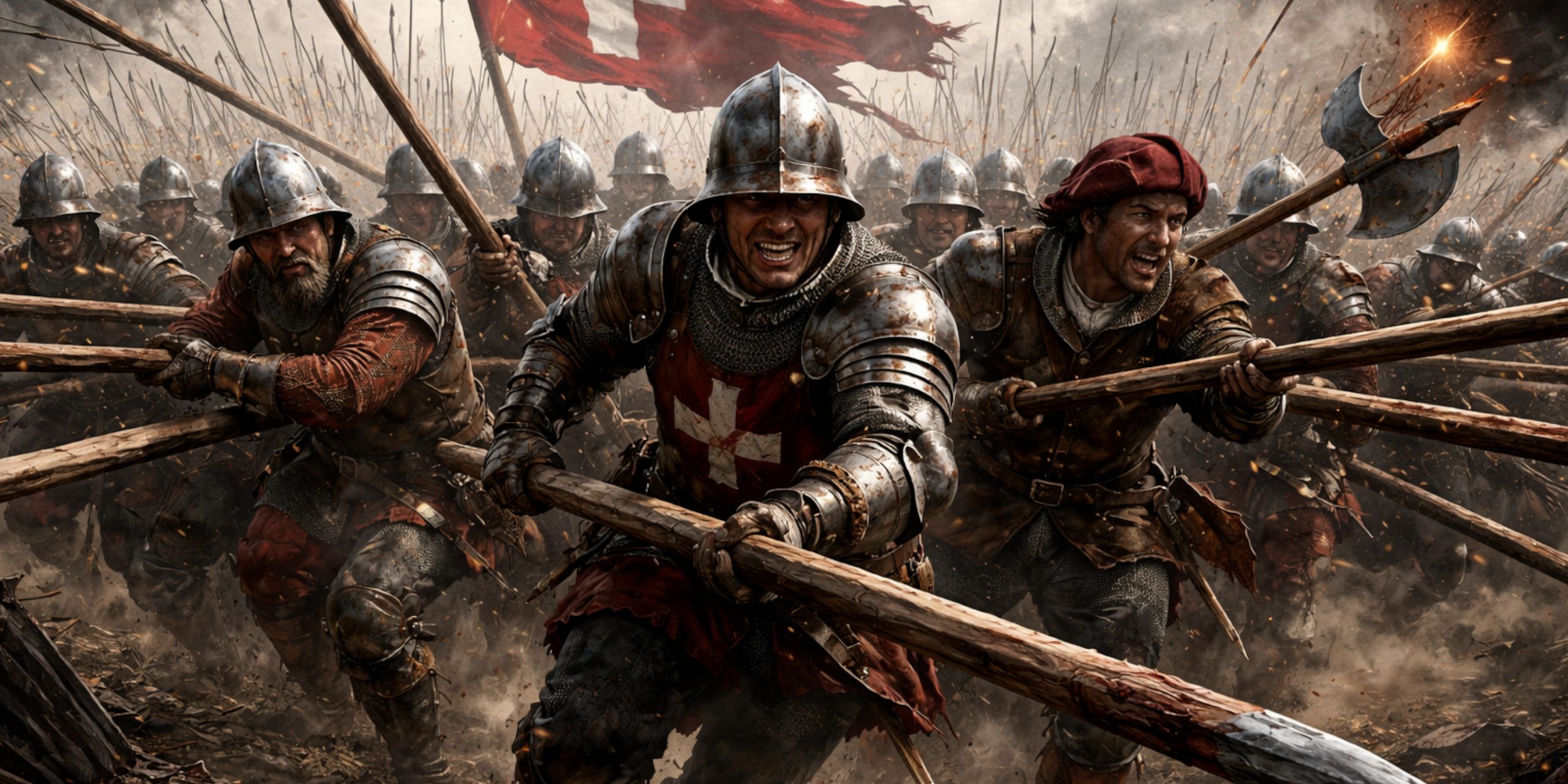
The Swiss pikemen were not an accident of geography or a brief fashion in warfare. They were the product of hard terrain, local independence, and a culture that expected free men to fight well or be ruled by someone who did. From the late thirteenth century into the sixteenth, infantry from the Alpine cantons shattered the assumption that disciplined heavy cavalry ruled European battlefields. Knights discovered, usually too late, that a forest of ash shafts could be as final as a lance charge.
What follows is a clear look at who these men were, how they fought, what they carried, and why Europe spent a century trying, and often failing, to copy them.
Origins and Social Background
The roots of Swiss infantry warfare lie in the early Swiss Confederacy, a loose alliance of rural cantons defending their autonomy against feudal overlords. These communities had little love for mounted aristocrats and even less patience for being told what to do. Military service was a civic duty, not a professional career, and training grew out of militia musters rather than courtly schools of arms.
Victory at Battle of Morgarten in 1315 did more than secure local independence. It set a pattern. Infantry, fighting on chosen ground and in close order, could annihilate a mounted force. The lesson was not lost on the Swiss, nor on their enemies.
Tactics and Battlefield Method
Swiss success rested on discipline and cohesion. The classic formation was the pike square, dense ranks advancing at speed, drums beating, banners forward. This was not a slow, ceremonial push. Contemporary accounts emphasise the shock of the Swiss advance, a human battering ram that relied on momentum as much as steel.
The Swiss preferred broken or constrained terrain where cavalry could not deploy effectively. When forced onto open ground, they advanced aggressively rather than waiting to be charged. Hesitation was death. The aim was to close quickly, break the enemy line, and turn the fight into a brutal melee where training and nerve mattered more than noble birth.
At Battle of Nancy, Swiss infantry smashed the forces of Charles the Bold, ending Burgundian ambitions in a single, freezing engagement. The duke’s armour was found days later. It had not helped him.
Arms and Armour
The pike was the star of the show, usually between four and five metres long, tipped with a robust steel head. Its purpose was simple. Stop cavalry, keep the enemy at distance, and kill efficiently when the lines met.
Yet Swiss pikemen were never one dimensional.
Many carried sidearms for close fighting once formations collapsed. Common sword types included the Swiss longsword, often broad bladed and well balanced, suited to cutting in tight quarters. Shorter arming swords were also widespread, practical and familiar to militia hands. By the late fifteenth century, some soldiers favoured the Katzbalger, a distinctive short sword later associated with German Landsknechts but already known in Swiss service.
Polearms such as halberds were equally important. The halberd was a Swiss specialty, excellent for hooking riders, splitting armour, and finishing fallen foes. In a press of bodies, it could be more useful than a full length pike.
Armour varied by wealth and period. Early Swiss infantry wore little more than padded garments and open helmets. As spoils and pay increased, breastplates, sallets, and arm defences became common. Full plate was rare. Mobility mattered more than display.
Organisation and Discipline
Swiss units were organised by canton and community. Men fought alongside neighbours and relatives, which encouraged steadiness under pressure. Cowardice was not just a personal failing, it was a public disgrace that followed a man home.
Mercenary service later professionalised Swiss warfare, but even then the ethos remained collective. Pay was important, yet reputation mattered more. Swiss units known to break or loot excessively struggled to find contracts. Those with a record of discipline and effectiveness were in constant demand.
This system produced soldiers who were confident, sometimes dangerously so. Contemporary critics noted Swiss arrogance on campaign. Success breeds certainty, and certainty can curdle into recklessness.
Archaeology and Material Evidence
Archaeological finds from Swiss battlefields support the written sources. At sites linked to late medieval engagements, excavations have uncovered pike heads with reinforced sockets, heavy halberd blades, and robust infantry armour rather than knightly panoply.
Grave finds and museum collections in Zurich, Bern, and Lucerne show swords built for hard use rather than ornament. These are not parade pieces. Edge damage, repairs, and simplified hilts speak of weapons carried often and maintained pragmatically.
Mass graves from conflicts such as Nancy reveal trauma consistent with close order fighting. Crushing blows, multiple wounds, and little sign of ransom injuries. The Swiss did not fight for prisoners.
Contemporary Views and Quotes
Swiss infantry made a deep impression on contemporaries, not all of it flattering.
Philippe de Commynes, reflecting on Burgundian defeats, observed that the Swiss fought “as one body, moving together like a living wall of iron.” The phrase is telling. He admired them, but he also feared them.
Niccolò Machiavelli later praised Swiss discipline while warning Italian states that bravery without order was useless. He considered Swiss infantry the model of effective citizen soldiers, even as he quietly noted their tendency to overestimate themselves.
A Burgundian chronicler, less charitable, wrote that facing the Swiss was “to see death advancing on foot, without mercy and without pause.” One suspects he had been closer to the front line than he would have liked.
Decline and Legacy
Swiss dominance did not last forever. Gunpowder weapons, improved artillery, and the rise of mixed formations gradually blunted the pike square’s supremacy. The Swiss themselves adapted slowly, and others learned faster.
By the sixteenth century, German Landsknechts had copied and modified Swiss methods, adding firearms and different tactical doctrines. The age of pure pike infantry was passing.
Yet the legacy endured. Swiss service became synonymous with reliability. Their influence shaped early modern infantry doctrine across Europe. Even today, the idea that disciplined foot soldiers can decide battles owes much to men who marched out of Alpine valleys carrying long poles and very few illusions.
Why They matter in the history
As a historian, it is hard not to admire the Swiss pikemen while keeping a raised eyebrow. They were effective, proud, and occasionally insufferable. Their victories rewrote military assumptions, but their confidence sometimes ran ahead of circumstance.
They remind us that warfare changes not only through technology, but through social organisation and mindset. When enough ordinary people decide they are competent to defend themselves, history tends to listen.
Watch the documentary: