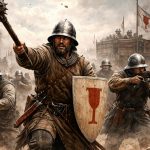
Sviatoslav I of Kyiv was Grand Prince of the Kievan Rus from 945 to 972, he spent much of his reign campaigning across the steppe, the Balkans, and the Volga. Chroniclers portray him as austere, direct, and utterly committed to war. He did not embrace Christianity as his mother Olga had done. He preferred the old gods and the old ways. Steel, oars, and fire.
When reading the Primary Chronicle, I am struck by how little domestic administration is attributed to him. His legacy rests on movement. Expansion. Risk. He reshaped the political map of Eastern Europe, and he paid for it with his life.
Early Life and Background
Sviatoslav was the son of Prince Igor of Kyiv and the formidable Princess Olga. After Igor’s death at the hands of the Drevlians in 945, Olga ruled as regent. She stabilised the realm, reformed tribute systems, and famously took revenge on her husband’s killers with chilling precision.
Sviatoslav came of age in a state that had already survived crisis. Unlike his mother, who leaned toward diplomacy and Christianisation, he chose a martial identity rooted in Norse and Slavic warrior traditions. The Kievan Rus at this time were a hybrid society, shaped by Scandinavian elites and Slavic populations, linked by river routes from the Baltic to the Black Sea.
Sviatoslav embraced that mobility fully. He did not rule from behind walls. He ruled from campaign tents.
Arms and Armour
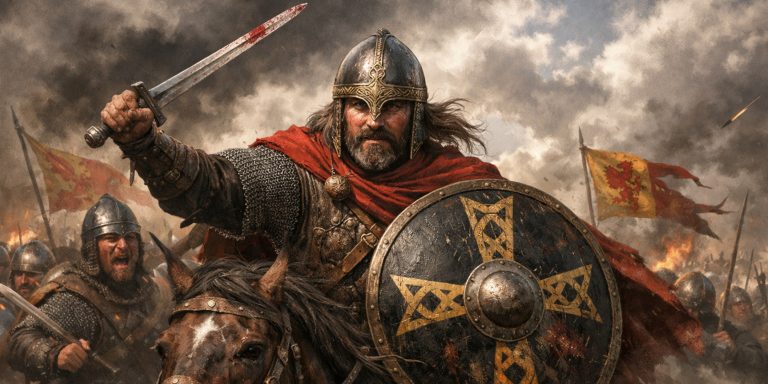
The archaeological record and comparative finds from the wider Viking world give us a reasonable sense of what Sviatoslav and his druzhina would have worn.
Weapons
- Pattern welded or early steel swords, often of Scandinavian type
- Spears as the primary battlefield weapon
- Axes, including bearded axes suited to close combat
- Seaxes and long knives
Swords were status symbols. A prince like Sviatoslav would almost certainly have carried a high quality blade, possibly imported or forged in the Norse tradition.
Armour
- Conical iron helmets, sometimes with nasal guards
- Mail shirts for elite warriors
- Round wooden shields with iron bosses
- Lamellar armour influenced by steppe and Byzantine styles, especially during Balkan campaigns
By the time Sviatoslav fought in the Balkans, contact with Byzantine and steppe forces likely influenced equipment. His army was not static in culture or kit. It absorbed what worked.
I find it telling that the Chronicle describes him living simply, sleeping on a saddle blanket and eating with his men. This was not the image of a jeweled monarch in ceremonial armour. It was a war leader among warriors.
Major Campaigns and Battles
Sviatoslav’s reign is defined by aggressive expansion. He attacked in multiple directions, often simultaneously.
Against the Khazars
In the 960s, Sviatoslav launched a decisive campaign against the Khazar Khaganate. He captured key centres such as Sarkel and likely destroyed Atil. This shattered a major power that had dominated trade routes along the Volga and Caspian.
The destruction of Khazar power altered the balance of Eastern Europe. It opened routes, but it also destabilised the steppe frontier. Removing a buffer can create opportunity. It can also create chaos.
Volga Bulgars and Steppe Campaigns
Sviatoslav also campaigned against the Volga Bulgars and other steppe groups. These expeditions strengthened Rus influence over trade corridors and tribute systems.
His strategy appears clear. Control the rivers. Control the wealth.
The Balkan Wars and Conflict with Byzantium
In 967, the Byzantine emperor invited Sviatoslav to attack Bulgaria. The Rus prince did so with enthusiasm, conquering large parts of the First Bulgarian Empire. Yet he soon envisioned shifting his capital to Pereyaslavets on the Danube, closer to the riches of Balkan trade.
That ambition alarmed Constantinople. War followed.
The campaign culminated in fierce fighting, including the siege of Dorostolon in 971. Byzantine sources describe brutal engagements between heavily armoured imperial troops and determined Rus warriors. Ultimately Sviatoslav negotiated withdrawal.
He had overextended.
Military Acumen
Sviatoslav’s strengths are evident.
- Strategic aggression
- Rapid riverine mobility using longships
- Effective integration of diverse warrior groups
- Ruthless elimination of rival powers
He understood logistics in a practical sense. Rivers were highways. Speed was a weapon.
Yet there were weaknesses. His campaigns stretched supply lines. His destruction of the Khazars removed a stabilising force on the steppe. When he withdrew from the Balkans in 972, he was ambushed and killed by the Pechenegs at the Dnieper rapids.
The lesson is uncomfortable. A warrior state built on constant campaigning can struggle with consolidation. Sviatoslav’s sons would soon turn on each other.
Character and Reputation
The Primary Chronicle portrays him as blunt and fearless. Before attacking, he supposedly sent a message to enemies that read simply, “I am coming for you.”
Whether literal or literary, the line captures his reputation. He did not hide behind diplomacy when war seemed viable.
As a historian, I admit a certain admiration for his clarity of purpose. I also recognise the cost. His reign expanded the reach of the Rus, but it left a fragile political landscape behind.
Artefacts and Where to See Them
Directly attributable artefacts from Sviatoslav himself are rare. However, material culture from 10th century Kievan Rus contexts provides insight.
You can see relevant finds at:
- National Museum of the History of Ukraine in Kyiv, which holds weapons, jewellery, and artefacts from the Kievan Rus period
- State Hermitage Museum, which houses Viking age and early Rus artefacts
- Historical Museum of Bulgaria, with material from the Balkan conflicts
These collections include swords, spearheads, belt fittings, and trade goods that reflect the interconnected world Sviatoslav inhabited.
Latest Archaeological Findings
Recent excavations along the Dnieper and in southern Ukraine have continued to uncover:
- Fortified settlements linked to Rus expansion
- Burial mounds with warrior grave goods
- Byzantine and Islamic coins indicating wide trade networks
Work at sites associated with Sarkel and other Khazar centres has deepened understanding of the political vacuum created by Sviatoslav’s campaigns.
Archaeology increasingly confirms what the chronicles suggest. The 10th century was a period of sharp transition. Trade routes shifted. Power centres collapsed and reformed. Sviatoslav was not the only actor, but he was one of the most forceful.
Death and Legacy
In 972, Sviatoslav was killed by the Pechenegs while returning from the Balkans. Later tradition claims the Pecheneg khan fashioned his skull into a drinking cup. It is a detail that may be embellished, but it speaks to the brutal culture of the steppe frontier.
His sons, including Vladimir who would later Christianise the Rus, inherited both his territory and his instability.
Sviatoslav’s reign marks a turning point. He broke the Khazar power, challenged Byzantium, and pushed Rus influence into the Balkans. He also exposed the limits of relentless expansion.
When I reflect on him, I see a ruler who embodied his age. Hard, mobile, ambitious. A prince who preferred open horizons to palace walls. History remembers him not for laws or liturgy, but for movement and impact.
And in a century defined by river routes and steel, that may have been enough.