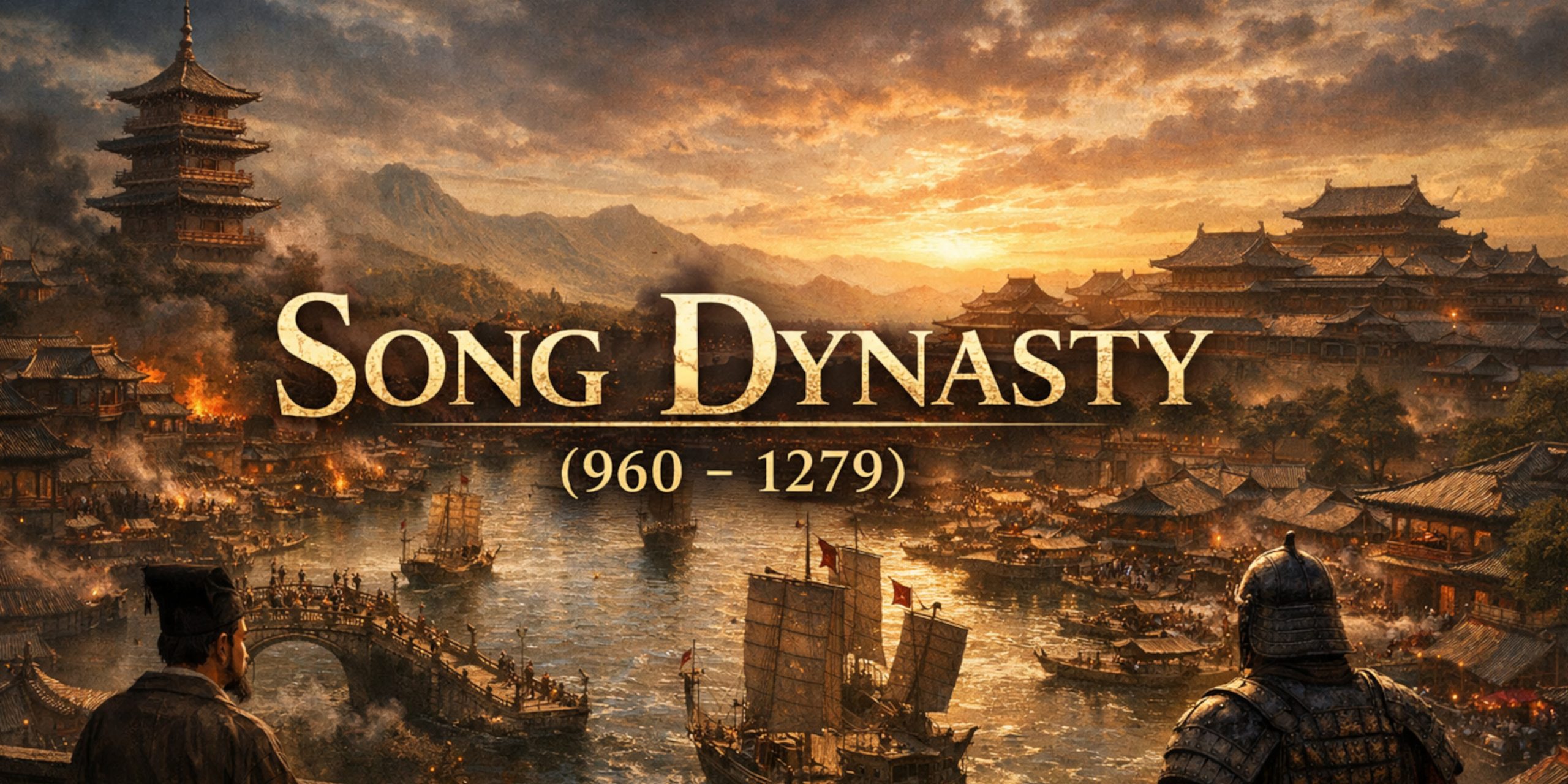
The Song Dynasty has always struck me as one of history’s quiet overachievers. It did not conquer vast lands with theatrical flair, nor did it leave behind monuments that shout across deserts. Instead, it refined, invented, organised, and occasionally worried itself into brilliance.
Founded in 960, the Song era is often divided into two phases, Northern Song and Southern Song, separated by invasion and retreat. What it lost in territory, it gained in ingenuity. If one were to measure civilisation by paperwork, porcelain, and philosophical debate, the Song would sit rather smugly at the top.
Origins and Founding
The dynasty begins with Emperor Taizu of Song, a military commander who did something refreshingly sensible for the time. He took power and then spent much of his reign ensuring nobody else could do the same to him.
After centuries of fragmentation during the Five Dynasties and Ten Kingdoms period, Taizu unified much of China. His solution to warlordism was simple in concept, if not in execution. He reduced the power of regional generals and placed authority firmly in the hands of civilian officials.
This decision shaped everything that followed. The Song became a dynasty governed not by warriors, but by scholars. That sounds admirable until one remembers that scholars are not always very good at stopping invasions.
Northern Song (960 to 1127)
The Northern Song ruled from Kaifeng, a city that must have felt like the centre of the world at the time. It was wealthy, crowded, and full of ideas.
This period saw extraordinary advances in:
- Printing technology, including movable type
- Gunpowder weapons in early forms
- Paper money, which still feels like a bold gamble even now
- Agricultural improvements such as fast-ripening rice
The civil service examination system reached its peak here. Men spent years memorising Confucian classics in hopes of passing exams that would grant them official posts. It was meritocratic in theory, though in practice it favoured those with the leisure to study, which is to say, not the average farmer.
Yet despite cultural brilliance, the Northern Song struggled militarily. Pressure from the Khitan Liao and later the Jurchen Jin proved too much. In 1127, Kaifeng fell in the Jingkang Incident, an event that reads like a historian’s worst nightmare. The emperor was captured, the court dismantled, and the dynasty forced south.
Southern Song (1127 to 1279)
The Southern Song regrouped in Hangzhou, a city so picturesque that even modern visitors tend to forgive its traffic.
Under Emperor Gaozong of Song, the dynasty stabilised. It lost the north but retained economic strength. In fact, the south became even more commercially vibrant.
This period leaned heavily on:
- Maritime trade across the South China Sea and beyond
- A strong navy, one of the most advanced of its time
- Urban growth and consumer culture
It is here that the Song feel most recognisably modern. Markets bustled, restaurants flourished, and people complained about prices, which I find oddly comforting.
Yet the looming presence of the Mongols would eventually bring matters to a close. Under Kublai Khan, the Mongol Empire absorbed the remaining Song territories, culminating in 1279 with a final naval defeat.
Government and Society
The Song state was a bureaucratic machine, elegant and occasionally suffocating. Officials were selected through rigorous examinations grounded in Confucian ideals.
Confucius would likely have approved, though he might have raised an eyebrow at the sheer volume of paperwork.
Key features of governance included:
- Centralised administration with limited military autonomy
- Scholar-official dominance
- Detailed record-keeping and taxation systems
Society itself was layered but fluid in certain respects. Wealth from commerce began to rival traditional land-based status. Merchants gained influence, even if they never quite achieved the moral respect granted to scholars.
Women’s roles became more restricted during this period, particularly among elites. Practices such as foot binding became widespread, a reminder that refinement often comes with uncomfortable costs.
Economy and Innovation
If the Song Dynasty had a defining trait, it was its economy. It was, quite simply, remarkable.
Agricultural output expanded with new rice strains, feeding a growing population. Urban centres thrived, and trade networks extended across Asia.
Notable innovations included:
- Widespread use of paper money
- Advances in iron and steel production
- Improved shipbuilding and navigation
- Sophisticated market systems
The Song economy has been described by some historians as proto-industrial. I hesitate to lean too heavily on modern labels, but there is no denying the scale and organisation of production.
One cannot help but wonder what might have happened had this system continued uninterrupted. Then again, history rarely indulges such tidy hypotheticals.
Culture, Art, and Intellectual Life
The Song period produced art that feels almost meditative. Landscape painting in particular reached extraordinary heights, capturing vast mountains and tiny human figures that seem politely aware of their insignificance.
Neo-Confucianism emerged as a dominant intellectual force, synthesising earlier traditions into something both rigorous and, at times, rather demanding.
Literature, poetry, and calligraphy flourished. Printing allowed texts to circulate more widely, which in turn encouraged education and debate.
There is a quiet confidence in Song culture. It does not need to shout. It assumes, quite reasonably, that it will be understood.
Military Weakness and External Threats
Here lies the persistent problem.
The Song prioritised civil governance over military strength. This was not an accident but a deliberate policy born from the chaos that preceded it.
Unfortunately, neighbouring powers did not share this preference.
The dynasty faced:
- The Liao in the north
- The Jin, who captured the Northern Song capital
- The Mongols, who ultimately ended the dynasty
The Song military was not entirely ineffective. It developed gunpowder weapons and maintained a capable navy. Yet it often struggled with coordination and leadership.
There is a certain irony in a state so advanced in administration yet repeatedly undone by force of arms. It is a reminder that competence in one area does not guarantee survival in another.
Fall of the Dynasty
The final chapter unfolds against the backdrop of Mongol expansion.
Under Kublai Khan, the Mongols pressed steadily southward. The Song resistance was determined, particularly at sea, but ultimately unsuccessful.
The dynasty ended in 1279 after the Battle of Yamen, where the last loyalists were defeated. Accounts describe a court that chose death over capture, which is either deeply tragic or grimly theatrical, depending on one’s mood.
Legacy
The Song Dynasty’s legacy is immense.
It laid foundations in:
- Economic organisation and commercial practice
- Technological innovation
- Bureaucratic governance
- Artistic and intellectual achievement
Many aspects of later Chinese society can be traced back to Song precedents. Even today, its influence lingers in ways that are easy to overlook.
If the Tang dazzled and the Ming commanded, the Song quietly built the machinery that made such grandeur possible.
Takeaway
I often find myself returning to the Song with a mix of admiration and mild exasperation.
Here was a dynasty that excelled in almost everything except the one thing that might have saved it. It trusted in systems, learning, and refinement, and for a time, that was enough.
History, of course, is not always kind to those who prefer books to swords. Still, one suspects the Song would have taken some comfort in knowing that, centuries later, we are still talking about their ideas rather than their battles.