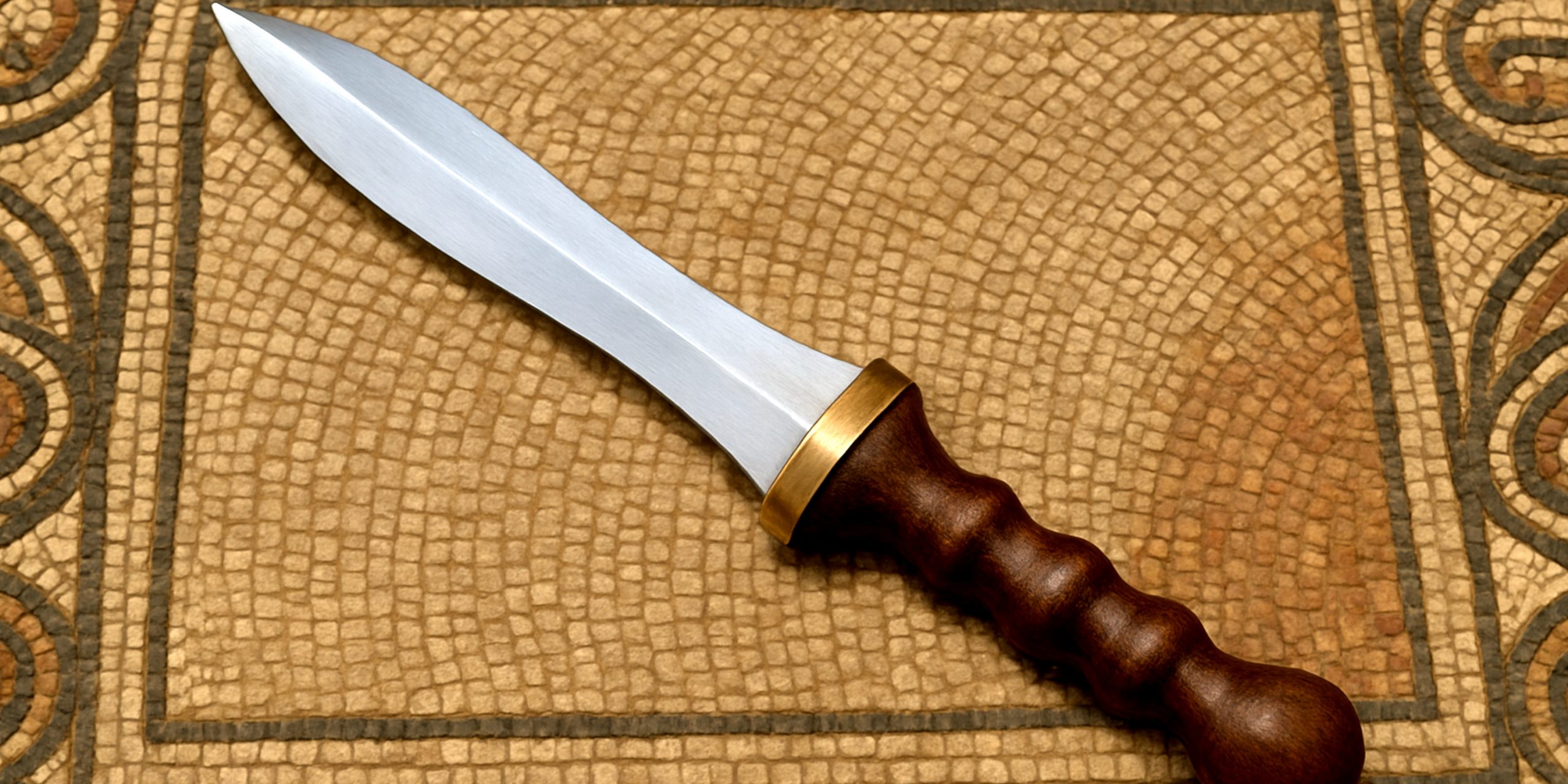
The pugio served as the Roman soldier’s personal blade, a compact sidearm used across the Republic and Empire. It acted as a backup weapon for close fighting, a utility tool for daily military tasks and a visible symbol of status within the legion. Despite its size, the pugio occupies a large place in Roman military culture. Surviving examples show fine decoration, careful craftsmanship and a surprising range of forms. It remains one of the most recognisable pieces of Roman kit.
Specification
Typical measurements vary by era and workshop, but most fall within a consistent range.
Blade
- Length 15 to 30 cm
- Width 3.5 to 6 cm
- Shape leaf or parallel edged with a reinforced midrib
- Steel or pattern welded iron depending on period
Grip
- Organic materials such as wood or bone
- Riveted plate construction on some early types
- Guard and pommel plates in iron or bronze
Scabbard
- Iron or bronze with embossed fittings
- Suspension rings for belt mounting
Table: Approximate Dimensions
| Element | Typical Range | Notes |
|---|---|---|
| Blade length | 15 to 30 cm | Longer examples appear in early Imperial period |
| Blade width | 3.5 to 6 cm | Midrib strengthens thrusting ability |
| Grip length | 8 to 12 cm | Designed for a secure single handed hold |
| Weight | 250 to 450 g | Depends on fittings and scabbard style |
History and Evolution
Early pugiones share traits with blades from the Iberian Peninsula and North Africa. Legionaries who served in these regions may have influenced the adoption of the form. By the late Republic, the pugio had become standard issue for many Roman soldiers.
During the first century AD, scabbards became increasingly ornate. Embossed plates, engraved motifs and silver inlays show that the pugio was more than a work tool. Some carried personal decoration, suggesting identity or unit pride. Over time, the design became simpler again. Later Imperial examples tend to be less extravagant, with plainer hilts and fewer decorative scabbards. The role of the pugio also shifted as the spatha became common among infantry. Even so, the blade retained ceremonial value and appeared in civilian contexts.
Advantages and Disadvantages
Advantages
- Compact and easy to carry
- Strong midrib improves penetration
- Useful as both battlefield backup and daily camp tool
- Can be drawn quickly due to belt suspension system
- Durable and straightforward to maintain
Disadvantages
- Limited reach compared with larger sidearms
- Decorative fittings can weaken quickly when used heavily
- Not suited to cutting against armoured targets
- Short length reduces versatility in open combat
Comparison with Similar Weapons
Blade types contemporary to or comparable with the pugio help place it in context.
| Weapon | Region | Strengths | Weaknesses |
|---|---|---|---|
| Roman pugio | Rome | Punchy thrust, compact, easy to carry | Short reach, limited cutting |
| Greek parazonium | Greece | Ceremonial appeal, longer blade | Less practical for daily soldier use |
| Iberian faca knife | Iberia | Sturdy utility blade | Lacks Roman reinforcement midrib |
| Celtic dagger | Western Europe | Robust ironwork | Often heavier and slower to draw |
The pugio differs through its reinforced geometry, distinctive leaf form and role as a standardised military symbol.
Legacy
The pugio remains an iconic reminder of Rome’s armies. Museums, living history groups and archaeological digs have brought many examples to light. Its distinctive profile appears in modern media, artwork and reenactment equipment. Scholars view the pugio as a marker of military identity and daily practicality within the legion.
Where to See
The best preserved pieces often come from dry or sealed conditions. Notable collections include:
- British Museum, London
- Romano Germanic Museum, Cologne
- Museum of Roman Civilisation, Rome
- Vindolanda Museum, Northumberland
- Legionary fort sites along the Rhine and Danube where scabbard plates and blades have been recovered
Collectors Guide
Collectors value pugiones for their condition, completeness, age and decorative detail. Scabbard fittings are particularly sought after, since they often carry engraved or embossed motifs.
What collectors look for
- Intact blade with visible midrib
- Original grip plates, even in fragmentary form
- Scabbard with surviving mounts
- Provenance linked to a known site
- Minimal modern cleaning or restoration
Condition grading
- Complete with scabbard and fittings. High value
- Blade intact, scabbard partial. Mid value
- Blade only, stabilised. Lower value but still collectable
Typical auction prices
- Complete decorated pugio with scabbard. 7,000 to 18,000 GBP depending on provenance
- Plain service type pugio. 1,200 to 4,000 GBP
- Fragmentary blade pieces. 150 to 500 GBP
- Scabbard fittings on their own. 200 to 1,000 GBP depending on decoration
Legal considerations
- Export rules vary by country
- Avoid pieces without secure provenance
- Ensure compliance with local heritage laws