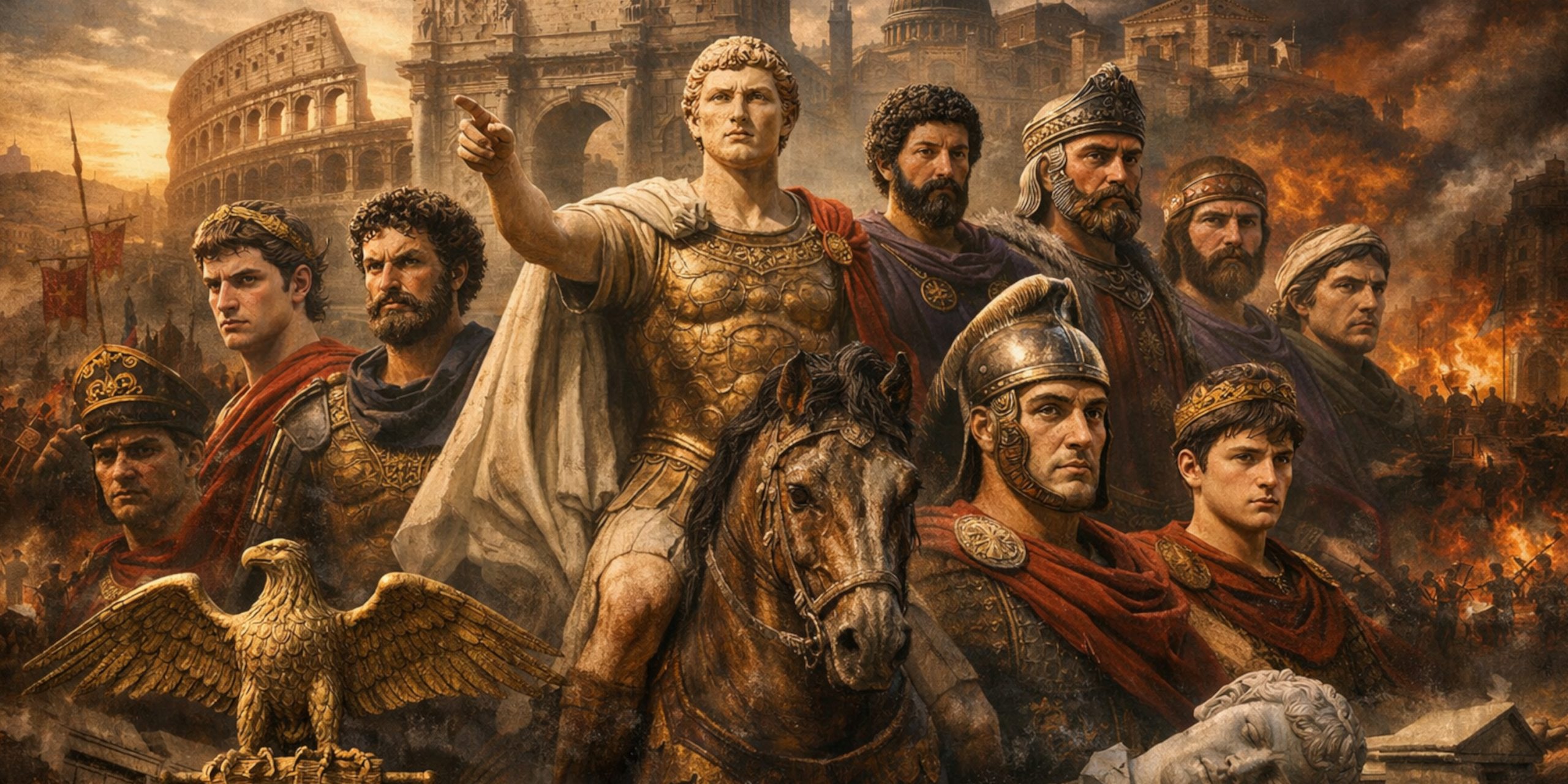
The Roman emperors form one of history’s longest and most uneven chains of power. Some were careful administrators, some gifted soldiers, some monsters, many a mix of all three. What follows is a clear, chronological account of the emperors from the birth of the Principate to the fall of the Western Empire, written with the benefit of hindsight and a little professional scepticism. Roman sources flatter, lie, and contradict each other, so certainty is often a luxury rather than a rule.
The Julio-Claudian Dynasty (27 BC to AD 68)
Augustus
Augustus created the imperial system while pretending not to. His genius lay in restraint. Power was wrapped in republican language, and Rome accepted monarchy because it felt familiar rather than imposed.
Tiberius
A capable soldier who ruled cautiously and withdrew from public life. The sources despise him, often unfairly, but his reign kept the system stable.
Caligula
Brief, chaotic, and probably exaggerated by hostile writers. Even allowing for slander, his rule damaged the illusion that emperors were merely first among equals.
Claudius
Scholarly, underestimated, and surprisingly effective. He expanded the empire into Britain and strengthened provincial administration.
Nero
Artist, autocrat, and political liability. His reign ended in rebellion and set the pattern for emperors who lost the army’s confidence.
The Year of the Four Emperors (AD 69)
Galba
Elected by revolt, undone by austerity and indecision.
Otho
Ruled for months, died by suicide to spare Rome further civil war.
Vitellius
Popular with soldiers, disastrous in government.
The Flavian Dynasty (AD 69 to 96)
Vespasian
Restored order through discipline and humour. He rebuilt Rome’s finances and its confidence.
Titus
Remembered kindly despite disasters including Vesuvius. His reign was short but competent.
Domitian
Efficient, authoritarian, and murdered for it. The senate never forgave him for ruling without pretending.
The Nerva-Antonine Emperors (AD 96 to 192)
Nerva
A compromise emperor who set the vital precedent of adopting a capable successor.
Trajan
Rome at its territorial height. A soldier-emperor who knew when to listen.
Hadrian
Administrator, traveller, and consolidator. He understood that limits were strength, not weakness.
Antoninus Pius
Quiet competence over drama. Often overlooked, unfairly.
Marcus Aurelius
Philosopher on the throne. His writings reveal exhaustion as much as wisdom.
Commodus
A warning sign. Personal vanity replaced public duty, and the balance broke.
The Severan Dynasty (AD 193 to 235)
Septimius Severus
Built power on the army and never apologised. The senate’s role shrank further.
Caracalla
Granted citizenship widely while ruling brutally. A paradox with a sword.
Geta
Murdered by his brother in full view of their mother.
Macrinus
An administrator who never controlled the legions.
Elagabalus
Religious radicalism collided with Roman conservatism. The outcome was inevitable.
Severus Alexander
Well intentioned, politically naive, and killed by his own troops.
The Crisis of the Third Century (AD 235 to 284)
This era saw emperors rise and fall at military speed. Authority depended almost entirely on soldier loyalty.
Key emperors include Maximinus Thrax, Decius, Valerian, and Aurelian.
Aurelian stands out. He reunified the empire and proved it was not beyond saving, only exhausted.
The Tetrarchy and Constantinian Era (AD 284 to 337)
Diocletian
Rebuilt imperial government from the ground up. He accepted that Rome could no longer be ruled as before.
Constantius Chlorus
A steady presence in the west.
Constantine the Great
Transformed the empire permanently. Christianity moved from persecuted sect to imperial faith, and the centre of gravity shifted east.
The Divided Empire (AD 337 to 395)
This period featured co-emperors ruling east and west. Unity existed mostly in theory.
Notable rulers include Constantius II, Julian the Apostate, and Valentinian I.
Theodosius I was the last to rule both halves. After his death, division became permanent.
The Western Roman Emperors (AD 395 to 476)
The western throne became fragile, then symbolic.
Key figures include Honorius, Valentinian III, and Majorian.
The line ends with Romulus Augustulus, deposed in AD 476. Rome did not fall overnight. It simply stopped pretending the west still mattered.
Roman Emperors Timeline Table (27 BC to AD 476)
| Period | Emperor | Reign | Dynasty or Era | Historical Significance |
|---|---|---|---|---|
| 27 BC to AD 14 | Augustus | 27 BC to AD 14 | Julio-Claudian | Founded the imperial system and stabilised Rome after civil war |
| AD 14 to 37 | Tiberius | AD 14 to 37 | Julio-Claudian | Consolidated Augustus’ system, strong military record |
| AD 37 to 41 | Caligula | AD 37 to 41 | Julio-Claudian | Tyranny and instability damaged imperial credibility |
| AD 41 to 54 | Claudius | AD 41 to 54 | Julio-Claudian | Expanded bureaucracy and conquered Britain |
| AD 54 to 68 | Nero | AD 54 to 68 | Julio-Claudian | Cultural patronage mixed with political collapse |
| AD 69 | Galba | AD 69 | Civil War | First of four emperors in a year of chaos |
| AD 69 | Otho | AD 69 | Civil War | Short reign ended by suicide |
| AD 69 | Vitellius | AD 69 | Civil War | Overthrown by eastern legions |
| AD 69 to 79 | Vespasian | AD 69 to 79 | Flavian | Restored stability and finances |
| AD 79 to 81 | Titus | AD 79 to 81 | Flavian | Ruled during disasters, remembered positively |
| AD 81 to 96 | Domitian | AD 81 to 96 | Flavian | Centralised power, assassinated |
| AD 96 to 98 | Nerva | AD 96 to 98 | Nerva-Antonine | Began adoptive succession |
| AD 98 to 117 | Trajan | AD 98 to 117 | Nerva-Antonine | Empire reached maximum territorial size |
| AD 117 to 138 | Hadrian | AD 117 to 138 | Nerva-Antonine | Consolidated borders and reformed administration |
| AD 138 to 161 | Antoninus Pius | AD 138 to 161 | Nerva-Antonine | Long, peaceful, and prosperous reign |
| AD 161 to 180 | Marcus Aurelius | AD 161 to 180 | Nerva-Antonine | Philosopher emperor during frontier wars |
| AD 180 to 192 | Commodus | AD 180 to 192 | Nerva-Antonine | Marked decline in imperial discipline |
| AD 193 to 211 | Septimius Severus | AD 193 to 211 | Severan | Military-based monarchy |
| AD 211 to 217 | Caracalla | AD 211 to 217 | Severan | Extended Roman citizenship empire-wide |
| AD 217 to 218 | Macrinus | AD 217 to 218 | Severan | First emperor from equestrian class |
| AD 218 to 222 | Elagabalus | AD 218 to 222 | Severan | Religious radicalism alienated Rome |
| AD 222 to 235 | Severus Alexander | AD 222 to 235 | Severan | Last Severan, murdered by troops |
| AD 235 to 270 | Multiple Emperors | AD 235 to 270 | Crisis of Third Century | Military anarchy and fragmentation |
| AD 270 to 275 | Aurelian | AD 270 to 275 | Crisis Recovery | Reunified the empire |
| AD 284 to 305 | Diocletian | AD 284 to 305 | Tetrarchy | Reformed administration and army |
| AD 306 to 337 | Constantine the Great | AD 306 to 337 | Constantinian | Legalised Christianity, founded Constantinople |
| AD 379 to 395 | Theodosius I | AD 379 to 395 | Late Empire | Last ruler of united empire |
| AD 395 to 423 | Honorius | AD 395 to 423 | Western Empire | Rome sacked during his reign |
| AD 425 to 455 | Valentinian III | AD 425 to 455 | Western Empire | Political collapse accelerated |
| AD 457 to 461 | Majorian | AD 457 to 461 | Western Empire | Last effective western ruler |
| AD 475 to 476 | Romulus Augustulus | AD 475 to 476 | Western Empire | Deposed, symbolic end of Western Rome |
Final Thoughts from a Historian
Reading the emperors in order strips away myth. Rome was not undone by decadence or Christianity alone, but by the impossible task of ruling a vast empire with ancient tools. The emperors who lasted were flexible, dull when needed, and ruthless at the right moments. The rest became anecdotes, warnings, or punchlines. History remembers them all, but it judges them very unevenly.
Watch the documentary: