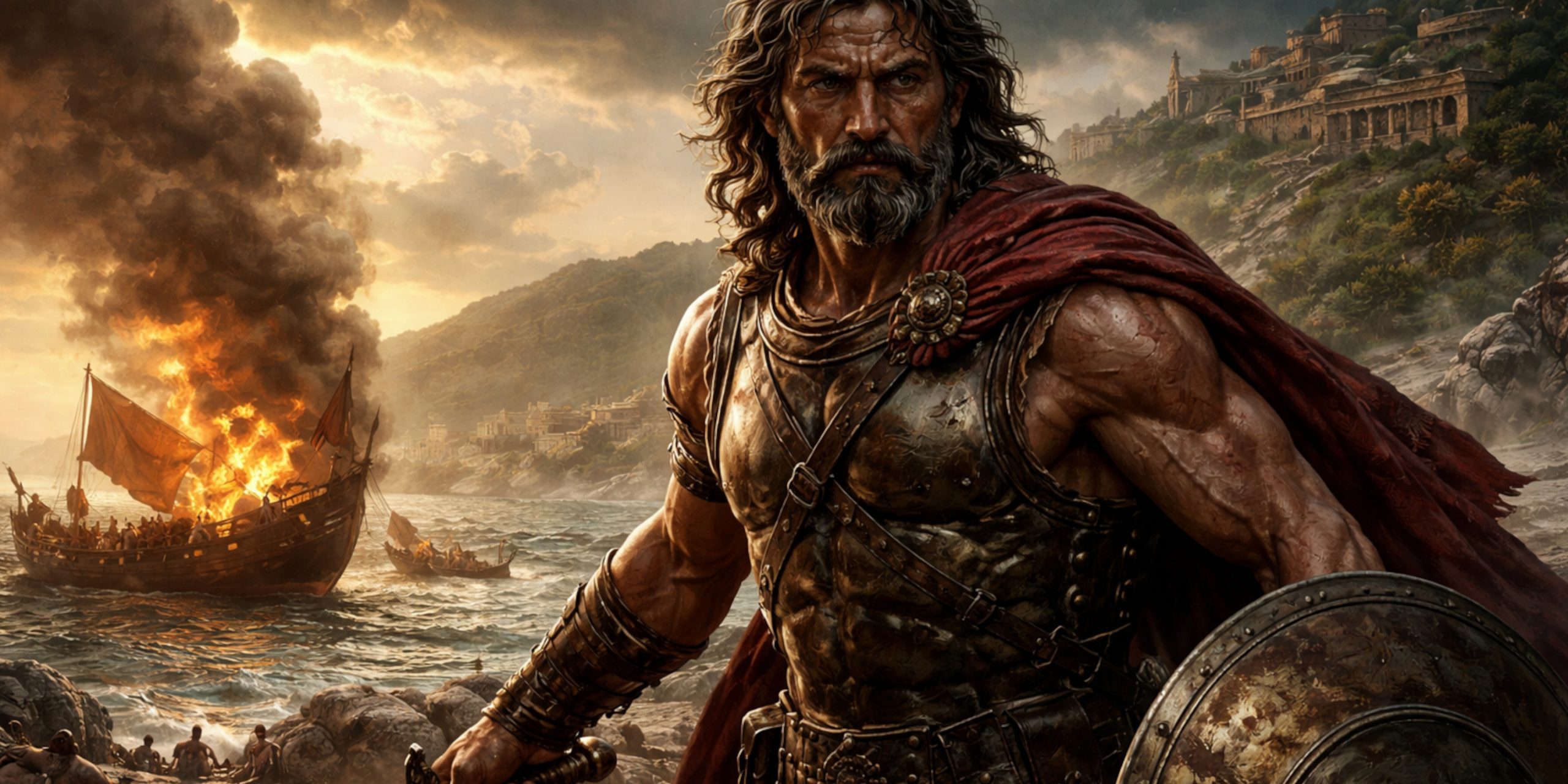
Odysseus is a king, a veteran, a liar, a survivor, and at times a menace. When ancient audiences heard his story, they were not listening for moral purity. They were listening for recognition. This is a man shaped by war, sharpened by hunger, and slowly unpicked by time away from home. That is why he lasts.
What follows is not a tidy hero profile. It is a portrait of a Bronze Age war leader whose world was violent, fragile, and medically primitive, and who survived not because he was noble, but because he adapted.
Origins and early life
Odysseus is traditionally presented as the king of Ithaca, a small and rocky island with limited wealth and fewer illusions of grandeur. His father Laertes represents an older heroic generation, while his mother Anticlea grounds him firmly in the domestic world that he will spend decades trying to reclaim. Unlike the grand princes of Mycenae or Troy, Odysseus rules a marginal place. That matters.
From the beginning, his defining trait is not strength but intelligence. Ancient sources describe him as polytropos, a word that suggests many turns, many paths, many selves. Even before Troy, this is a man who solves problems sideways. As a historian, I find this detail persuasive rather than flattering. Small kingdoms survive by thinking rather than overpowering.
The Trojan War
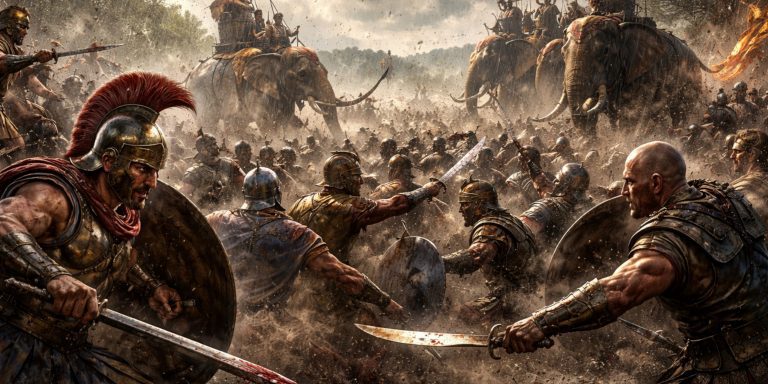
Odysseus is indispensable to the Greek war effort, though rarely admirable in a clean sense. He exposes Achilles on Skyros, engineers the Trojan Horse, and carries out morally dubious tasks with grim efficiency. This is not battlefield heroism. It is operational warfare.
Ten years of fighting shape him profoundly. Homer never romanticises the experience. The war grinds men down. Odysseus watches friends die, commits acts that would be considered atrocities in any age, and internalises a brutal logic where survival and victory eclipse honour. When Troy falls, it is not a moment of relief. It is the beginning of his unravelling.
War and its cost
The Iliad gives us moments of rage and spectacle. The Odyssey shows us aftermath. Odysseus is not triumphant after Troy. He is hollowed out. War has taught him suspicion, caution, and cruelty when required. It has also made him incapable of straightforward living.
His constant disguises, false names, and testing of loyalties read like the behaviour of someone who no longer trusts the world to be safe. Modern readers sometimes call this cunning. I read it as damage.
Disease in the heroic world
Disease in Homeric epic is poorly understood but deeply feared. Illness arrives suddenly and often carries divine blame. Plague opens the Iliad. Wounds fester. Infection is a quiet killer.
Odysseus survives years at sea with no real medical care beyond herbal knowledge and divine intervention. His crew die not only by monsters but through exhaustion, exposure, and neglect. Circe’s potions and Calypso’s island offer fantasy cures, but these moments highlight how fragile the human body was in Bronze Age thought. Survival often came down to luck and restraint.
It is striking that Odysseus himself avoids serious illness. The danger is always external, as if the story cannot allow his body to fail when his mind already carries so much strain.
Famine and hunger
Hunger is one of the Odyssey’s most persistent pressures. Odysseus’ men are constantly desperate for food. They slaughter Helios’ cattle despite clear warnings, not because they are stupid, but because starvation strips away obedience.
Odysseus understands hunger intimately. He begs, steals, and lies for food on Ithaca. This is not humiliation for narrative effect. It reflects a world where famine was a seasonal reality. Kings who could not secure grain did not remain kings for long.
The suitors gorging themselves in Odysseus’ hall are not just rude. They represent the collapse of food security and social order. Their punishment is brutal, but in a subsistence economy, hoarding is a form of violence.
Homecoming and violence
Odysseus’ return is not gentle. He does not reclaim his throne through recognition alone. He does it through slaughter. As a historian, I find this ending uncomfortable but honest. Power in early societies was enforced, not debated.
Penelope’s endurance is often praised, rightly so, but Odysseus’ inability to reintegrate peacefully is just as telling. War has rewired him. He tests everyone. He trusts almost no one. Even after the suitors are dead, peace is fragile.
Legacy and interpretation
Odysseus survives because he changes. That is his gift and his curse. Later Greek culture admired this adaptability, even while distrusting it. Roman writers alternated between praise and suspicion. Medieval audiences often softened him. Modern readers tend to psychoanalyse him.
I suspect the ancient audience saw something simpler. This is what war does to a clever man. It keeps him alive and makes him restless forever.
Odysseus is not a role model. He is a warning and a witness. In a world of war, disease, and famine, survival demands compromise. The cost is rarely visible at first. It follows you home, waits quietly, and never quite leaves.
Watch the documentary: