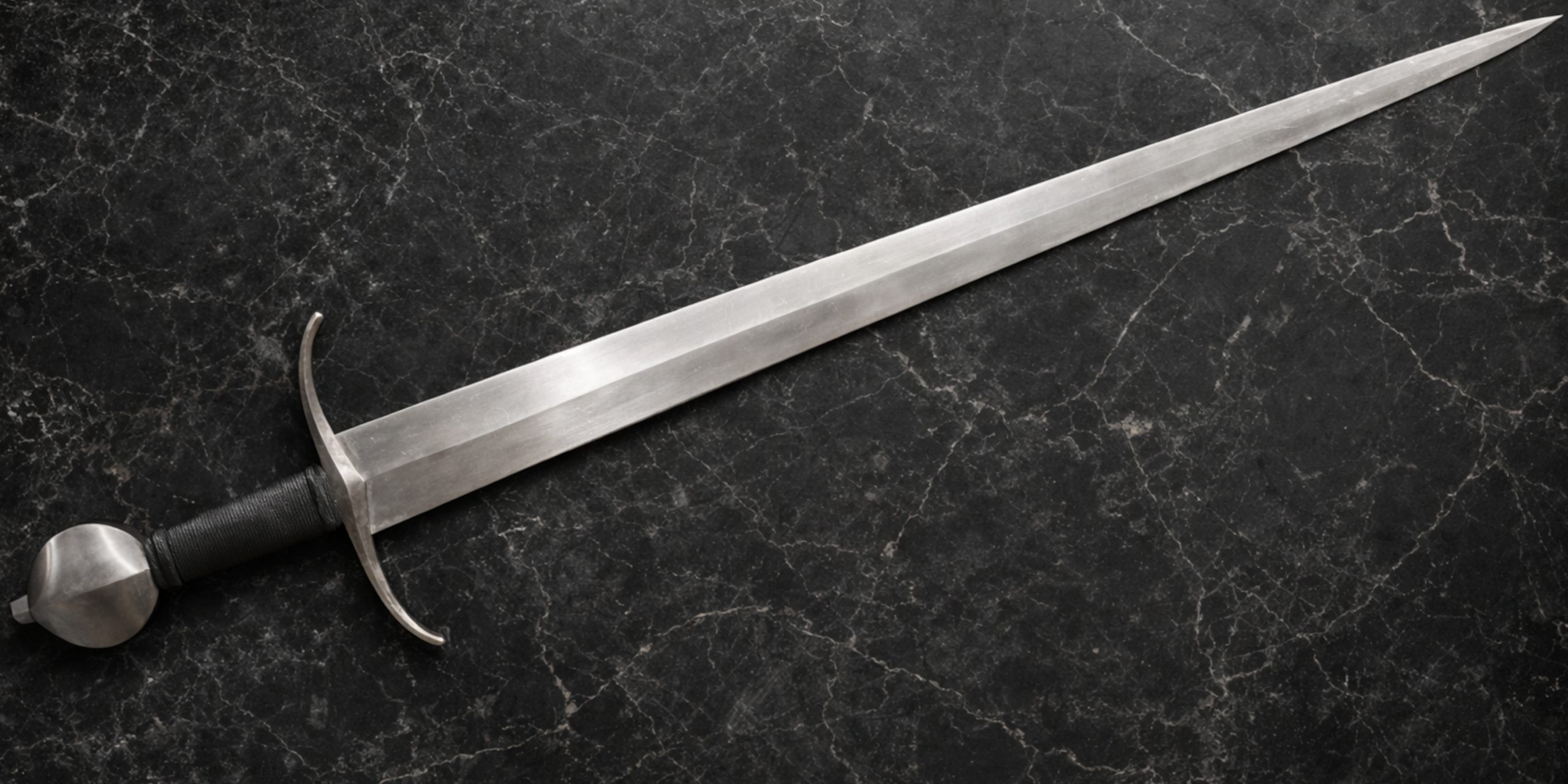
Oakeshott Type XVI belongs to the moment when European swords stopped pretending armour was someone else’s problem. It appears in the 14th century as mail remained widespread and plate armour was becoming more common but far from universal. The design responds with intelligence rather than brute force, keeping real cutting ability while developing a point that could be driven with purpose. This is not a compromise born of indecision, but a practical answer to a changing battlefield.
Specification
Type XVI covers a family of blades rather than a single rigid pattern. Surviving examples show variation, but the defining features are consistent.
Core characteristics
| Feature | Type XVI | Type XVIa |
|---|---|---|
| Primary role | Balanced cut and thrust | Cut and thrust with emphasis on reach and control |
| Blade profile | Broad at the base, strong taper to an acute point | Longer blade with decisive taper |
| Cross-section | Flattened diamond or ridged for stiffness | Often hexagonal near the forte |
| Fuller | Present near the hilt, usually moderate in length | Shorter fuller, often limited to the lower third |
| Grip | One hand or hand-and-a-half | Commonly hand-and-a-half |
| Period | Mainly 14th to early 15th century | Late 14th into 15th century |
Visual identification notes
- The blade narrows assertively rather than gradually
- The point looks engineered rather than decorative
- The fuller retreats early, leaving the upper blade stiff
- The sword feels deliberate in hand, not lively to the point of recklessness
History and Evolution
The rise of Type XVI reflects a battlefield reality rather than a fashion trend. Earlier cutting swords still worked, but armour development demanded better point performance. Fully thrust-centric designs were still some way off, so Type XVI fills the gap.
Key developments include:
- Reinforced points capable of exploiting gaps in mail and early plate
- Reduced fuller length to stiffen the foible
- In the XVIa variant, longer grips that allow leverage and controlled two-handed use
Rather than replacing earlier forms outright, Type XVI sits alongside them, giving soldiers and retainers a sword that could handle mixed threats without needing a full change in fighting style.
Advantages and Disadvantages
Advantages
- True versatility
Effective against lightly armoured opponents while retaining credible thrusting capability. - Strong point control
The taper and ridge provide confidence in directed thrusts. - Historically sensible
A realistic choice for a professional warrior dealing with varied opponents.
Disadvantages
- No miracle against heavy plate
It improves your odds but does not defeat armour on geometry alone. - Relies on correct geometry
Poorly made examples lose the balance that defines the type. - Subtle damage matters
Corrosion or over-cleaning can erase the ridge and distort identification.
Comparison with Similar Weapons
| Type | Character | Strengths | Limitations |
|---|---|---|---|
| Type XIV | Broad, aggressive cutter | Devastating cuts, lively handling | Less refined thrusting |
| Type XV | Point-driven specialist | Excellent armour awareness | Reduced cutting authority |
| Type XVI | Balanced and adaptable | Credible cut and thrust | Not extreme in either role |
| Type XVII | Long and stiff | Reach and thrust dominance | Less forgiving as a cutter |
| Type XVIII | Later refinement | Highly efficient geometry | Very broad category |
If Type XV is a deliberate thrusting statement, Type XVI is a confident conversation that adapts as needed.
Legacy
Type XVI represents a turning point rather than an endpoint. It demonstrates how sword design matured in response to armour without abandoning versatility. Many later forms build on the same logic, refining rather than reinventing.
In modern historical study and reproduction circles, Type XVI has become a reference point for what a practical medieval sword should look and feel like. It avoids extremes and rewards good technique, which may explain its enduring appeal.
Where to See Examples
Original examples and close parallels can be found in major European collections, particularly in Britain. Study collections are especially valuable, as they allow comparison across types and periods rather than isolating a single blade. Seeing a Type XVI beside earlier cutting swords and later thrust-focused designs makes its purpose immediately clear.
Collector’s Guide (Including Auction Prices)
Original medieval swords occupy a demanding corner of the market. Condition, authenticity, and documentation matter far more than typology labels.
What experienced collectors prioritise
- Clear provenance and ownership history
- Intact blade geometry, especially at the point and ridge
- Consistency between blade, tang, and hilt components
- Conservative conservation rather than cosmetic restoration
Common warning signs
- Polished surfaces that erase original geometry
- Vague dating tied to romantic labels
- Mixed components presented as original without explanation
Auction price overview
| Category | Typical price range |
|---|---|
| Fragmentary or excavated examples | Low to mid five figures (GBP) |
| Complete, sound examples | Mid to high five figures |
| Exceptional provenance or condition | Six figures and beyond |
Prices fluctuate widely. Two swords of the same type can differ by tens of thousands based on documentation and preservation alone.
Practical buying advice
- Buy reputation before object
- Budget for independent appraisal
- For handling and training, high-end reproductions are the sensible choice