Nuno Álvares Pereira is one of those historical figures whose reputation feels almost inconveniently complete. He was undefeated in battle, decisive at moments when the country itself hung in the balance, and later walked away from power to become a Carmelite friar. Medieval Portugal produced many capable nobles, but only one national saviour who managed not to lose his head, metaphorically or literally.
What follows is not a saint’s life or a patriotic legend retold uncritically, but a grounded look at what we actually know, and why he still matters.
Early Life and Rise
Born in 1360 to a lesser branch of the Pereira family, Nuno was never supposed to dominate Portuguese history. He was a younger son with limited inheritance prospects, educated for service rather than sovereignty. His early military exposure came through border skirmishes and household retinues, the unglamorous apprenticeship of late medieval warfare.
The crisis of 1383 changed everything. With King Ferdinand I dead and the Portuguese throne contested by Castile, Nuno aligned himself with João of Aviz. It was a gamble that would either end in glory or confiscated estates. Medieval Portugal had little patience for losers.
Battles and Military Acumen
Nuno Álvares Pereira’s reputation rests not on one battle, but on a sequence of victories that show consistent tactical intelligence.
At Battle of Atoleiros, he employed a compact infantry square, resisting cavalry charges in a way that anticipates later developments in European warfare. The result was a Castilian force repelled without a single Portuguese fatality, which sounds suspicious until you read the sources carefully and realise how disciplined the formation must have been.
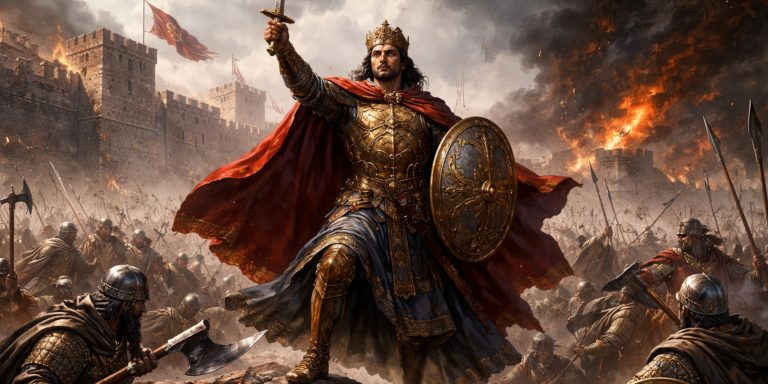
The defining moment came at the Battle of Aljubarrota. Facing a larger Castilian army, Nuno oversaw defensive preparations that combined terrain selection, field fortifications, and infantry coordination. Stakes, ditches, and narrow killing zones turned numerical disadvantage into irrelevance. English longbowmen assisted, but this was not a borrowed victory. It was a Portuguese plan, executed ruthlessly well.
Later campaigns, including Battle of Valverde, reinforced the pattern. Nuno favoured preparation over bravado, defence over reckless attack, and cohesion over individual heroics. This made him deeply respected by soldiers and quietly frustrating to romantic chroniclers.
Arms and Armour
As Constable of Portugal, Nuno Álvares Pereira would have been equipped to the highest contemporary standard, though not extravagantly so.
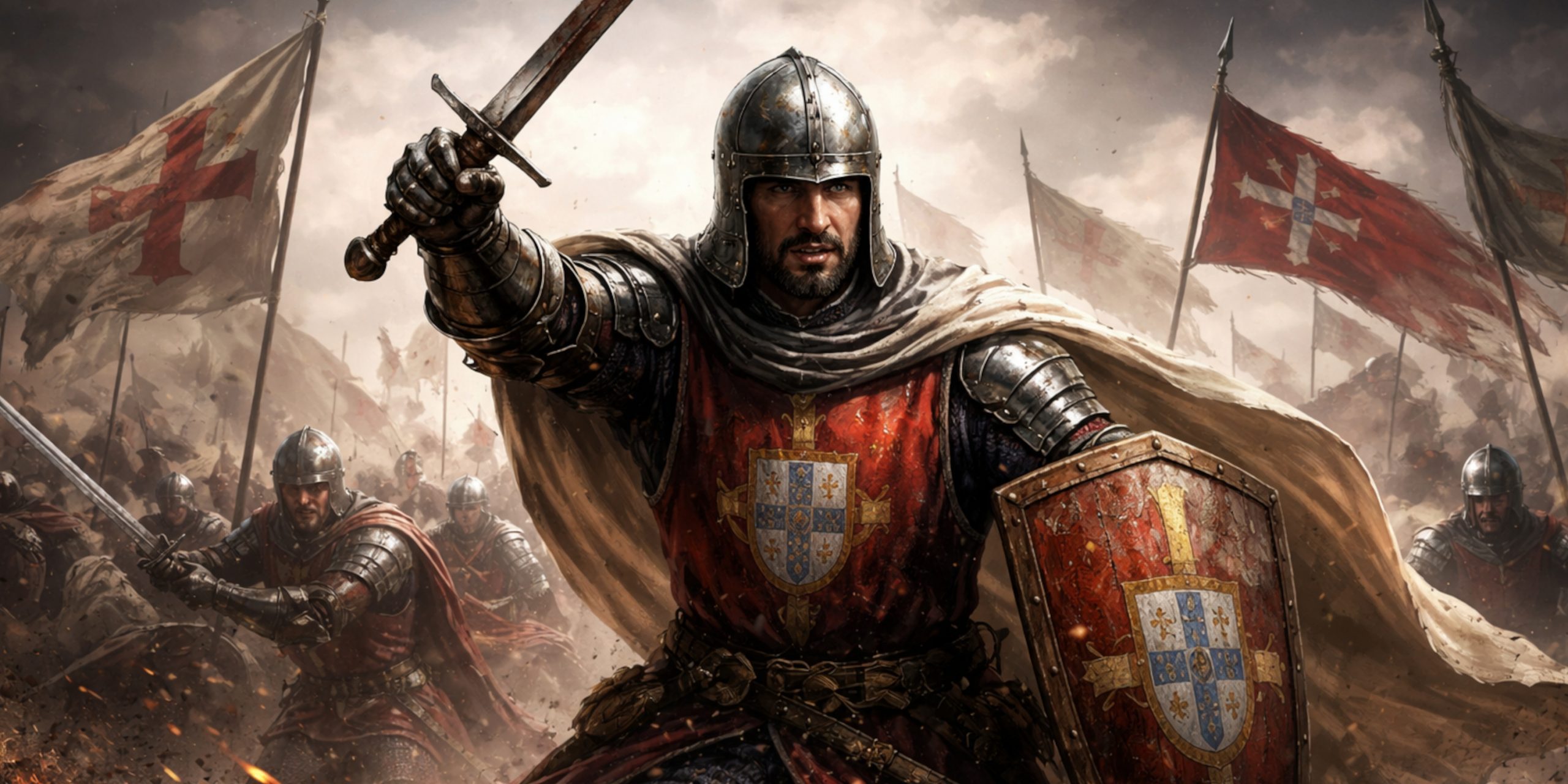
He likely wore a transitional harness combining mail with plate elements. A bascinet helmet with a visor would have been typical, offering protection without sacrificing awareness. Surviving descriptions suggest practicality rather than ostentation, which aligns neatly with his personality.
His primary weapon was almost certainly a longsword suited to armoured combat, paired with a lance when fighting mounted. On foot, he would have fought with sword and shield or polearm depending on context. There is no evidence of unusual or experimental weaponry. His advantage lay in command, not kit.
Personality and Leadership Style
Sources consistently describe Nuno as austere, intensely pious, and personally brave to a fault. He was known to place himself where the fighting was thickest, which is admirable but also a terrible habit for someone whose death would have collapsed national morale.
What sets him apart is restraint. He resisted the temptation to turn military success into personal kingship, remaining loyal to João I even when he held more battlefield authority than many crowned heads. In a century of overambitious nobles, this alone marks him as unusual.
As a historian, I find this more impressive than any charge or counterattack. Winning battles is hard. Knowing when not to seize power is rarer.
Artefacts and Where to See Them
Material culture linked directly to Nuno Álvares Pereira is limited, but significant.
The most important site is the Convento do Carmo, which he founded after retiring from military life. Though partially ruined by the 1755 earthquake, it remains one of Lisbon’s most evocative medieval structures.
Artefacts associated with his life, including funerary elements and later devotional objects, can be found at the Museu Nacional de Arte Antiga and within the Carmo complex itself. These are not glittering war trophies, but objects tied to memory, commemoration, and sanctity.
Archaeology and Recent Findings
Archaeological work at the Battlefield of Aljubarrota has significantly deepened our understanding of Nuno’s warfare. Excavations have uncovered defensive ditches, stake holes, and artefact scatters that confirm the deliberate construction of killing zones described in chronicles.
These findings matter because they anchor Portuguese narrative sources to physical evidence. Aljubarrota was not just a lucky stand. It was engineered.
Ongoing landscape archaeology continues to refine troop positioning and engagement phases, reinforcing the view of Nuno Álvares Pereira as a commander who understood terrain as well as any modern general.
Seven Swords Takeaway
Nuno Álvares Pereira sits at an awkward crossroads for historians. He is too successful to be dismissed as legend, too devout to be easily secularised, and too disciplined to fit the mould of the swashbuckling medieval knight.
Portugal survived the fourteenth century because of structural factors, alliances, and economics. It also survived because one man consistently made the right decision under pressure. History rarely gives us such clarity. When it does, it deserves to be taken seriously.