Who Was Nikephoros II Phokas?
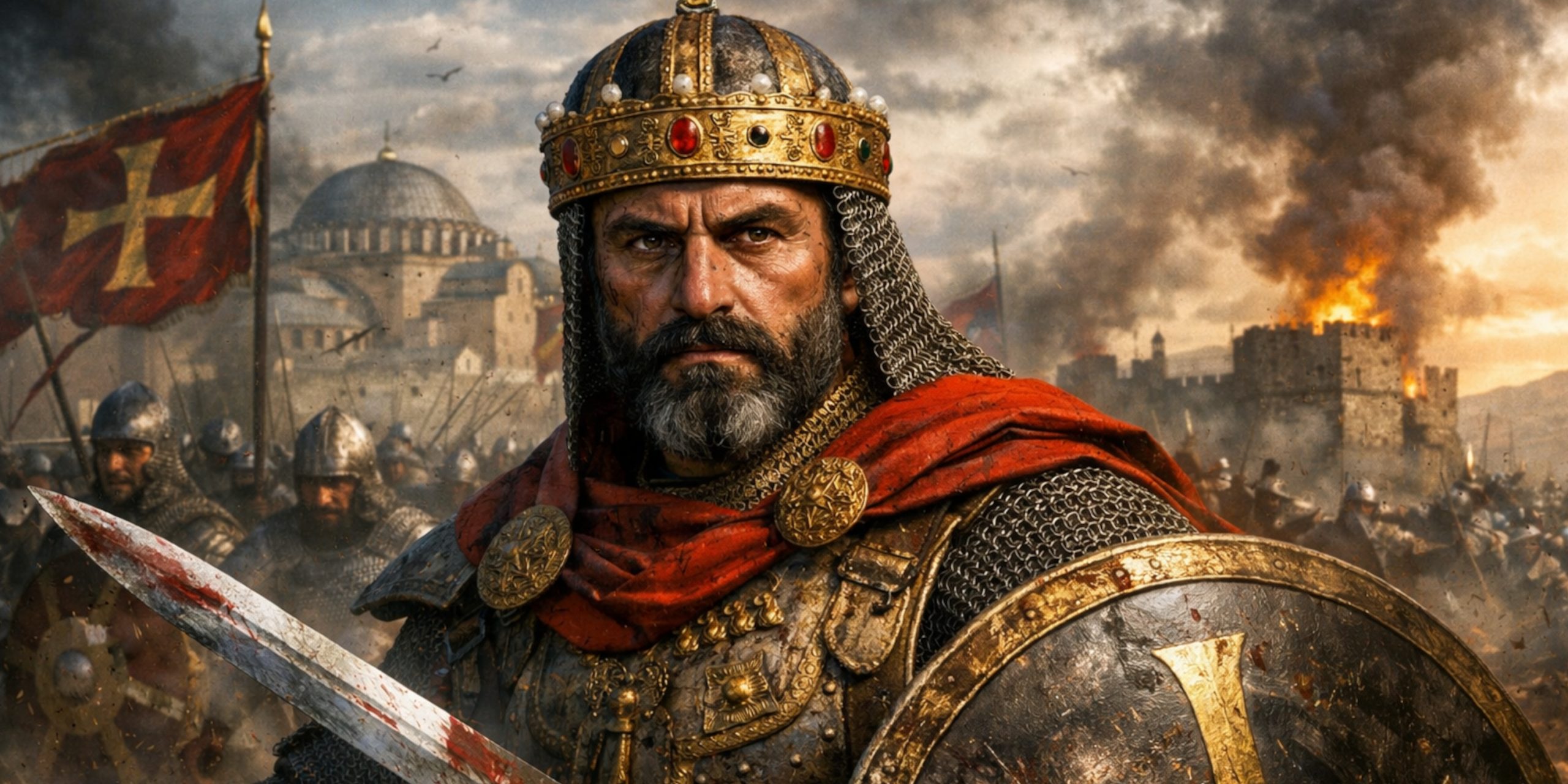
Nikephoros II Phokas was not your typical silk robed court emperor. He looked more like a veteran general who had accidentally wandered into the throne room and decided to stay. Lean, deeply pious, famously austere, and slightly terrifying, he ruled the Byzantine Empire from 963 to 969 and spent most of that time doing what he did best, winning wars.
Born around 912 into the powerful Phokas military family, he grew up in a world where command was expected. The eastern frontier with the Islamic caliphates was brutal, fluid, and relentless. For decades the Byzantines had fought defensive wars. Nikephoros changed the tempo. He went on the offensive.
The Road to Power
Before he ever wore a crown, Nikephoros built his reputation as a commander. Under Emperor Romanos II, he led campaigns that stunned the Mediterranean world.
His greatest early triumph came in 960 to 961 with the reconquest of Crete from the Emirate of Crete. For over a century, the island had been a pirate stronghold, raiding Byzantine coasts and trade routes. Nikephoros landed with a massive force, besieged Chandax, and after a gruelling campaign brought the island back under imperial control.
Not long after, he pushed east into Cilicia and northern Syria, capturing key fortresses and restoring Byzantine confidence. When Romanos II died unexpectedly in 963, the army backed Nikephoros as emperor. He married the widowed empress Theophano and secured the throne.
It was a military coup with a veneer of legitimacy, and it worked.
Military Campaigns and Expansion
Nikephoros did not slow down once crowned.
In the east, he struck at the weakening Abbasid frontier. In 965 he seized Cyprus. In 969 he captured Antioch, a city of immense symbolic and strategic weight. For a Byzantine ruler to retake Antioch after three centuries was not a minor achievement. It was a statement.
His armies were professional, disciplined, and increasingly effective. He invested heavily in cavalry, particularly the armoured kataphraktoi, shock troops designed to break enemy lines with concentrated force. Siegecraft improved. Logistics were tightened. He understood that sustained campaigning required money and supply, not just heroics.
If you were living in tenth century Constantinople, you would have felt it. The empire was no longer merely surviving. It was advancing.
The Soldier Emperor at Home
The same qualities that made Nikephoros formidable in war made him complicated in peace.
He was intensely religious, almost monastic in temperament. He fasted, slept on the floor, and reportedly considered abandoning the throne to become a monk. That kind of spiritual seriousness did not always translate into political charm.
To fund his campaigns, he raised taxes and tightened control over the powerful landowning aristocracy. He attempted to prevent the wealthy from swallowing up peasant lands, aiming to preserve the smallholders who formed the backbone of the army. In theory, this was socially stabilising. In practice, it annoyed a lot of rich people.
He also clashed with segments of the church over property and privilege. For a ruler so pious, he had a knack for making enemies among clerics.
Byzantium Reforged
It is hard to overstate how important Nikephoros was in shifting Byzantine strategy.
For generations, the empire had been on the defensive against Arab powers. Under Nikephoros, the frontier stabilised and then pushed outward. His campaigns laid the groundwork for further expansion under his successors, particularly John I Tzimiskes and later Basil II.
He also authored a military treatise, often linked to the Praecepta Militaria, outlining tactical principles and battlefield formations. This was not just a warrior swinging a sword. He was thinking about doctrine.
You can almost see him as a tenth century operations manager who also happened to command cavalry charges.
The Fall: Palace Intrigue and Assassination
For all his victories, Nikephoros did not die in battle. He died in his own palace.
In December 969, he was assassinated in Constantinople in a conspiracy involving his wife Theophano and his trusted general John Tzimiskes. Accounts describe assassins climbing into the imperial bedchamber at night. It is the kind of ending that feels scripted.
John Tzimiskes took the throne. Theophano was exiled. The empire continued expanding, built partly on foundations Nikephoros had laid.
It is a sharp reminder that in Byzantium, surviving the battlefield was often easier than surviving the palace.
Character and Legacy
Nikephoros II Phokas divides opinion even now.
To some, he was a hero of Christendom, a restorer of imperial strength, a commander of rare discipline. To others, he was dour, harsh, and politically tone deaf. He did not cultivate popularity. He cultivated results.
From a modern perspective, he feels strangely contemporary. A specialist leader elevated to the top job because he was good at one thing and trusted by the army. Brilliant in crisis, less comfortable in compromise.
His reign was short, just six years, yet transformative. He helped turn the tide for Byzantium in the eastern Mediterranean and set the stage for what historians often call the Macedonian renaissance.
If you measure rulers by spectacle, he may not rank first. If you measure them by structural impact, he stands very high indeed.
Seven Swords Takeaway
Nikephoros reminds us that empires are not only shaped by charismatic diplomats or glamorous courts. Sometimes they are reshaped by disciplined generals who understand logistics, morale, and timing.
He took a state that had been battered for generations and gave it momentum. That alone secures his place in history.
And if nothing else, he proves that in tenth century Constantinople, the most dangerous battlefield might have been the bedroom floor of the imperial palace.