The medieval Islamic world did not stumble into innovation by accident. It cultivated it. Between roughly the eighth and fifteenth centuries, scholars working from Cordoba to Baghdad treated knowledge as something to be tested, improved, and shared. They inherited Greek, Persian, Indian, and Roman ideas, then pushed them further with an energy that still catches historians off guard. As a medievalist, I find the surprise telling. We still underestimate how deliberate and systematic this culture of invention really was.
Mathematics That Learned to Behave
Algebra did not emerge from idle curiosity. It came from the need to solve practical problems in inheritance law, trade, and land measurement. The word itself comes from al jabr, part of the title of a treatise by Al-Khwarizmi, whose work laid out methods for solving equations step by step. No mysticism, no rhetorical flourishes, just logic and clarity.
Decimal positional notation, refined from Indian mathematics, made calculation faster and more reliable. This was not glamorous work, but it was transformative. European bookkeeping, engineering, and later science would have been unthinkable without it. I sometimes imagine medieval accountants cheering quietly over cleaner sums.
Optics and the Birth of Experimental Science
Ibn al-Haytham approached vision with a question that seems obvious now but was radical then. What if sight comes from light entering the eye, rather than rays shooting out of it. He tested this with controlled experiments, dark rooms, lenses, and careful observation.
His work on optics did more than explain eyesight. It introduced a method. Hypothesis, experiment, verification. This habit of mind travelled west through Latin translations and quietly rewired how European scholars approached nature. If modern science has a medieval ancestor, Ibn al-Haytham is sitting prominently in the family portrait.
Engineering That Enjoyed Showing Off
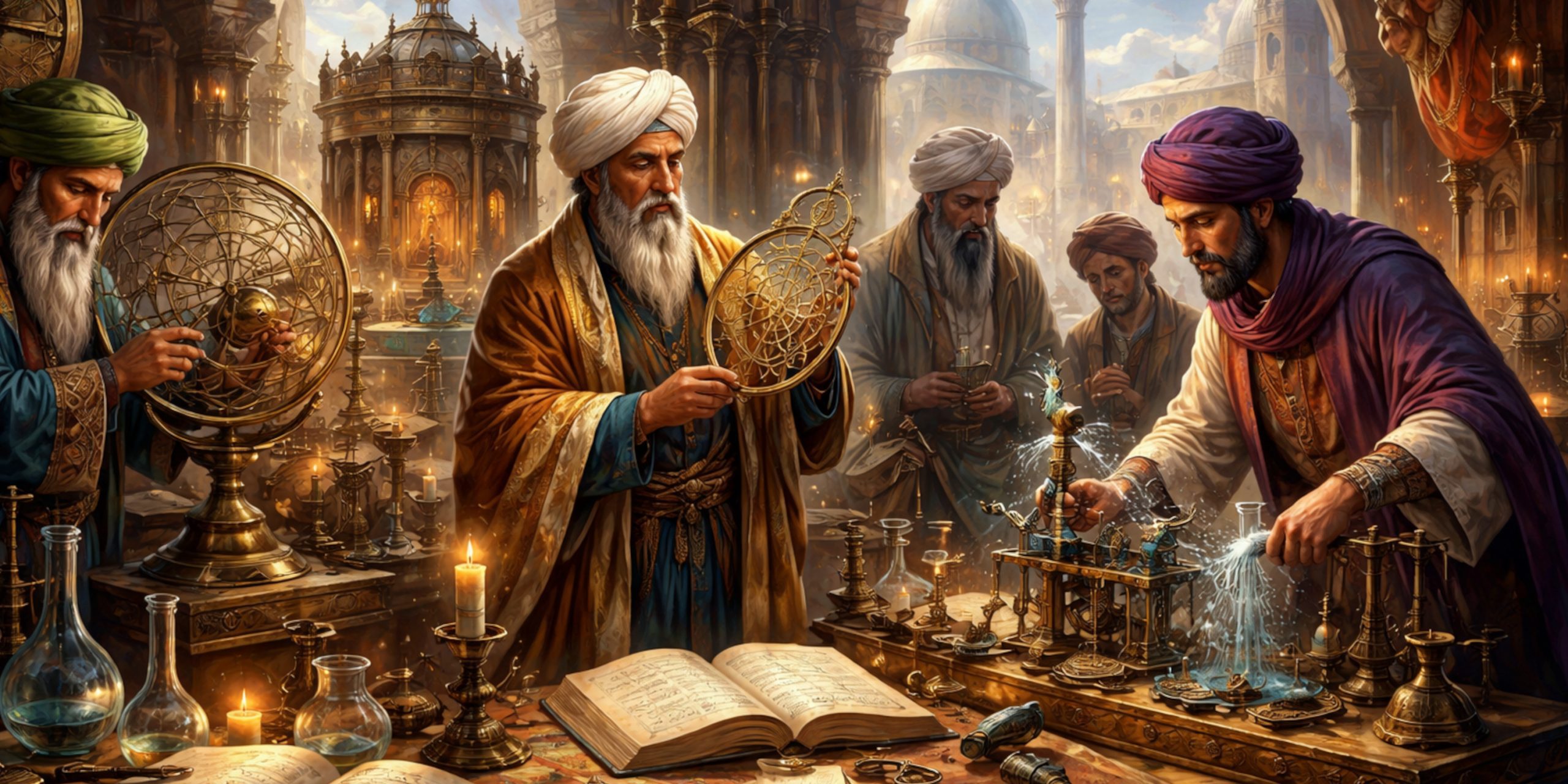
The medieval Islamic world had a taste for elegant machines. Water clocks that marked the hours with moving figures, automated hand washers, and mechanical musicians were not just novelties. They demonstrated mastery of hydraulics, gearing, and timing.
The star of this tradition is Al-Jazari, whose illustrated book of ingenious devices reads like a medieval engineer’s notebook crossed with a showman’s catalogue. His machines used crankshafts, valves, and cams centuries before they appeared in European mechanical design. Practical, playful, and deeply clever, which is my favourite combination.
Medicine Organised as a Public Service
Hospitals, or bimaristans, were not places of last resort. They were structured institutions with wards, pharmacies, teaching spaces, and salaried staff. Patients were treated regardless of wealth, and records were kept with care.
Physicians such as Avicenna systematised medical knowledge in works that balanced theory with observation. His Canon of Medicine became a standard reference in Europe for centuries. Medieval Islamic medicine was not perfect, but it was methodical, ethical, and surprisingly humane by the standards of the time.
Astronomy for Faith, Travel, and Curiosity
Astronomy mattered because it answered real questions. When should one pray. Which direction is Mecca. How do we navigate long distances safely. Instruments like the astrolabe were refined into precise tools that combined mathematical theory with practical use.
Observatories supported long term observation, not just star gazing for its own sake. Tables of planetary motion improved accuracy, and critiques of earlier models showed a willingness to challenge authority. Reverence for tradition did not exclude revision, which feels like a lesson worth repeating.
Chemistry Before the Name Stuck
Alchemy in the Islamic world leaned toward experimentation rather than symbolism. Scholars developed distillation techniques, acids, and laboratory equipment that look surprisingly familiar. Substances were classified by properties, not just by philosophical associations.
These practices fed directly into later chemistry. Even the language tells the story, with words like alcohol and alkali carrying their Arabic roots into modern science. Medieval laboratories were busy, smoky places, and progress often smelled terrible.
Knowledge as an Inherited Responsibility
Translation movements in centres like Baghdad treated knowledge as something to preserve and improve, not to lock away. Greek philosophy, Persian science, and Indian mathematics were translated, commented on, and corrected. Errors were noted. Assumptions questioned.
This was not passive transmission. It was active scholarship, driven by the belief that understanding the world was a form of devotion. I find that quietly radical.
Why These Inventions Still Matter
Muslim medieval inventions shaped how we calculate, observe, build, and heal. They did so through institutions, methods, and habits of thought that travelled far beyond their place of origin. When Europe later experienced its scientific and intellectual expansions, it did not start from nothing. It inherited a toolkit already well used.
History rarely offers clean origin stories. This one is no exception. But if we are serious about understanding how the modern world took shape, the medieval Islamic contribution is not a footnote. It is part of the main text, written in careful script, occasionally smudged with ink, and still worth reading closely.
Watch the documentary: