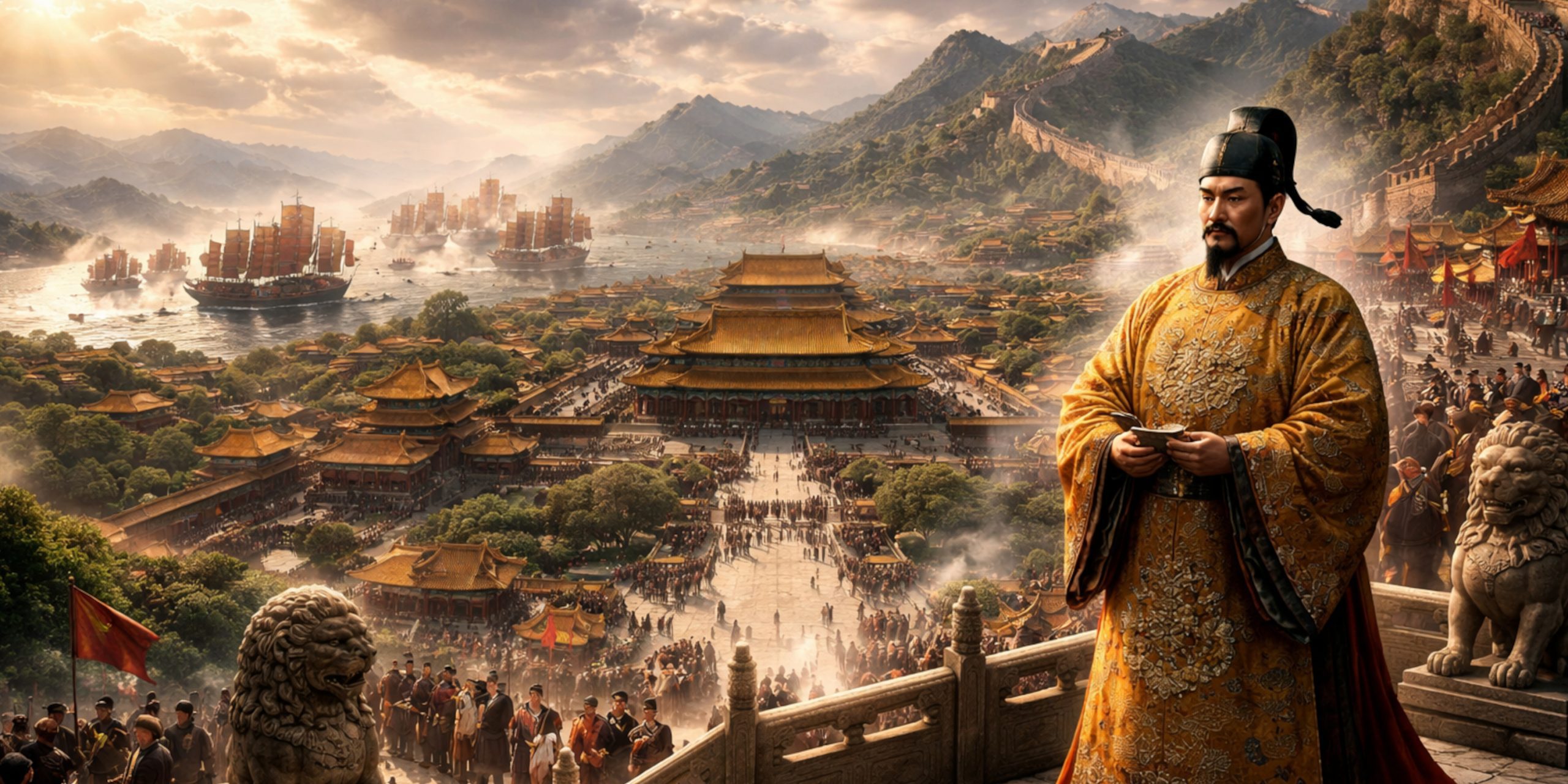
The Ming Dynasty ruled China from 1368 to 1644, a period that still shapes how China is imagined both at home and abroad. Porcelain, grand walls, naval expeditions, scholarly bureaucracy, silver flowing in from the New World, and emperors who ranged from brilliant to catastrophically withdrawn. It is a dynasty that feels confident, theatrical, and at times deeply anxious about its own survival.
As a historian, I have always found the Ming slightly dramatic. It begins with rebellion and ends with rebellion. In between, it builds some of the most recognisable monuments on earth and produces art so refined that museums still quarrel over provenance.
Founding: From Monk to Emperor
The Ming was founded by Hongwu Emperor, born Zhu Yuanzhang. He began life in poverty, spent time as a Buddhist novice after his family died in famine, and rose through rebel ranks during the collapse of the Mongol-led Yuan Dynasty.
By 1368 he had seized the capital and proclaimed a new dynasty. The message was clear. China would be ruled by Han Chinese once again.
Hongwu was energetic, suspicious, and relentless. He abolished the post of chief minister after suspecting treason and concentrated authority in the throne. Officials were monitored, purges were frequent, and the bureaucracy was tightened like a drum.
He believed order came from moral rectitude and personal control. This works well for a while. It does not age gracefully.
Government and Bureaucracy
The Ming state was built on a Confucian foundation.
Key features included:
- A powerful centralised emperor
- A civil service selected through rigorous examinations
- Six ministries overseeing personnel, revenue, rites, war, justice, and works
- Regional administration under provincial governors
The civil service examinations became the backbone of elite life. Young men memorised classical texts for years in the hope of securing office. Success meant status and influence. Failure meant tutoring the neighbour’s son and pretending not to mind.
Over time, however, factionalism grew within the bureaucracy. Court politics became intense, especially as some emperors withdrew from active governance. Eunuchs began to wield greater influence, sometimes acting as counterweights to scholar officials, sometimes creating their own networks of power.
One cannot discuss the Ming without acknowledging the political theatre of the court. It was never dull.
The Yongle Expansion
The third emperor, the Yongle Emperor, reshaped the dynasty’s trajectory.
He seized the throne after a civil war against his nephew and promptly moved the capital from Nanjing to Beijing. There he commissioned the construction of the Forbidden City, an architectural statement of imperial authority that still dominates the city.
Yongle also sponsored the great maritime expeditions of Zheng He. Between 1405 and 1433, Zheng He led massive fleets across the Indian Ocean, reaching Southeast Asia, India, Arabia, and East Africa.
These voyages demonstrated wealth and power rather than territorial conquest. Tribute missions returned with exotic animals, envoys, and trade goods. The scale was extraordinary. The fleets dwarfed most contemporary European expeditions.
Yet the voyages were halted after Yongle’s reign. Court priorities shifted inward. One senses that Ming confidence was real, but also cautious. Exploration was impressive. Consolidation felt safer.
Economy and Global Trade
The Ming economy expanded significantly, particularly in its middle and later phases.
Major features included:
- Agricultural recovery after the Yuan collapse
- Commercialisation of rural regions
- Expansion of internal markets
- Growing use of silver as currency
Silver, much of it arriving via global trade routes linked to Spanish America, became central to taxation and exchange. China’s economy was increasingly connected to a developing global system.
Cities flourished. Suzhou and Hangzhou thrived as commercial and cultural centres. Merchant wealth grew, even if merchants officially ranked below scholars in social hierarchy. As is often the case, money has a quiet way of rearranging status.
However, reliance on silver created vulnerabilities. Fluctuations in global supply later contributed to fiscal strain. Economic sophistication did not eliminate fragility.
Society and Culture
The Ming period saw remarkable cultural production.
Literature blossomed. The great novels often associated with late imperial China, including Journey to the West and Water Margin, took shape during this era. These works combined folklore, satire, and moral commentary in ways that still resonate.
Painting and calligraphy flourished among scholar elites. Porcelain production reached technical heights, particularly the blue and white wares that became global symbols of Chinese craftsmanship.
Socially, the Ming upheld Confucian hierarchies. Family structure, filial piety, and ritual propriety were emphasised. Women’s roles were constrained within this framework, though elite women could be highly educated and influential within domestic and literary spheres.
As a female historian, I find Ming sources both illuminating and frustrating. Women appear often in moral discourse, less often in political narrative. Their influence is present, but frequently filtered through male pens. Reading between lines becomes a habit.
Military and the Great Wall
The Ming military inherited the challenge of defending a vast frontier, especially against steppe powers in the north.
During the dynasty, extensive rebuilding and reinforcement of the Great Wall of China took place. The brick and stone sections most visitors see today are largely Ming constructions.
The army was organised under a hereditary military household system early on, though effectiveness declined over time. Firearms and artillery were used, and the Ming adopted and adapted gunpowder technologies.
Threats included Mongol confederations and later the rising Manchu power in the northeast. Defensive measures were substantial, but costly.
Walls are reassuring. They are not always decisive.
Religion and Belief
Confucianism structured governance and education, yet religious life was plural.
Buddhism and Daoism continued to shape spiritual practice. Local cults and ancestral rites remained important. The state occasionally sponsored grand rituals to reinforce imperial legitimacy.
The Ming did not isolate itself from religious exchange. Islam had a longstanding presence, and Christian missionaries arrived in the late sixteenth century, including Matteo Ricci, who engaged with scholar elites through mathematics and astronomy.
Intellectual curiosity coexisted with caution. The court was selective in what it embraced.
Decline and Collapse
By the seventeenth century, multiple pressures converged:
- Fiscal strain due to silver shortages
- Corruption and factional struggles at court
- Peasant unrest linked to famine and taxation
- Rising Manchu power beyond the northern frontier
In 1644, rebel leader Li Zicheng captured Beijing. The last Ming emperor took his own life on a hill behind the palace. Shortly thereafter, Manchu forces entered China and established the Qing Dynasty.
The Ming fell not in a single dramatic instant, but through cumulative exhaustion. Its institutions, once instruments of strength, struggled to adapt to compounded crises.
There is something quietly tragic in that.
Legacy
The Ming left an imprint that remains vivid.
Its architectural achievements dominate Beijing. Its porcelain defines global collecting categories. Its novels remain pillars of Chinese literature. Its wall still stretches across northern hills like a stubborn line in stone.
In many ways, the Ming represents a high point of late imperial confidence. It also serves as a reminder that strong states require flexibility as much as authority.
When I teach the Ming, I tell students that it feels very human. Brilliant, proud, occasionally paranoid, capable of extraordinary creativity, and ultimately undone by a mixture of external pressure and internal rigidity.
Empires do not collapse because they are weak alone. They falter when they cannot adjust.
The Ming knew how to build magnificently. It struggled, in the end, to bend.
And history, as ever, favours those who can do both.