Mehmed II, known to history as Mehmed the Conqueror, was not merely the man who took Constantinople. He was the architect of a transformation. When he ascended the throne of the Ottoman Empire in 1451 for the second time, he inherited a rising power. When he died in 1481, he left behind a centralised imperial state that straddled Europe and Asia and no longer considered itself a frontier principality.
As a historian, I have always found him unsettling in the most fascinating way. He combined cold pragmatism with intellectual curiosity. He read Latin and Greek texts, collected Italian art, yet ordered sieges with a ruthless efficiency that reshaped the eastern Mediterranean.
Early Life and Accession
Born in 1432 in Edirne, then the Ottoman capital, Mehmed was the son of Murad II. He briefly became sultan in 1444 as a teenager while his father retired, only to see Murad return to confront European crusaders. That early taste of power was formative.
When he took the throne again in 1451, he was nineteen. Young, yes. Unprepared, absolutely not. He had already governed provinces, studied statecraft, and, crucially, nurtured a clear objective. Constantinople would fall.
The Conquest of Constantinople
The siege of Constantinople in 1453 remains one of the most consequential events in world history. The city, capital of the fading Byzantine Empire, was defended by Emperor Constantine XI Palaiologos and a small but determined force.
Mehmed approached the problem methodically.
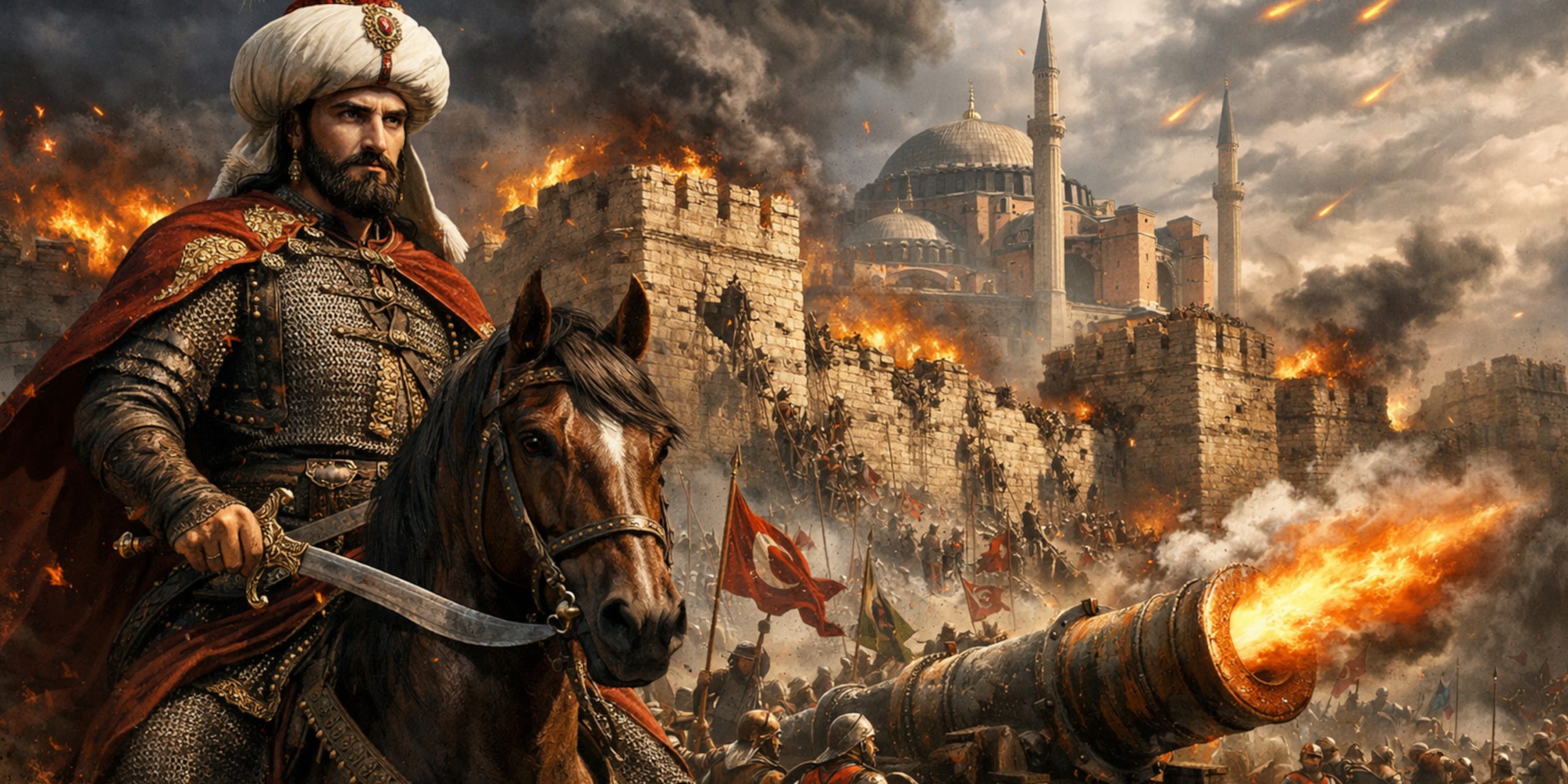
He commissioned massive bombards from the Hungarian engineer Orban. These guns battered the Theodosian Walls, which had resisted armies for a thousand years. He transported ships overland into the Golden Horn to bypass the defensive chain. He maintained relentless pressure for weeks.
On 29 May 1453, the city fell.
The psychological impact was enormous. A medieval Christian capital became the new Ottoman seat, soon known as Istanbul. Mehmed styled himself Kayser i Rum, Caesar of Rome, and he meant it.
Major Battles and Military Acumen
Mehmed’s career did not end at Constantinople. It barely began there.
Key Campaigns
- 1456, Siege of Belgrade. A rare setback against Hungarian forces led by John Hunyadi.
- 1461, Conquest of Trebizond, ending the last Byzantine successor state.
- 1463 to 1479, War with Venice, consolidating control over the Aegean and Adriatic.
- 1473, Battle of Otlukbeli, decisive victory over Uzun Hasan of the Aq Qoyunlu.
Military Strengths
- Mastery of siege warfare and artillery integration.
- Effective use of the Janissary corps as disciplined infantry.
- Strategic naval development to challenge Venetian sea power.
- Ruthless administrative reforms to secure conquered territories.
He understood that conquest without consolidation was folly. Fortresses were repaired, populations resettled, tax systems standardised. His empire did not merely expand. It absorbed.
Arms and Armour
The military machine under Mehmed reflected a transitional age, where gunpowder and traditional arms coexisted.
Offensive Weapons
- Kilij, a curved sabre suited for cavalry charges.
- Straight double edged swords influenced by earlier Islamic and Byzantine forms.
- Composite bows, still formidable in trained hands.
- Early handguns and large bombards in siege contexts.
Defensive Equipment
- Mail and plate combinations for elite troops.
- Turban helmets with fluted designs.
- Shields of wood and leather for infantry.
Mehmed himself would have worn high quality mail and plate with silk garments beneath, both for protection and symbolism. Ottoman sultans did not fight recklessly, but they projected martial authority. Image mattered.
Governance and Cultural Policy
Mehmed rebuilt Constantinople as an imperial capital. He sponsored mosques, markets, and educational institutions. The Topkapi Palace complex emerged as the political heart of the empire.
He also invited Greek scholars, Armenian merchants, Jewish refugees from Iberia, and Italian artists. Gentile Bellini painted his portrait. That painting alone tells you something about his self perception. He was no provincial warlord.
His legal reforms strengthened central authority. The devshirme system expanded, feeding talent into the Janissary corps and bureaucracy. It was harsh, yet effective.
Where to See Artefacts from His Reign
For those who wish to see tangible remnants of his era:
- Topkapı Palace houses imperial weapons, armour, and manuscripts associated with his court.
- Istanbul Archaeology Museums display material culture from the conquest period.
- National Gallery holds the Bellini portrait of Mehmed II.
Standing before these objects, one feels the weight of ambition made metal and stone.
Latest Archaeological Findings
Recent excavations in Istanbul, particularly around the Theodosian Walls and the Yenikapı area, have revealed layers of Byzantine and early Ottoman occupation. Shipwrecks discovered during Marmaray tunnel works offer insight into the maritime world Mehmed sought to dominate.
Archaeologists continue to reassess the scale of artillery used in 1453. Surviving cannon fragments and casting sites suggest an industrial effort larger than once believed.
There is also renewed study of early Ottoman palace foundations, refining our understanding of how rapidly Mehmed reshaped the city’s urban fabric.
Death and Succession
Mehmed died in 1481 during preparations for another campaign, possibly against Italy or the Mamluks. The exact target remains debated. He was forty nine.
His son Bayezid II succeeded him after a brief power struggle.
The empire he left was centralised, wealthy, and feared.
Legacy
Mehmed II altered the geopolitical map of Europe and the Near East. The fall of Constantinople redirected trade routes, influenced Renaissance thought, and solidified Ottoman dominance in the Balkans and Anatolia.
As a historian, I find him difficult to categorise. He was both destroyer and builder. A patron of art who commanded massacres. A scholar who wielded cannon.
History does not require us to admire him. It does require us to understand him. And in understanding Mehmed II, we grasp the moment the medieval world tipped into something new.