Claude Louis Hector de Villars, later Duc de Villars, stands among the most capable commanders of the reign of Louis XIV. He did not possess the early glamour of Condé or the icy method of Turenne, yet when France was exhausted, invaded, and close to collapse during the War of the Spanish Succession, it was Villars who steadied the line.
He was ambitious, undeniably vain, and sometimes difficult with his peers. He was also resilient, pragmatic, and tactically inventive. As a historian, I find him fascinating precisely because he was not a flawless hero. He was a survivor in a brutal political and military system, and survival in Louis XIV’s court was half the battle.
Early Life and Rise to Command
Born in 1653 into a modest Provençal noble family, Villars entered military service young. He fought in the Franco Dutch War under Turenne and quickly learned the importance of mobility, terrain, and disciplined infantry.
His ascent was not smooth. He lacked the aristocratic sheen of some rivals and made enemies at court. Yet he combined political instinct with military competence. During the Nine Years’ War, he proved himself in Germany and earned promotion. By the outbreak of the War of the Spanish Succession in 1701, he was ready for independent command.
The War of the Spanish Succession
The War of the Spanish Succession tested France to breaking point. Coalition forces under commanders such as John Churchill, 1st Duke of Marlborough and Prince Eugene of Savoy repeatedly defeated French armies in the field.
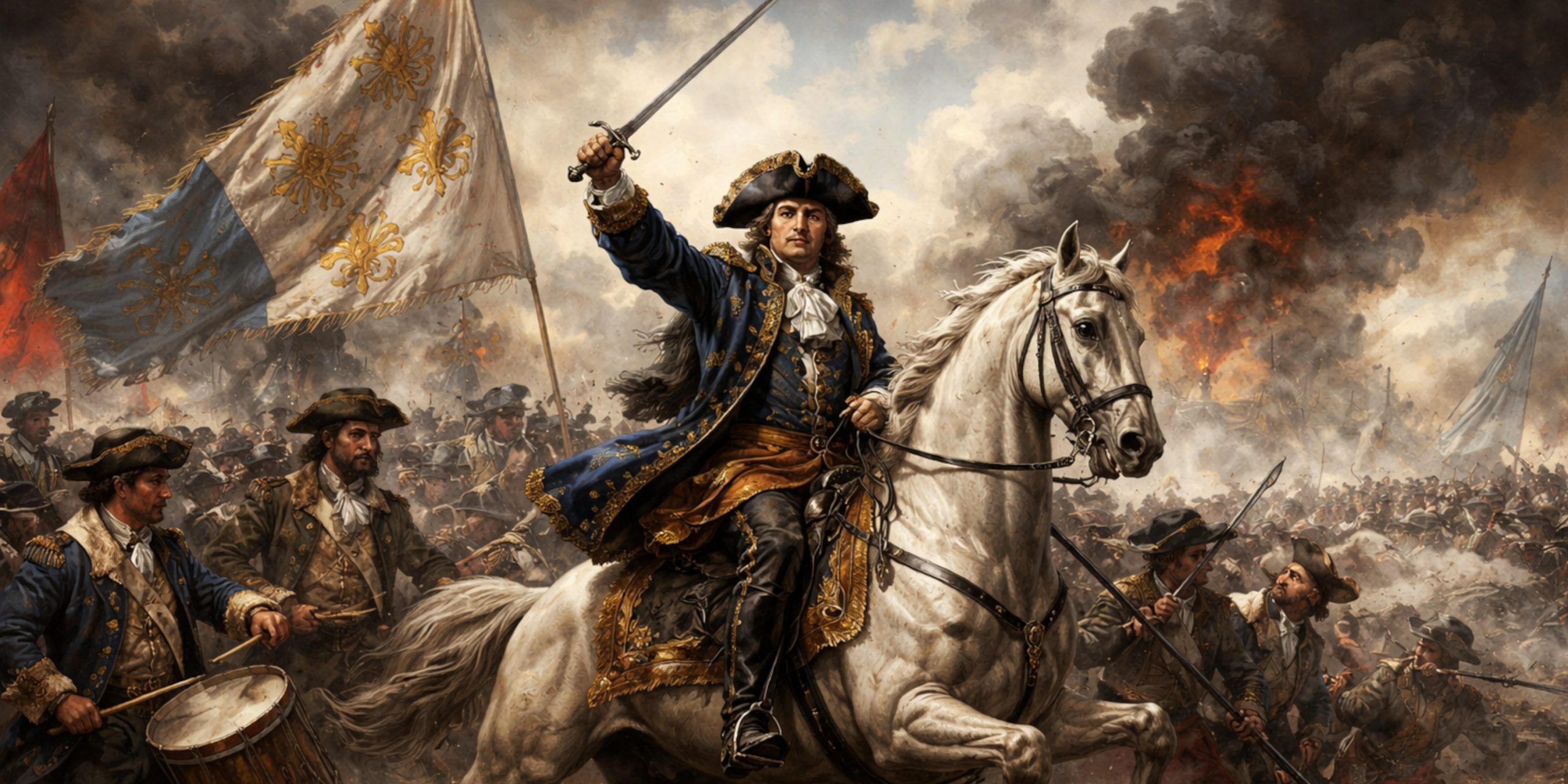
Villars’ early campaign in Germany ended in controversy, but he redeemed himself spectacularly in 1709 at the Battle of Malplaquet. Though technically a defeat, he inflicted such severe casualties on Marlborough’s army that the Allied advance stalled. Malplaquet marked a psychological turning point. France was battered, yet not broken.
In 1712 at Denain, Villars struck decisively. Exploiting overextended Allied lines, he defeated Prince Eugene and reversed French fortunes in Flanders. Denain is often overlooked, but strategically it helped bring about negotiations that culminated in the Treaty of Utrecht.
Major Battles
Battle of Friedlingen, 1702
A bold and aggressive engagement on the Rhine. Villars showed willingness to attack superior forces, a trait that defined his style.
Battle of Malplaquet, 1709
Often labelled a French defeat, yet the Allied losses were staggering. Villars was wounded, reportedly declaring that one more such victory would ruin the enemy. He understood morale and perception as much as manoeuvre.
Battle of Denain, 1712
A masterstroke. Villars attacked isolated Allied positions, broke through, and restored French confidence. It was a reminder that boldness, carefully timed, can change a war.
Military Acumen
Villars was not a rigid theorist. He adapted to circumstances.
- He favoured offensive action when morale demanded it.
- He made careful use of field fortifications when resources were thin.
- He understood logistics and supply in an era when armies could starve faster than they could be defeated.
- He maintained discipline without crushing initiative.
Unlike some contemporaries, he did not chase glory at the expense of strategic necessity. Denain was not dramatic in the way Blenheim was, yet it was decisive.
His weakness lay in temperament. He could be boastful and thin skinned. Court politics mattered in Louis XIV’s France, and Villars played that game as vigorously as he fought in the field.
Arms and Armour of Villars’ Armies
By Villars’ era, warfare had shifted decisively toward firearms and disciplined line infantry.
Infantry Equipment
- Flintlock muskets with socket bayonets
- Infantry swords, often hanger style sidearms
- Tricorn hats replacing earlier broad brimmed styles
- Buff coats largely abandoned, though some officers retained decorative cuirasses
Cavalry Equipment
- Heavy cavalry with cuirasses and helmets, particularly in elite units
- Straight cavalry swords designed for thrusting
- Pistols carried in holsters at the saddle
Artillery was increasingly central. Villars understood the importance of coordinated infantry, cavalry, and guns, particularly in fortified environments in Flanders.
Armour had become more symbolic than practical for many officers. Commanders dressed richly, but the age of full battlefield plate had long passed.
Artefacts and Where to See Them
Artefacts linked to Villars and his campaigns can be found in several institutions.
- The Musée de l’Armée holds weapons, uniforms, and campaign material from the reign of Louis XIV, including pieces associated with the War of the Spanish Succession.
- The Château de Versailles preserves portraits and archival material connected to senior marshals of the Sun King.
- Regional museums in Flanders and northern France contain artefacts recovered from Denain and surrounding battlefields.
Personal items directly attributed to Villars are rarer. Like many commanders of his rank, much of his legacy is preserved through documents, portraits, and regimental relics rather than intimate battlefield objects.
Latest Archaeology
Battlefield archaeology at Malplaquet and Denain has yielded musket balls, uniform buttons, fragments of equipment, and mass burial sites. Modern forensic work has helped scholars understand casualty patterns and the brutal density of close range musket fire.
Studies of ballistics from Malplaquet suggest prolonged, intense firefights at surprisingly short distances. It reinforces contemporary accounts of the carnage. War in 1709 was not an elegant chess match. It was mud, smoke, and human endurance stretched to breaking point.
Final Years and Legacy
Villars survived Louis XIV and remained influential during the Regency. He died in 1734 after yet another campaign, still serving France in his eighties. Longevity alone commands respect.
His reputation fluctuated. For a time he was overshadowed by Marlborough and Prince Eugene in anglophone histories. French scholarship has long recognised Denain as a pivotal moment. Today, many historians view him as one of the most capable defensive commanders of his generation.
If Turenne was the model of disciplined brilliance, Villars was the man who held France together when brilliance was no longer enough.
Takeaway
Marshal Villars was ambitious, occasionally exasperating, and undeniably talented. He thrived in a system that rewarded both skill and political survival. His campaigns illustrate the transition of European warfare into a modern, gunpowder dominated era, where coordination and logistics mattered as much as personal courage.
As a historian, I admire his stubborn refusal to accept defeat as inevitable. In 1709 France looked finished. In 1712 it stood upright again. That recovery bears his imprint.
He may not command the instant recognition of Marlborough, but without Villars the story of Louis XIV’s final decades would have ended very differently.