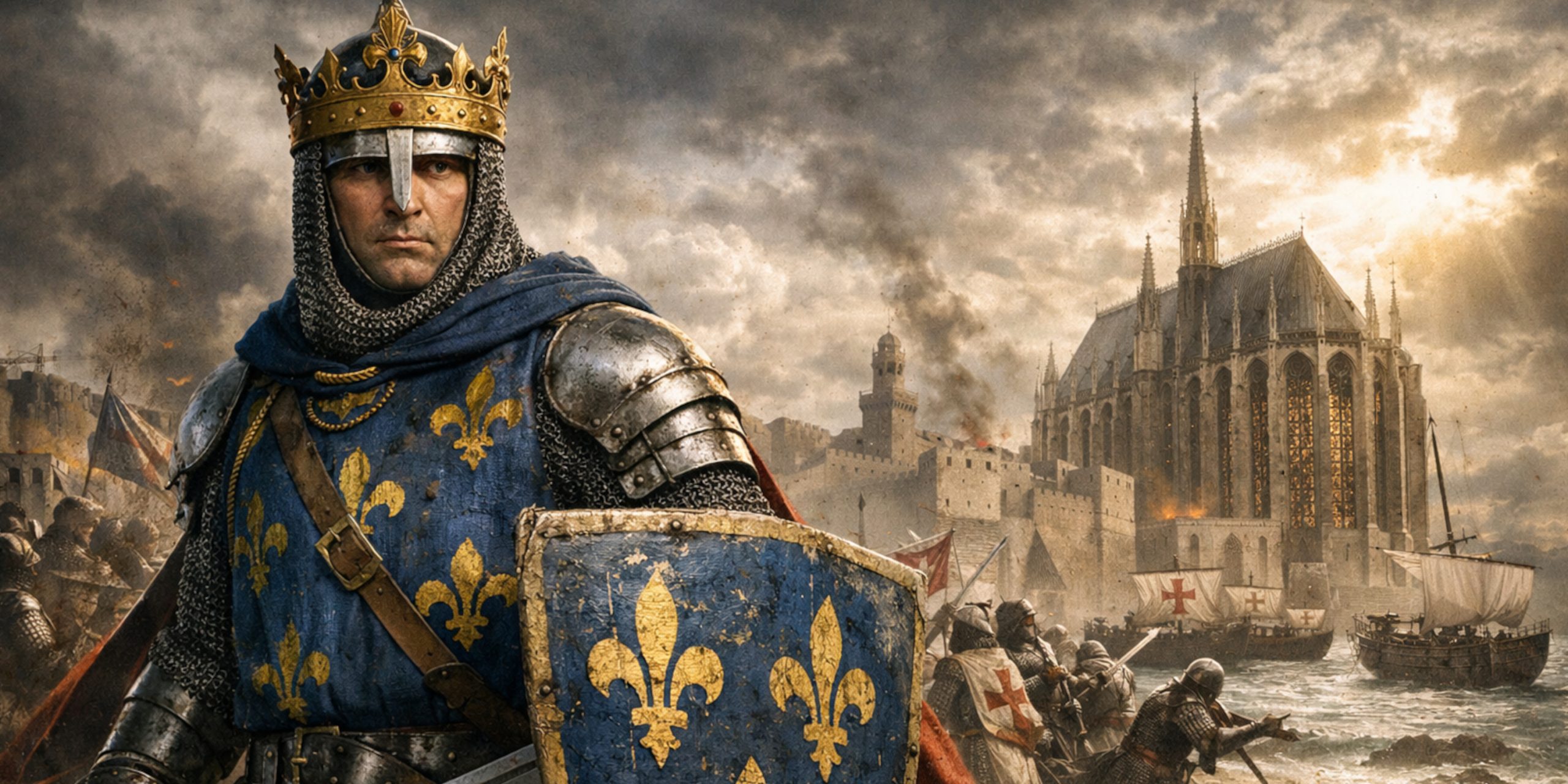
Few medieval kings leave such a conflicted record. Louis IX was both an exacting ruler and a devout ascetic, a man who built courts and chapels with equal seriousness, and who carried the French crown deep into the eastern Mediterranean twice with stubborn conviction. He is remembered as Saint Louis, yet his reign also exposes the limits of piety when pressed into war. As a historian, I find him compelling not because he was flawless, but because he was consistent to a fault.
Early Life and Kingship
Born in 1214, Louis inherited the throne at the age of twelve. His mother, Blanche of Castile, governed as regent and deserves far more credit than she usually receives. She crushed revolts, steadied royal authority, and shaped her son into a ruler who believed kingship was a moral vocation rather than a privilege.
When Louis assumed full power in the 1230s, France was already stronger than under his predecessors. He did not waste that inheritance. Instead of chasing glory at home, he focused on justice, administration, and the crown’s moral standing. Royal courts expanded, private warfare was curbed, and appeals increasingly flowed to the king. His reputation as a fair judge was not mythmaking. Contemporary sources reflect real confidence in royal justice, which was no small achievement in a feudal world.
Arms and Armour
Louis was no armchair monarch. He trained, hunted, and fought as a mounted knight, equipped in the best fashion of mid thirteenth century France.
His arms and armour reflected both status and practicality.
- Helmet: early great helm or reinforced cervelliere beneath mail
- Body armour: full mail hauberk with coif and chausses, padded gambeson beneath
- Shield: large heater shield bearing the Capetian fleurs-de-lis
- Primary sword: a straight, double edged knightly arming sword of Oakeshott Type XII or XIII, optimised for cutting with competent thrusting ability
- Secondary arms: lance for mounted combat, mace or dagger for close fighting
What stands out is not innovation but reliability. Louis did not favour exotic weapons or experimental kit. His equipment matched his temperament. Solid, orthodox, and intended to endure long campaigns rather than dazzle on a tournament field.
Battles and Military Acumen
Louis IX’s military record is inseparable from the Crusades, and this is where admiration must sit alongside criticism.
The Seventh Crusade
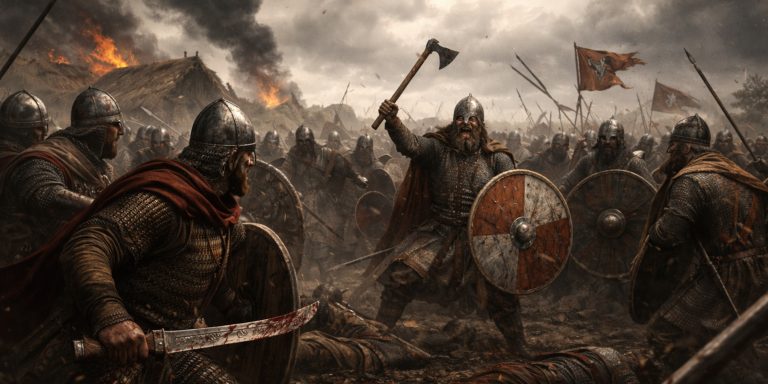
In 1248, Louis led a massive expedition to Egypt, believing that striking the Ayyubid heartland would unlock Jerusalem. The capture of Damietta came easily. The campaign unravelled at Mansurah.
Louis showed courage and discipline, but limited flexibility. He advanced slowly, insisted on strict moral order in camp, and underestimated logistical strain. The result was catastrophe. French forces were mauled, disease ravaged the army, and Louis himself was captured. Few kings in medieval Europe experienced such public humiliation.
To his credit, he negotiated calmly, paid the ransom, and spent years in the Levant strengthening remaining Crusader holdings. It was sensible work, though too late to redeem the campaign.
The Eighth Crusade
His final expedition in 1270 targeted Tunis, driven by a mix of strategy and misplaced hope of conversion. The army never fought a major battle. Disease struck again, and Louis died outside Carthage.
From a military perspective, Louis was brave, conscientious, and stubborn. He lacked the opportunism of a great battlefield commander. His strength lay in endurance and moral authority rather than tactical brilliance. One suspects he would have been a far more effective general had he lived a century later, when logistics and administration mattered as much as swordplay.
Governance, Law, and Faith
Away from the battlefield, Louis excelled. He issued reforms limiting feudal courts, outlawed trial by ordeal, and expanded written law. He famously held open air justice sessions, listening directly to subjects. Whether every story is true matters less than the fact that people believed them.
His piety shaped policy. He protected Jews from mob violence, even while enforcing restrictive laws that modern readers rightly criticise. He funded hospitals, ransomed captives, and lived with deliberate simplicity. His court was not joyless, but it was restrained. Gambling, blasphemy, and excess were discouraged. Courtiers grumbled. The kingdom benefited.
Artefacts and Where to See Them
Material remains from Louis IX’s reign are unusually rich.
- Sainte-Chapelle, Paris: commissioned by Louis to house the Crown of Thorns, still one of the clearest expressions of royal piety ever built
- Treasury of Notre-Dame, Paris: associated relics and liturgical objects from his reign
- Louvre Museum: manuscripts, seals, and sculpture connected to Capetian kingship
- Bibliothèque nationale de France: illuminated crusade manuscripts and royal ordinances
- Basilica of Saint-Denis: royal necropolis, though Louis’s tomb suffered during later upheavals
These objects reinforce a key truth. Louis invested in permanence. Stone, parchment, and glass were his preferred monuments, not triumphal arches.
Archaeology and Recent Research
Modern archaeology has refined our understanding of Louis’s campaigns.
Excavations around Mansurah have clarified the battlefield layout and river crossings that trapped the French army. Bioarchaeological studies from crusader burial sites in the eastern Mediterranean reveal high rates of disease and malnutrition, supporting contemporary accounts of logistical failure.
In France, architectural analysis of Sainte-Chapelle continues to uncover construction techniques that pushed Gothic design to its limits. Louis did not merely fund art. He drove innovation through patronage, with results that still dominate Paris’s skyline.
Legacy and Final Thoughts
Louis IX remains a paradox. He was canonised for holiness, admired for justice, and criticised for military failure. All three are deserved.
As a ruler, he strengthened the French monarchy without cruelty. As a crusader, he clung to ideals long after circumstances had changed. As a man, he believed that a king should answer to God before history. That belief carried France forward in law and administration, even as it led him into disastrous wars.
If there is dry humour to be found, it is this. Louis spent his life trying to impose moral order on an untidy world, and the world responded by reminding him, repeatedly, that it had other plans.
Watch the documentary: