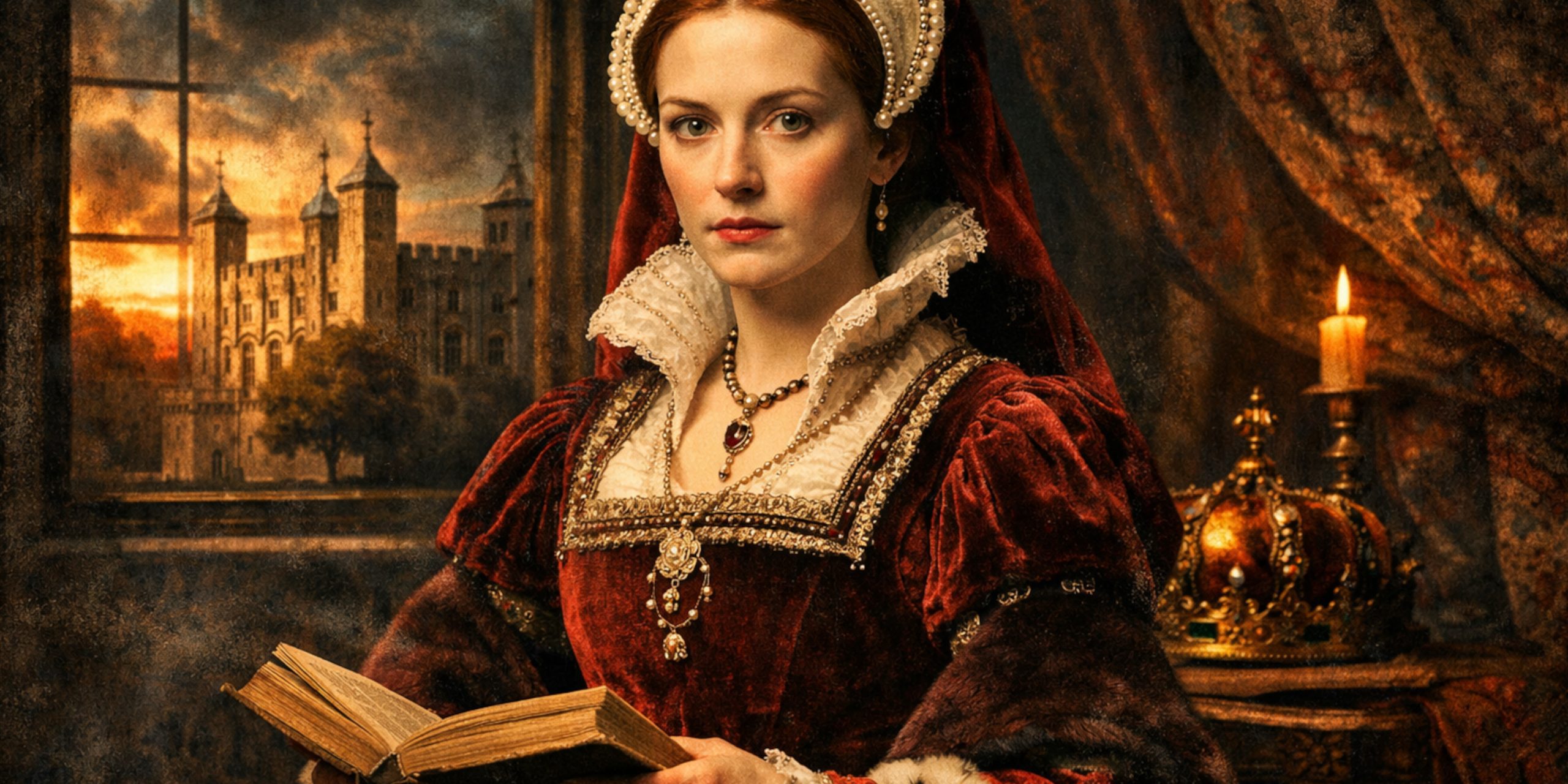
Lady Jane Grey has always seemed oddly out of place in Tudor history
The Tudor story is crowded with larger-than-life figures. Henry VIII stomps through it like an angry giant in silk. Elizabeth I arrives wrapped in theatre, politics and carefully arranged portraits. Mary I still divides people faster than almost any Tudor monarch.
Then there is Lady Jane Grey.
She appears suddenly, reigns for nine bewildering days, loses everything almost immediately, and dies at just seventeen. For centuries she has been presented as Tudor history’s tragic girl heroine, all pale dresses, prayer books and doomed innocence. It is a tidy story. Perhaps a little too tidy.
Jane mattered because her brief reign exposed the deepest fault lines of Tudor England. Religion, succession, noble ambition and the dangerous habit Tudor monarchs had of leaving things complicated all collided around her. She was not simply a footnote. She became the point where everything cracked.
Who was Lady Jane Grey?
Lady Jane Grey was born in October 1537, the eldest daughter of Henry Grey, Marquess of Dorset, later Duke of Suffolk, and Frances Brandon.
Her claim to the throne came through her mother. Frances was the daughter of Mary Tudor, Queen of France, who was Henry VIII’s younger sister. That made Jane Henry VIII’s great-niece.
Jane was therefore close enough to the royal line to matter, particularly once Henry VIII’s only legitimate children, Edward, Mary and Elizabeth, all remained unmarried and childless.
Under Henry VIII’s will, the succession after Edward, Mary and Elizabeth was supposed to pass to the descendants of his younger sister Mary Tudor. Jane therefore stood surprisingly near the front of the queue, although not quite at the front. Technically, her mother Frances had the stronger claim.
That small detail was inconvenient for ambitious men who wanted a teenage Protestant queen they could influence more easily than a grown woman with opinions of her own.
Which, if one is being honest, was very much the Tudor approach to politics.
Jane’s education and reputation
Jane Grey was one of the most highly educated women of her age. She studied Latin, Greek and Hebrew, and could also read Italian and French. Humanist scholars admired her, and she was praised for her intelligence and seriousness.
The scholar Roger Ascham famously visited her in 1550 and found her reading Plato in Greek while the rest of the household was out hunting. Jane told him she preferred study to the entertainments of court because learning brought her more pleasure than “all their sport in the park”.
It is an image historians have never quite been able to resist. There is something almost painfully Tudor about it: a brilliant girl quietly reading Greek while everyone else is off chasing deer and making bad political decisions.
Jane was also a committed Protestant. This mattered enormously. By the final years of Edward VI’s reign, religion had become inseparable from politics. Edward and his leading advisers wanted England to remain firmly Protestant. Mary, Edward’s elder half-sister, was openly Catholic.
To Protestant nobles, Mary represented not merely a different ruler but the possible destruction of everything they had built since Henry VIII broke with Rome.
Why Lady Jane Grey became queen
By 1553 Edward VI was dying, probably from tuberculosis. He was only fifteen.
Edward did not want his Catholic half-sister Mary to succeed him. Neither did John Dudley, Duke of Northumberland, the most powerful man in England and effectively Edward’s chief minister.
Northumberland persuaded Edward to alter the succession. Instead of allowing Mary, and then Elizabeth, to inherit according to Henry VIII’s will, Edward named Lady Jane Grey as his heir.
There were several reasons for choosing Jane:
- She was Protestant.
- She had a plausible royal claim.
- She had recently married Guildford Dudley, Northumberland’s son.
- She was young and could probably be controlled.
The marriage to Guildford Dudley took place in May 1553. It was not a romantic match. Tudor aristocratic marriages rarely were. They were closer to business mergers, except with more velvet and significantly worse consequences when they failed.
When Edward died on 6 July 1553, Jane was informed that she was now queen.
According to later accounts, she was horrified.
Jane reportedly burst into tears and insisted she had no right to the crown. Whether this happened exactly as described is impossible to know. Tudor writers adored a dramatic scene. Still, there is good reason to think Jane had little enthusiasm for becoming queen. She understood perfectly well how dangerous the situation was.
The Nine Days Queen
Jane was proclaimed queen on 10 July 1553.
Her reign lasted only nine days.
The problem with Jane’s claim
Jane’s position was weak from the beginning.
Henry VIII’s will had named Mary as Edward’s successor. Parliament had recognised that arrangement. Most people in England, even many Protestants, believed Mary had the better legal claim.
Mary moved quickly. She gathered supporters in East Anglia and presented herself as the rightful queen. Nobles, local gentry and ordinary people rallied to her cause.
Jane, meanwhile, remained in the Tower of London, where new monarchs traditionally stayed before their coronation. It must have felt less like a palace and more like a waiting room full of increasingly nervous men pretending everything was under control.
Northumberland marched out to stop Mary, but his support collapsed almost immediately. Several members of Jane’s council abandoned her and declared for Mary.
On 19 July 1553, Mary was proclaimed queen in London.
Jane’s reign was over before many people had fully grasped that it had begun.
Was Lady Jane Grey a victim or a participant?
This is the central question.
For centuries Jane was treated almost entirely as a victim. Protestant writers after her death portrayed her as an innocent martyr, forced into a crown she never wanted. Victorian historians took this even further. They turned Jane into a saintly child, trapped by ruthless adults.
There is truth in that picture. Jane was certainly manipulated by her father, Northumberland and the men around her. She was young, isolated and had very little power.
Yet Jane was not completely passive.
She had strong religious convictions and understood the political stakes. She knew that accepting the throne meant displacing Mary. During her short reign she resisted attempts to make her husband king, which suggests she was capable of independent judgement.
Jane may not have chosen the situation, but once she was in it she acted with more determination than people sometimes allow.
She was both a victim and a participant. Tudor history is inconveniently untidy like that.
Lady Jane Grey in the Tower
After Mary became queen, Jane and Guildford Dudley were imprisoned in the Tower of London.
At first Mary did not intend to execute Jane. Mary seems to have regarded her as a misguided girl rather than a genuine rival. Jane had been used by others, and Mary may even have felt some sympathy for her.
The real danger came in early 1554 with Wyatt’s Rebellion.
This uprising attempted to overthrow Mary, partly because of opposition to her planned marriage to Philip of Spain. Some rebels hoped to replace Mary with Jane.
After that, Jane became too dangerous to leave alive.
Mary faced a grim calculation. As long as Jane lived, she could be used by future rebels. Every discontented Protestant noble suddenly had a ready-made alternative queen.
Jane and Guildford Dudley were condemned to death.
The execution of Lady Jane Grey
Lady Jane Grey was executed on 12 February 1554 inside the Tower of London.
She was seventeen years old.
Guildford Dudley was executed first. Jane reportedly saw his body being carried back past her rooms.
Shortly afterwards, she was led to the scaffold.
Contemporary accounts describe Jane as calm and composed. She gave a brief speech in which she accepted that she had broken the law, while insisting that she had never truly sought the crown.
Her final words included a prayer asking God to receive her soul.
The execution itself went badly. Blindfolded, Jane struggled to find the block and cried out, “What shall I do? Where is it?”
It is one of the most haunting moments in Tudor history because it strips away all the politics and symbolism. Suddenly she is not the Nine Days Queen or a Protestant martyr. She is simply a frightened teenager on a scaffold.
And then, almost immediately, she becomes a legend.
Why Lady Jane Grey became a Protestant martyr
After her death, Protestant writers transformed Jane into a symbol.
The most important account appeared in John Foxe’s Acts and Monuments, better known as Foxe’s Book of Martyrs. Foxe presented Jane as the perfect Protestant heroine: learned, pious, courageous and unjustly killed by a Catholic regime.
This image proved remarkably powerful.
For generations, Jane became part of a larger Protestant story about suffering and persecution under Mary I. She appeared in paintings, poems, novels and plays. Nineteenth-century artists particularly adored her. They painted her as luminous, delicate and almost absurdly tragic, usually dressed in white and surrounded by gloomy men who looked as though they had wandered in from a Victorian melodrama.
The famous painting by Paul Delaroche, The Execution of Lady Jane Grey, did more than almost any history book to shape her image. It is moving, theatrical and not especially accurate, which rather sums up the way Jane has often been remembered.
Lady Jane Grey’s real place in Tudor history
Jane never governed England. She issued very few proclamations and made almost no political decisions.
So why does she still matter?
Because her story reveals how fragile the Tudor monarchy really was.
The Tudors often look solid in hindsight. Henry VII founded the dynasty. Henry VIII dominated it. Elizabeth I finished it in glory. Yet beneath the surface the dynasty was alarmingly unstable.
The succession was uncertain. Religion divided the country. Noble families schemed constantly. A teenage girl could be placed on the throne for nine days because a handful of powerful men thought they could rearrange the monarchy to suit themselves.
Jane’s brief reign also showed that public support mattered. Mary won because more people believed she had the legitimate claim. Even in Tudor England, raw political force was not always enough.
Jane also occupies an unusual place in the history of women and power. She was intelligent, highly educated and politically aware, yet she had almost no control over her own life. The men around her repeatedly made decisions on her behalf, first her father, then Northumberland, then her husband’s family.
And yet, in the final months of her life, she found a kind of authority in her own words and beliefs. The letters she wrote from prison are thoughtful, defiant and unexpectedly mature.
Jane did not shape Tudor history because she ruled.
She shaped it because her rise and fall exposed everything that was dangerous, unstable and deeply human about the Tudor world.
My own view of Lady Jane Grey
The older I get, the less interested I become in the question of whether Jane was innocent or ambitious. Tudor people were rarely allowed the luxury of being only one thing.
Jane seems to me intelligent, serious and rather sharper than many of the men who tried to use her. She understood the world she lived in, even if she could not escape it.
There is also something deeply frustrating about her story. One cannot help wondering what might have happened had she been born in a less spectacularly dangerous family. She might have become a scholar, a writer or one of the great intellectual women of the sixteenth century.
Instead she became famous for nine days and died before she was old enough to make sense of any of it.
Tudor history has a habit of swallowing people whole. Jane Grey is perhaps the clearest example.
Takeaway
Lady Jane Grey’s place in Tudor history is far larger than the length of her reign would suggest.
She was the last desperate attempt to preserve Edward VI’s Protestant England. She was the victim of noble ambition, but she was also a committed believer in the cause she represented. Her fall secured Mary I’s throne and shaped the religious struggles that would continue throughout the Tudor period.
Most of all, Jane endures because her story still feels painfully human. She was clever, frightened, stubborn, learned, manipulated and brave, sometimes all at once.
That is far more interesting than the old myth of the helpless girl in white.
History rarely gives us saints. It occasionally gives us people who deserved better.