Early Life and the Making of a Navigator
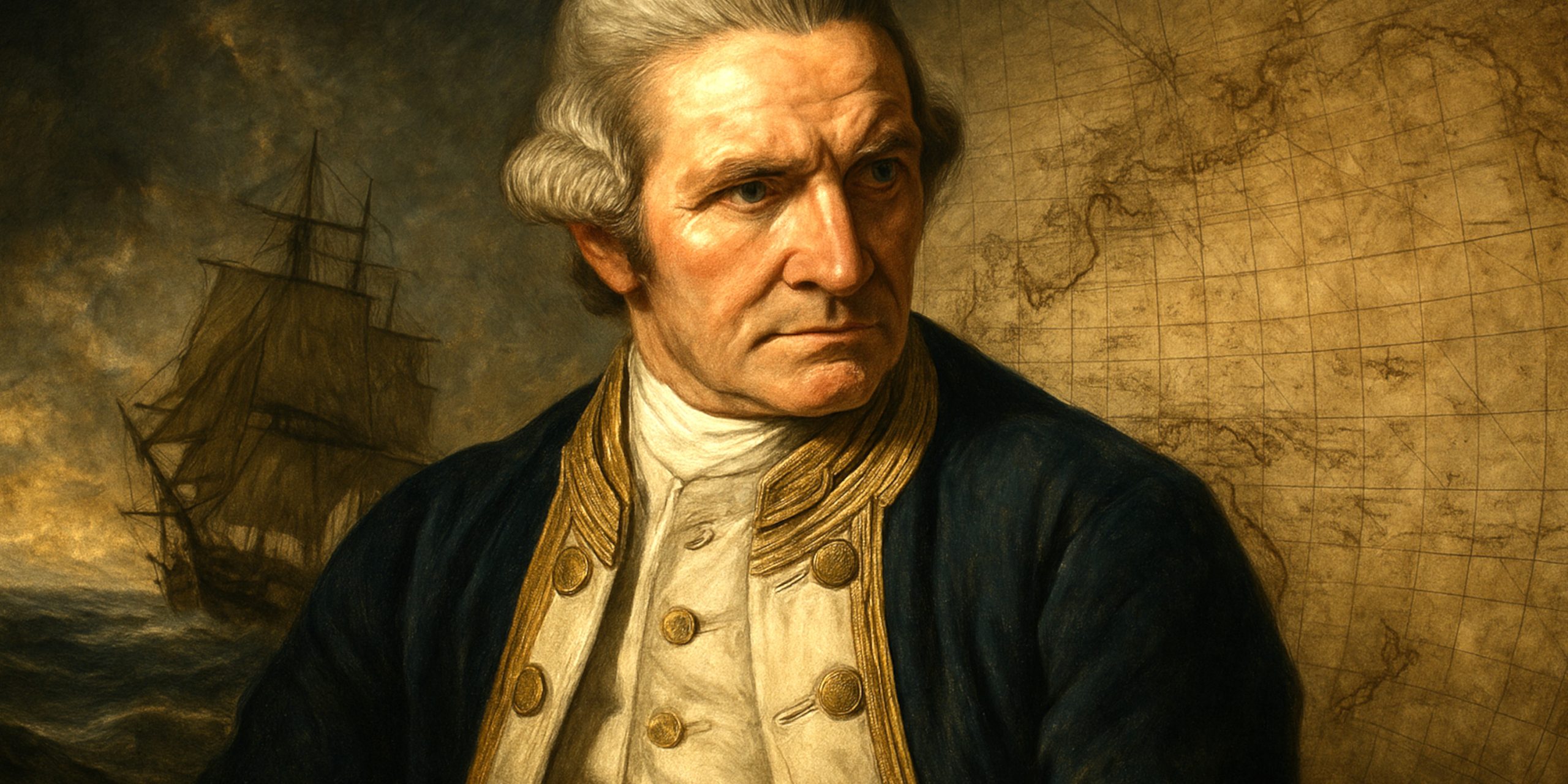
There is something oddly reassuring about James Cook’s beginnings. No gilded cradle, no aristocratic patron at his shoulder. He was born in 1728 in the village of Marton in Yorkshire, the son of a farm labourer who worked hard enough to give his bright child a chance at something more. Cook’s early years were shaped by the quiet discipline of northern coastal life. He learned mathematics and practical seamanship while working in Whitby’s coal trade, which has none of the glamour of tall ships and far horizons but teaches patience, steady nerves and how to survive weather that seems personally offended by your existence.
This careful technical grounding made him stand out when he joined the Royal Navy in 1755. His talent for surveying became obvious during the Seven Years War, not least in his charts of Newfoundland which were so sharp and clean you can almost hear the tide running past the rocks.
The Three Voyages
Cook’s first Pacific voyage, beginning in 1768, was the product of Enlightenment curiosity. He was sent to observe the Transit of Venus, though the Admiralty rather conveniently added a sealed set of orders instructing him to search for new lands once the astronomy was done. This mix of science and imperial ambition followed him everywhere.
He reached New Zealand and mapped it with a precision that still impresses any map obsessed historian. Then he turned west and charted the coast of Australia with a certain detachment that suggests he was slightly more focused on reefs than philosophical consequences. Considering how often the Endeavour scraped alarming shallows, one cannot blame him.
The second voyage pushed deep into the southern oceans. Cook proved there was no great southern continent hiding under the fog, much to the disappointment of several mapmakers who had already drawn it. The third voyage, begun in 1776, aimed at finding a northern passage above America. That idea had tempted Europe for centuries. It still managed to lure Cook into an increasingly tense set of encounters across the Pacific, ending in Hawaii in 1779 where a dispute spiralled out of control and he was killed on the shoreline at Kealakekua Bay.
Encounters, Consequences and the Human Story
Cook’s voyages opened geographical understanding on a scale few individuals have matched. Yet they also sit in the long shadow of European expansion. Encounters with Indigenous peoples were complex, often respectful at first, then strained as imperial expectations followed the ships into every harbour. Some communities gained new knowledge and new opportunities, while others faced loss, disease and disruption.
A modern historian cannot pretend otherwise. Cook was a gifted navigator and surveyor with a scientific mind, but his journeys were never isolated from the political and cultural pressures of the century that sent him out. To study him properly is to walk a tightrope between admiration for his skill and a clear view of the consequences that rippled out from his charts.
Legacy and How We Use It
Cook’s name is carved into ships, coastlines and schoolhouses across the world. His journals remain a rich source for anyone curious about early scientific exploration. His maps shaped navigation long after his death. At the same time, his reputation is debated more fiercely than ever. That debate is healthy. It stops us slipping into hero worship and forces us to treat history like the untidy and contested field it truly is.
I find Cook an intriguing figure. He worked with meticulous care, worried constantly about the safety of his crew, respected scientific inquiry, yet still carried the assumptions of his age across the ocean. In a way, he represents both the best and the most troubling aspects of eighteenth century exploration.
Seven Swords Takeaway
James Cook’s life is a reminder that history rarely offers neat categories. He transformed global knowledge and left a trail of consequences that communities are still navigating today. For a historian, he is a challenging subject, which is precisely what makes him worth returning to.