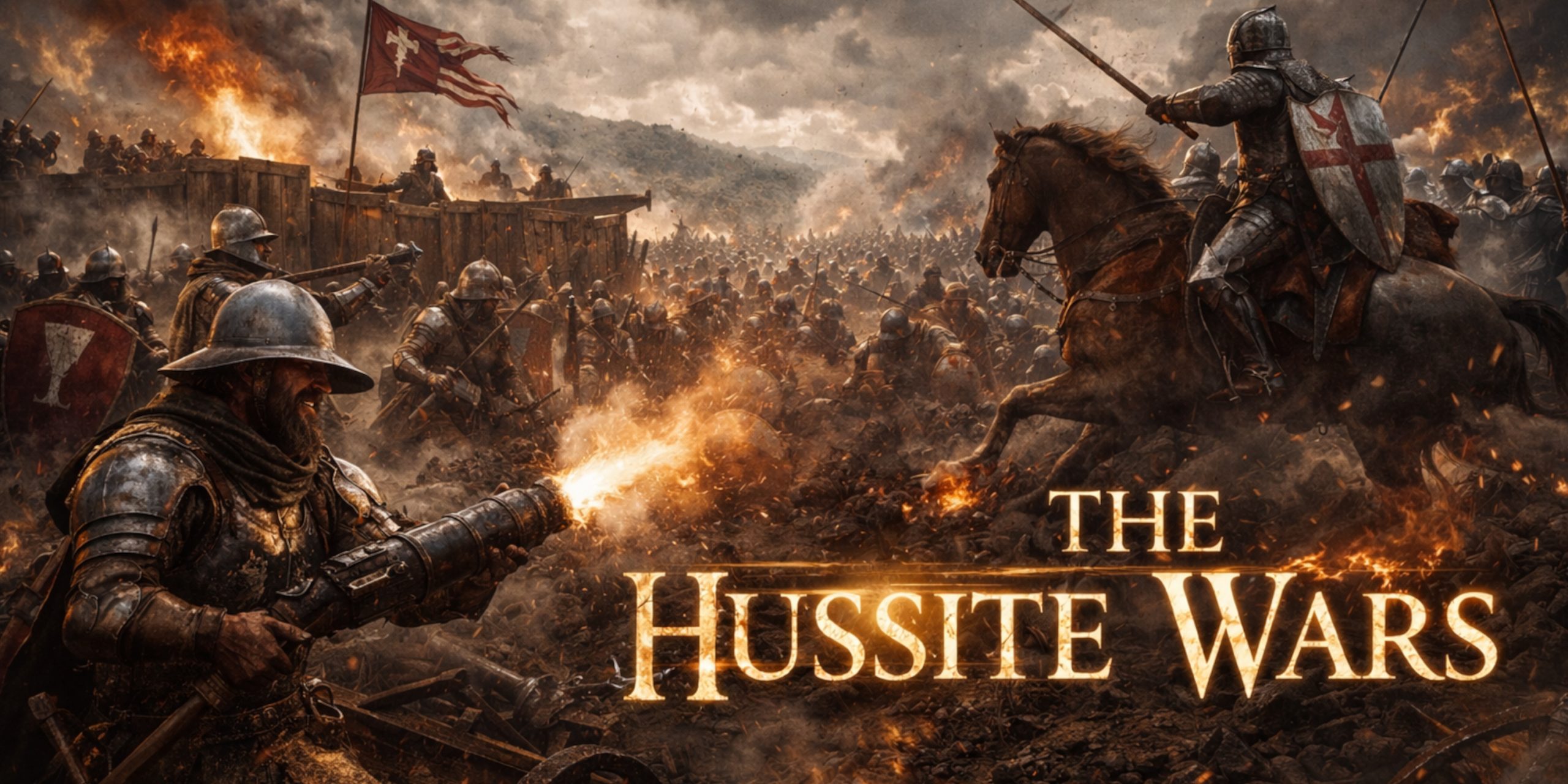
The Hussite Wars remain one of the most unusual conflicts of the late Middle Ages. They were religious wars, certainly. Yet they were also something more radical. A small kingdom in central Europe managed to defeat repeated crusades launched by the most powerful rulers of Christendom.
At the heart of the story lies Bohemia, a land that today forms much of the Czech Republic. In the early fifteenth century it became the centre of a religious uprising inspired by the reformer Jan Hus. What followed was a generation of warfare that transformed military tactics and revealed how gunpowder, discipline and stubborn belief could overturn the traditional dominance of knightly armies.
As a historian, the Hussite Wars have always struck me as one of those moments where the old medieval world visibly cracks. You can almost hear the armour creaking while the wagons roll forward and the handguns start firing.
Background: The Crisis After Jan Hus
The conflict began with the execution of Jan Hus in 1415 at the Council of Constance. Hus had preached church reform, criticised corruption, and argued that scripture should guide the Christian faith more than papal authority.
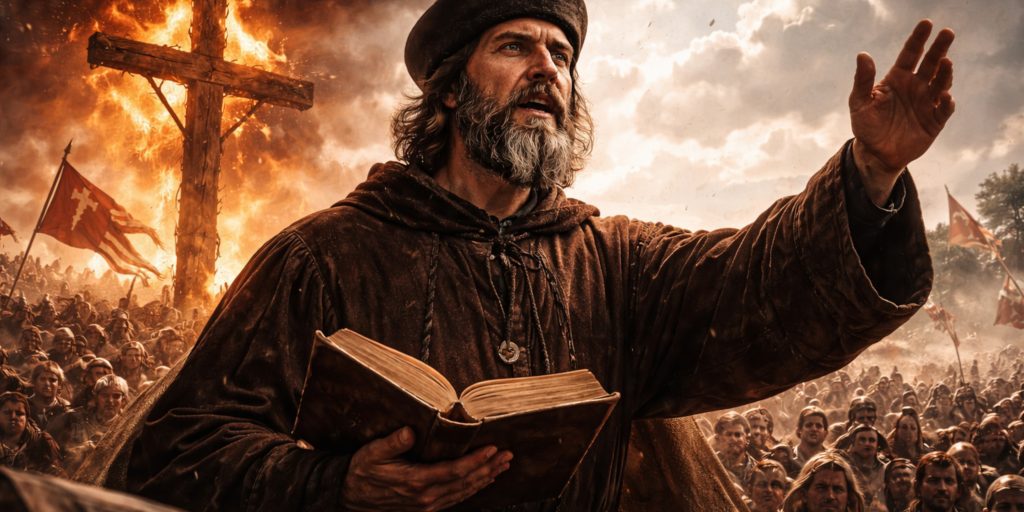
To the Bohemian population he became a martyr.
His death triggered a powerful reform movement that soon blended religion with politics and national identity. Many Czechs resented the dominance of German clergy and nobles within the kingdom. Hus offered both a spiritual cause and a symbol of resistance.
By 1419 tensions erupted into open revolt. A famous episode known as the First Defenestration of Prague saw angry reformers throw several Catholic officials out of a city hall window. Medieval politics was not subtle.
King Wenceslaus IV died soon afterwards. His brother Sigismund, Holy Roman Emperor and a fierce opponent of the Hussites, claimed the Bohemian throne. The stage was set for war.
The Hussite Movement
The Hussites were not a single unified faction. Instead they split into several groups with differing visions for religious reform.
Major Hussite factions
- Utraquists
Moderate reformers who demanded communion in both bread and wine for ordinary believers - Taborites
Radical reformers based in the fortified town of Tábor who promoted sweeping religious and social change - Orphans
A militant faction that emerged after the death of Jan Žižka
Despite their differences, these groups fought together against outside crusading armies. Their survival depended on it.
Leaders and Personalities
Several remarkable figures emerged during the wars.
Jan Žižka was the most famous commander. A veteran soldier who eventually became completely blind, he proved to be one of the most inventive generals of the medieval period. Under his leadership the Hussite armies developed new tactics that stunned their opponents.
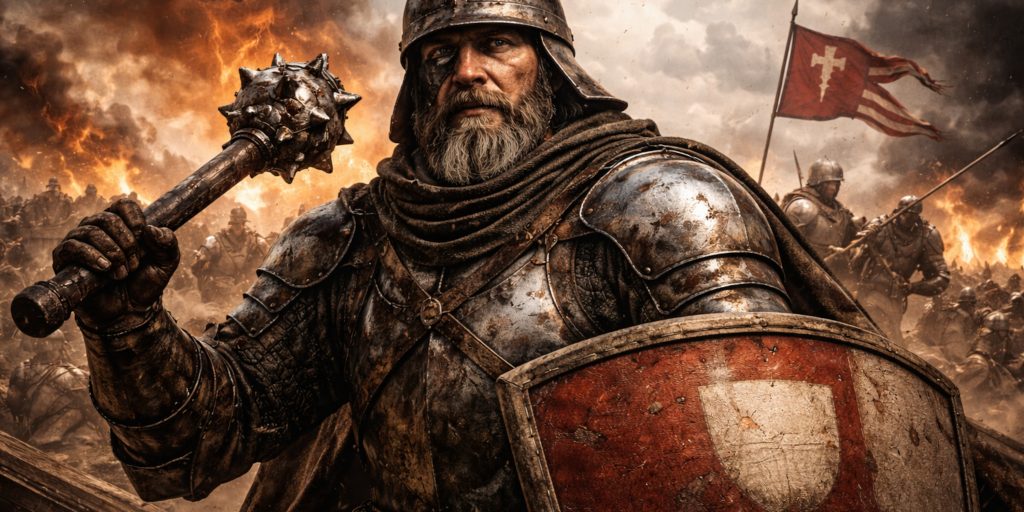
Another important leader was Prokop the Great, who carried the war beyond Bohemia into neighbouring regions during the later phases of the conflict.
On the Catholic side stood powerful rulers such as Sigismund of Luxembourg, supported by crusading contingents from across the Holy Roman Empire and beyond.
Arms and Armour
The Hussite Wars sit at a fascinating transitional point in military technology. Traditional knightly equipment remained common, yet gunpowder weapons were becoming increasingly important.
Common Hussite weapons
- Hand cannons and early firearms
- Crossbows
- Flails adapted from agricultural tools
- Spears and polearms
- Early field artillery
Armour and equipment
- Mail shirts and brigandines
- Kettle helmets and sallets
- Pavise shields
- Reinforced wagon fortifications
The most famous innovation was the wagon fort, known in Czech as the wagenburg. Heavy wagons were chained together to form mobile defensive positions. Inside these makeshift fortresses infantry armed with firearms and crossbows could repel cavalry charges with surprising effectiveness.
To a traditional knight charging into that wall of wagons, the experience must have felt rather like riding into a brick factory.
The Wagon Tactics
The Hussite armies were largely composed of townsmen, peasants and lower nobles. They lacked the heavy cavalry that dominated medieval battlefields.
Instead they turned mobility and coordination into their strengths.
The wagon forts functioned as both defensive positions and moving fortresses. Soldiers could fire from behind cover, while infantry armed with polearms protected the gaps between wagons. When enemy formations broke under gunfire and crossbow bolts, Hussite troops would surge forward to counterattack.
This combination of defence, firepower and sudden assault proved devastating.
Major Battles of the Hussite Wars
Several battles became legendary demonstrations of Hussite tactics.
Battle of Sudoměř (1420)
One of Jan Žižka’s earliest victories. A small Hussite force used marshy ground and wagon defences to defeat a larger crusading army.
Battle of Vítkov Hill (1420)
Hussite defenders held a strategic hill near Prague against an assault by imperial forces. The victory prevented Sigismund from capturing the city.
Battle of Kutná Hora (1421)
Žižka conducted a daring breakout using wagon formations to smash through encircling crusader forces.
Battle of Ústí nad Labem (1426)
A major Hussite victory that destroyed a crusading army and demonstrated the growing power of their military system.
Battle of Lipany (1434)
The war ended with a tragic twist. Moderate Hussites allied with Catholic forces and defeated the radical Taborites. The revolutionary phase of the movement collapsed.
Lipany reminds us that revolutions often consume themselves.
Archaeology of the Hussite Wars
Archaeological research has added valuable insights into the conflict.
Excavations across Bohemia have uncovered:
- Cannonballs and gunstone ammunition
- Fragments of early firearms
- Wagon fittings and chain links used in wagon forts
- Arrowheads and crossbow bolts
- Mass burial sites from battlefields
Battlefield archaeology at sites like Sudoměř and Kutná Hora has confirmed the heavy use of gunpowder weapons. These findings support contemporary accounts describing the loud and terrifying impact of firearms on medieval battlefields.
The evidence suggests the Hussites were among the first European armies to systematically integrate gunpowder into battlefield tactics.
Contemporary Accounts and Quotes
Chroniclers of the time often struggled to comprehend the Hussite victories.
The chronicler Aeneas Silvius Piccolomini, later Pope Pius II, wrote with a mixture of alarm and fascination about the movement:
“Peasants and common men, without armour or noble birth, dared to stand against princes and armies.”
Another chronicler described the psychological effect of Hussite warfare:
“The thunder of their guns and the rumbling of their wagons struck fear into the hearts of many knights.”
Even critics grudgingly acknowledged the effectiveness of the new tactics.
The End of the Conflict
By the 1430s exhaustion and internal divisions weakened the Hussite movement.
Moderate leaders sought compromise with the Catholic Church. Negotiations eventually produced the Compactata of Basel, which granted limited religious concessions to Bohemia.
The radical factions were defeated at the Battle of Lipany in 1434, bringing the main phase of the wars to an end.
Bohemia remained deeply shaped by the conflict for generations.
Legacy of the Hussite Wars
The Hussite Wars left several lasting impacts.
Military influence
- Demonstrated the growing importance of gunpowder weapons
- Showed that disciplined infantry could defeat heavily armoured cavalry
- Influenced later European battlefield tactics
Religious consequences
- Strengthened early movements for church reform
- Anticipated ideas later associated with the Protestant Reformation
Cultural memory
In Czech history the Hussites became symbols of national resistance and religious conviction.
Jan Žižka in particular occupies a legendary place in Czech historical memory. Statues of him still stand across the country, often depicted with the stern determination of a commander who refused to accept defeat.
Takeaway
The Hussite Wars were not the largest wars of medieval Europe. They were not fought by the richest kingdoms or the most famous dynasties.
Yet they revealed something important about the changing nature of warfare.
Knights charging across open fields had dominated European battlefields for centuries. In Bohemia they encountered wagon walls, gunpowder and stubborn infantry who refused to run.
The result was a series of defeats that must have been deeply unsettling to the military elite of the time.
History rarely changes in a single moment. Still, if you were looking for one battlefield where the medieval age began to tilt toward the early modern world, the Hussite Wars would be a strong candidate.