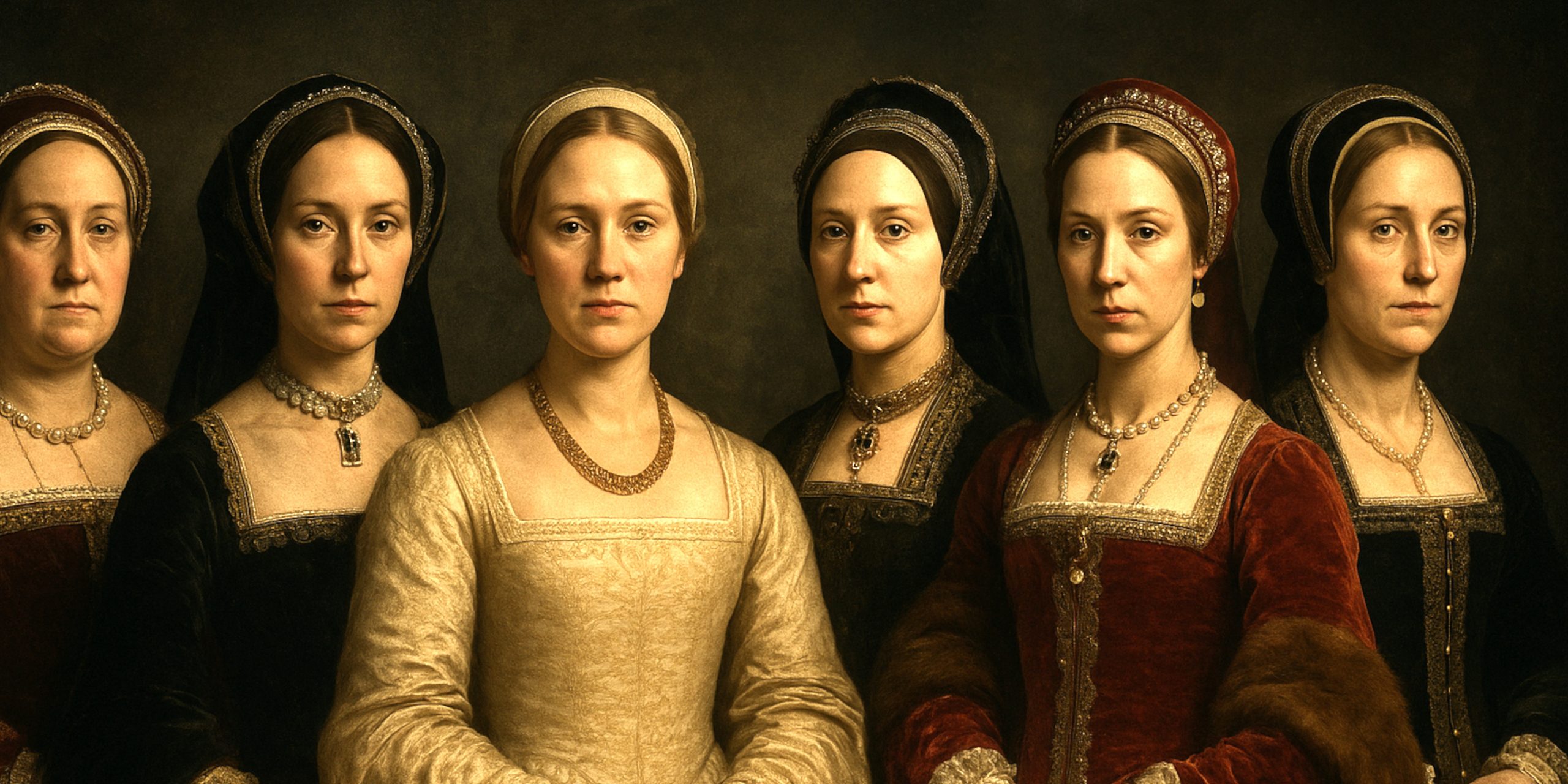
A historian gets used to certain questions. This one rarely leaves the top three. The six wives of Henry VIII remain a sort of national shorthand for Tudor drama. Yet each woman deserves more than a neat rhyme or a lazy bit of pub wisdom. Their stories shaped a kingdom and, in several cases, paid a heavy price for it.
Below is a tour through all six marriages, written with the care the subject demands and with the occasional raised eyebrow that the Tudor court tends to inspire.
Catherine of Aragon
Henry’s first marriage is often treated as prelude, which never sits well with anyone who has read her letters. Catherine arrived with the weight of Spain behind her and expected a life of political partnership rather than melodrama. For many years she had exactly that. The pair ruled together with notable harmony, and Catherine even served as regent during the Scottish invasion of 1513, a role she handled with enviable steadiness.
The marriage fractured under the pressure of failed pregnancies and Henry’s growing obsession with securing a male heir. What followed has been told and retold, though rarely with enough attention to Catherine’s resolve. She refused to vanish quietly. Had stubborn dignity been a weapon, she might well have won.
How She Died
Catherine died in 1536 at Kimbolton Castle, weakened by years of stress and isolation. Modern suggestions lean toward cancer. Even from her sickbed she wrote with warmth to Henry. One suspects he found that harder to bear than he ever admitted.
Anne Boleyn
Anne’s rise carried all the bright edges of ambition, charm and political turbulence. She captured Henry’s attention with a courtly skill that contemporaries alternately admired and complained about. She brought reformist ideas into the king’s orbit and showed the sort of quick intelligence that can be dangerous in a royal marriage, especially when surrounded by courtiers with sharp ears.
Her relationship with Henry transformed the English Church, for better or worse depending on where you place your sympathies. Once Elizabeth was born and no son followed, the atmosphere darkened. Accusations flew with suspicious convenience, and the trial moved with unsettling speed. Tudor justice had many qualities, but patience was not one of them.
How She Died
Anne was executed by sword on Tower Green in 1536. The French executioner was brought in for a cleaner stroke, which is about as generous as Henry’s court got that year.
Jane Seymour
Jane appears calm on the surface of the Tudor story. That may say more about the chroniclers than about Jane herself. She understood that presenting herself as the gentle antidote to Anne would serve her well. Henry found comfort in that, or at least believed he did.
Jane succeeded where the previous wives had not, delivering a male heir, the future Edward VI. After the birth her health deteriorated quickly. One cannot help but see a tragic parallel in the queen who finally solved Henry’s dynastic problem and then vanished before she could shape the kingdom her son would inherit.
How She Died
Jane died soon after childbirth in 1537, likely from infection. Henry mourned her with a sincerity he seldom granted others. He later chose to be buried beside her.
Anne of Cleves
Anne of Cleves is frequently reduced to a joke about a portrait. This is rather unfair. She entered England expecting the usual diplomatic choreography and instead found herself judged like a horse at market. The marriage barely functioned from the start, hindered by cultural distance, lack of attraction and Henry’s midlife irritability.
To Anne’s credit, she handled the annulment with admirable tact. She walked away unmarried, financially secure and with a household of her own. Had there been a handbook on surviving Henry VIII, Anne would have written the definitive edition.
How She Died
Anne died peacefully in 1557 at Chelsea. She remains the only wife outliving both Henry and his tumult.
Catherine Howard
Catherine Howard’s story is the one that still makes historians sigh into their notes. She was very young, dazzled by court life and quite unprepared for the storm of attention that hit once Henry noticed her. The king, dealing with age and a leg ulcer that never improved his mood, saw in her a revival of youth. The court saw opportunity, scandal and danger.
Her downfall unfolded with grim predictability. Old indiscretions resurfaced, new accusations followed and the political knives were out. The speed of her fall is shocking even by Tudor standards.
How She Died
Catherine was executed at the Tower of London in 1542. Reports say she asked for the execution block beforehand so she could practise. That detail alone says more about the Tudor world than most textbooks manage.
Catherine Parr
Catherine Parr survived not by luck but by intellect. She was a thoughtful writer, a religious reformer and possibly the only woman who truly managed the task of being Henry’s companion rather than his ornament. She also had the good sense to keep a careful balance between theological curiosity and the king’s temper, although even she came close to arrest when her views irritated the wrong councillors.
Catherine helped reconcile Henry with his daughters Mary and Elizabeth, a diplomatic feat as impressive as any battlefield victory. After Henry’s death she remarried, choosing the man she had wanted all along.
How She Died
Catherine Parr died in 1548 following complications from childbirth. It feels strangely unjust that the most pragmatic of Henry’s queens died in a manner so common and so quietly devastating.
The Tudor Court and the Weight of Survival
Looking across the six marriages, one sees ambition, resilience, calculation and tragedy. Some wives shaped England’s religious future. Others became casualties of a court that thrived on rumour and rivalry. The rhyme many learn at school flattens their histories into a jingle. A more honest summary is that each marriage reveals something about Henry’s shifting hopes and insecurities, and even more about the women who navigated a world built to test them.
How They Died at a Glance
For quick reference.
- Catherine of Aragon. Illness, likely cancer, 1536.
- Anne Boleyn. Execution by sword, 1536.
- Jane Seymour. Post childbirth complications, 1537.
- Anne of Cleves. Natural causes, 1557.
- Catherine Howard. Execution, 1542.
- Catherine Parr. Post childbirth complications, 1548.
Watch the documentary: