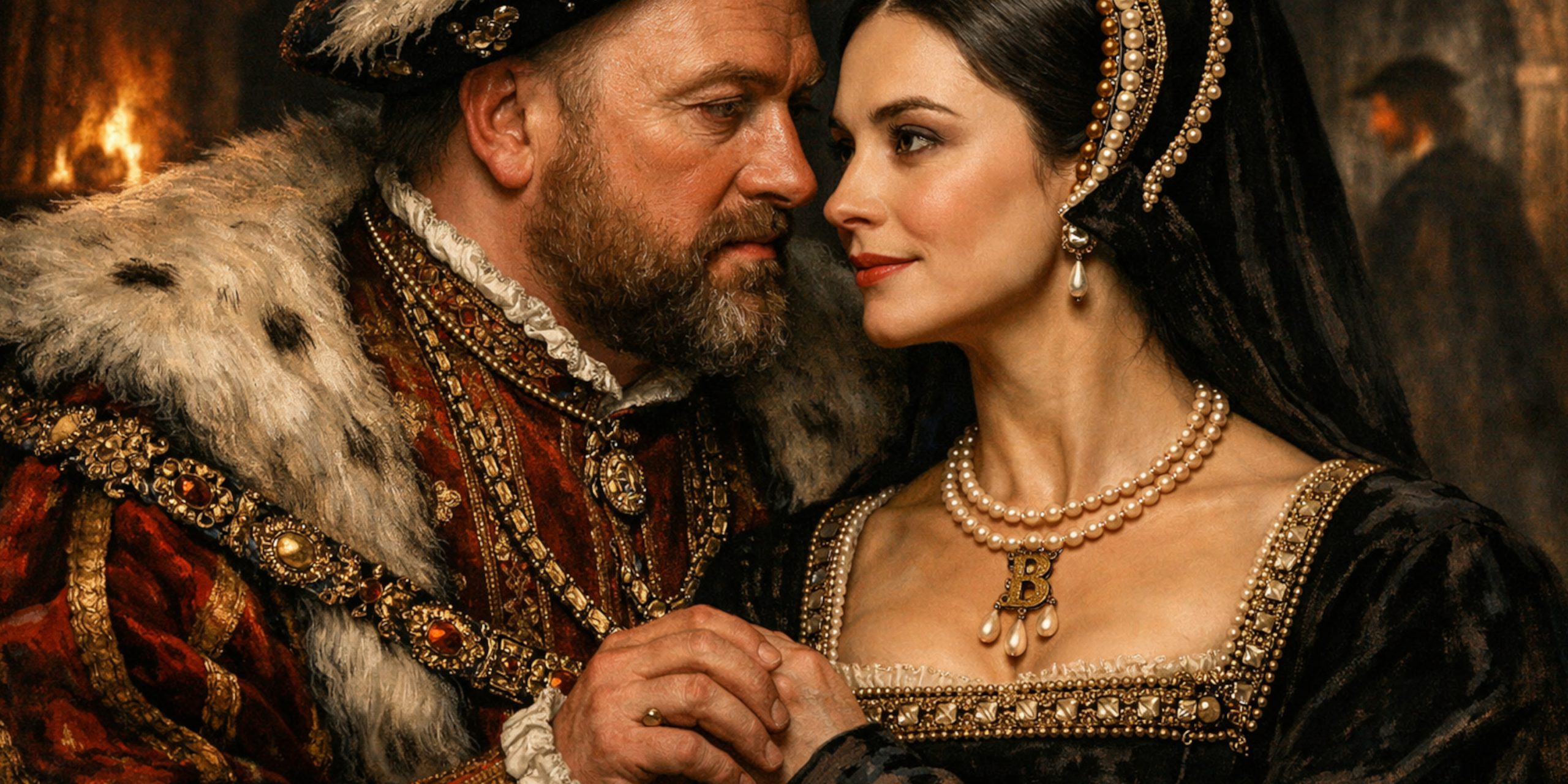
Few relationships have altered the course of a nation quite so dramatically as that between Henry VIII and Anne Boleyn. It began as a courtly fascination, became an obsession, and ended with a head falling on Tower Green. Somewhere in the middle, England broke with Rome, monasteries trembled, and an entire kingdom found itself dragged into a religious revolution because a king could not bear to be told “no”.
The popular version of the story often swings between romance and melodrama. Henry is cast either as a lovestruck monarch willing to sacrifice everything for the woman he adored, or as a tyrant who discarded wives like old gloves. Anne is either the ambitious temptress of hostile Tudor propaganda or the brilliant, unlucky woman who changed England by refusing to become a royal mistress.
The truth is more complicated, and therefore far more interesting.
Henry VIII Before Anne Boleyn
When Henry VIII first noticed Anne Boleyn in the 1520s, he had already been king for more than a decade. He was married to Catherine of Aragon, a respected queen and the widow of his elder brother Arthur. Their marriage had produced only one surviving child, Princess Mary.
For Henry, this was a problem that gnawed away at him. Tudor England was still haunted by the memory of the Wars of the Roses. A female heir seemed dangerously uncertain. Henry wanted a son, and not merely because kings tend to like having small versions of themselves running about in velvet.
By the mid-1520s, Henry had become increasingly convinced that his marriage to Catherine was cursed. He pointed to a passage in Leviticus which declared that a man who married his brother’s widow would be childless. Henry ignored the rather awkward fact that he already had a daughter. Tudor logic could occasionally be as selective as Tudor portraiture.
At court, meanwhile, Anne Boleyn had returned from France. She was intelligent, fashionable, witty, and rather more interesting than many of the ladies around her.
Who Was Anne Boleyn?
Anne Boleyn was born around 1501, probably at Blickling Hall in Norfolk or Hever Castle in Kent. She was the daughter of Thomas Boleyn and Elizabeth Howard, and belonged to an ambitious but not especially ancient noble family.
Anne spent much of her youth abroad. She served in the court of Margaret of Austria in the Low Countries, then in the French court. These years shaped her profoundly. She learned French, music, dancing and courtly manners. More importantly, she developed the confidence and sophistication that later made her stand out in England.
Contemporaries rarely described Anne as a great beauty. She was not the pale, fair-haired ideal of Tudor poetry. Instead, they remembered her dark eyes, sharp wit and magnetic presence. She seems to have possessed the rare ability to enter a room and immediately become the most interesting person in it.
The Venetian diplomat Francesco Sanuto described her as:
“Not one of the handsomest women in the world, but of middling stature, swarthy complexion, long neck, wide mouth, bosom not much raised.”
This is hardly the sort of description that launches a thousand sonnets. Yet Anne’s appeal lay elsewhere. She was clever, quick-tongued, and quite capable of matching Henry in conversation. For a king used to flattery and obedience, this was dangerously attractive.
The Courtship
Henry first became interested in Anne around 1526. At first he treated her as he had treated other women at court. He attempted to make her his mistress.
Anne refused.
This was the moment that changed everything.
Unlike her sister Mary Boleyn, who had previously been Henry’s mistress, Anne would not settle for being one more discreet royal diversion. Whether from ambition, conviction, or a mixture of both, she insisted on marriage.
Henry became increasingly infatuated. He wrote a series of passionate letters to Anne, some of which survive.
One of the most famous reads:
“I beseech you to give your whole mind, affection and body to me.”
Another reveals Henry’s growing frustration:
“For I have been struck these three years with the dart of love.”
Three years is quite a long time for a Tudor king to spend waiting. Henry was not accustomed to delay. Kings generally preferred their wishes to arrive immediately, preferably on a silver plate carried by somebody nervous.
Anne, however, continued to resist him. The longer she held out, the more determined Henry became.
The King’s Great Matter
By 1527 Henry had decided that he must end his marriage to Catherine of Aragon. This became known as “the King’s Great Matter”.
Henry sought an annulment from Pope Clement VII. He argued that his marriage to Catherine had never been valid. Unfortunately for Henry, the Pope was in a difficult position. Catherine was the aunt of the Holy Roman Emperor Charles V, who had recently sacked Rome and held enormous influence over the papacy. Granting Henry what he wanted would have been politically disastrous.
For years, Henry and his chief minister, Cardinal Wolsey, tried to secure the annulment. Courts met, arguments were presented, and Catherine defended herself with remarkable dignity.
At the legatine court in 1529, Catherine famously knelt before Henry and declared:
“Sir, I beseech you, for all the love that hath been between us, and for the love of God, let me have justice.”
She then reminded Henry that she had been his faithful wife for twenty years.
The Pope still refused.
The failure destroyed Wolsey, who fell from power and died in disgrace. It also pushed Henry towards a far more radical solution. If the Pope would not grant the annulment, then perhaps England no longer needed the Pope.
Anne Boleyn and the Break with Rome
Anne Boleyn did not single-handedly cause the English Reformation, despite the popular myth. England already contained reformers who criticised the Church, and Henry himself remained surprisingly conservative in religious belief.
Yet Anne undoubtedly influenced events.
She supported scholars who favoured religious reform and encouraged Henry to read works that challenged papal authority. Anne appears to have believed that kings should rule the Church within their own realms.
By 1533, Henry had secretly married Anne. She was already pregnant.
Thomas Cranmer, recently appointed Archbishop of Canterbury, declared Henry’s marriage to Catherine invalid and recognised Anne as queen. Shortly afterwards, Parliament passed the Act of Supremacy, making Henry the Supreme Head of the Church of England.
The consequences were enormous:
- England broke from Rome
- Monasteries were eventually dissolved
- The power of the Pope in England ended
- A new Protestant future, however uncertain, began to emerge
All because Henry wanted to marry Anne Boleyn. One can only imagine the expression on the Pope’s face. It was probably not encouraging.
Marriage and Queenship
Anne was crowned queen on 1 June 1533 in Westminster Abbey. It was a magnificent ceremony, though not everyone celebrated.
Many people still regarded Catherine of Aragon as the true queen. Anne remained unpopular in some quarters, particularly because she was blamed for Catherine’s suffering.
In September 1533 Anne gave birth, but the child was a girl.
That girl was Elizabeth.
At the time, the birth was a bitter disappointment to Henry. He had expected the long-awaited son. Yet history has a habit of enjoying irony. Elizabeth would become one of England’s greatest monarchs, while Henry’s desperately desired son, Edward VI, ruled for only a few years.
Anne later suffered several miscarriages, including at least one son. These losses placed immense strain on the marriage.
Meanwhile Anne’s enemies at court multiplied. She was outspoken, intelligent and sometimes sharp-tongued. These qualities impressed Henry during the courtship. They became less attractive once he was married to her. Tudor men often admired spirited women right up until the moment those women expressed opinions.
The Fall of Anne Boleyn
By 1536 Henry’s attention had begun to drift towards Jane Seymour. Anne’s position became increasingly dangerous.
In January 1536 Catherine of Aragon died. For a brief moment, Anne may have believed that her troubles were over. Instead, matters became worse. Soon afterwards she miscarried a son.
Henry was devastated. According to one contemporary, he declared:
“I see that God will not give me male children.”
Anne’s enemies, particularly Thomas Cromwell, moved against her. In May 1536 Anne was arrested and accused of adultery, incest and treason.
The charges were almost certainly false.
Anne was accused of affairs with several men, including her own brother, George Boleyn. The accusations were absurd and contradictory, but in Tudor England the law often served the wishes of the king rather better than the truth.
Anne defended herself with courage and wit. While imprisoned in the Tower, she reportedly joked about her own executioner:
“I have a little neck.”
It was a grim joke, but very much in character.
Anne was found guilty and sentenced to death.
The Execution
Anne Boleyn was executed on 19 May 1536 at the Tower of London. Henry, perhaps in an unusually thoughtful mood, arranged for a skilled French swordsman to carry out the sentence instead of the usual English axe.
On the scaffold Anne remained composed. She declared:
“I pray God save the king and send him long to reign over you.”
She did not openly protest her innocence, perhaps because doing so would have endangered her family.
The execution was swift.
Henry became engaged to Jane Seymour almost immediately and married her less than two weeks later. Even by Tudor standards, this was brisk work.
Anne was buried in the Chapel of St Peter ad Vincula within the Tower.
Did Henry Ever Truly Love Anne?
This is the question that has fascinated historians for centuries.
Henry certainly desired Anne intensely. His surviving letters show genuine passion, frustration and longing. For several years he risked his marriage, his reputation and England’s relationship with Rome in order to have her.
That was not a casual affair.
Yet Henry’s love always came with conditions. Anne was valuable while she remained desirable, obedient and capable of giving him a son. Once she failed to produce the male heir he wanted, and once she challenged him rather than comforting him, Henry’s devotion evaporated with astonishing speed.
Anne may have understood Henry better than anyone else. She had seen the charm, brilliance and energy that made him attractive. She had also seen the darker side: the vanity, insecurity and ruthless need to have his own way.
Their relationship changed England because it exposed all of those qualities at once.
Legacy
Anne Boleyn’s legacy is immense.
Without Anne, there may have been no English Reformation, at least not in the form it took. The Church of England might not have emerged when it did. The monasteries might have survived longer. England’s political and religious future would have looked very different.
Most importantly, Anne was the mother of Elizabeth I. Through Elizabeth, Anne’s bloodline eventually shaped one of the most successful reigns in English history.
For centuries Anne was portrayed as a scheming seductress. More recent historians have been kinder, and probably fairer. Anne was intelligent, ambitious and determined. In a court dominated by powerful men, these qualities made her dangerous.
She was also, perhaps, the last person in England who truly believed she could manage Henry VIII.
That was a mistake many people made. Few paid such a high price for it.