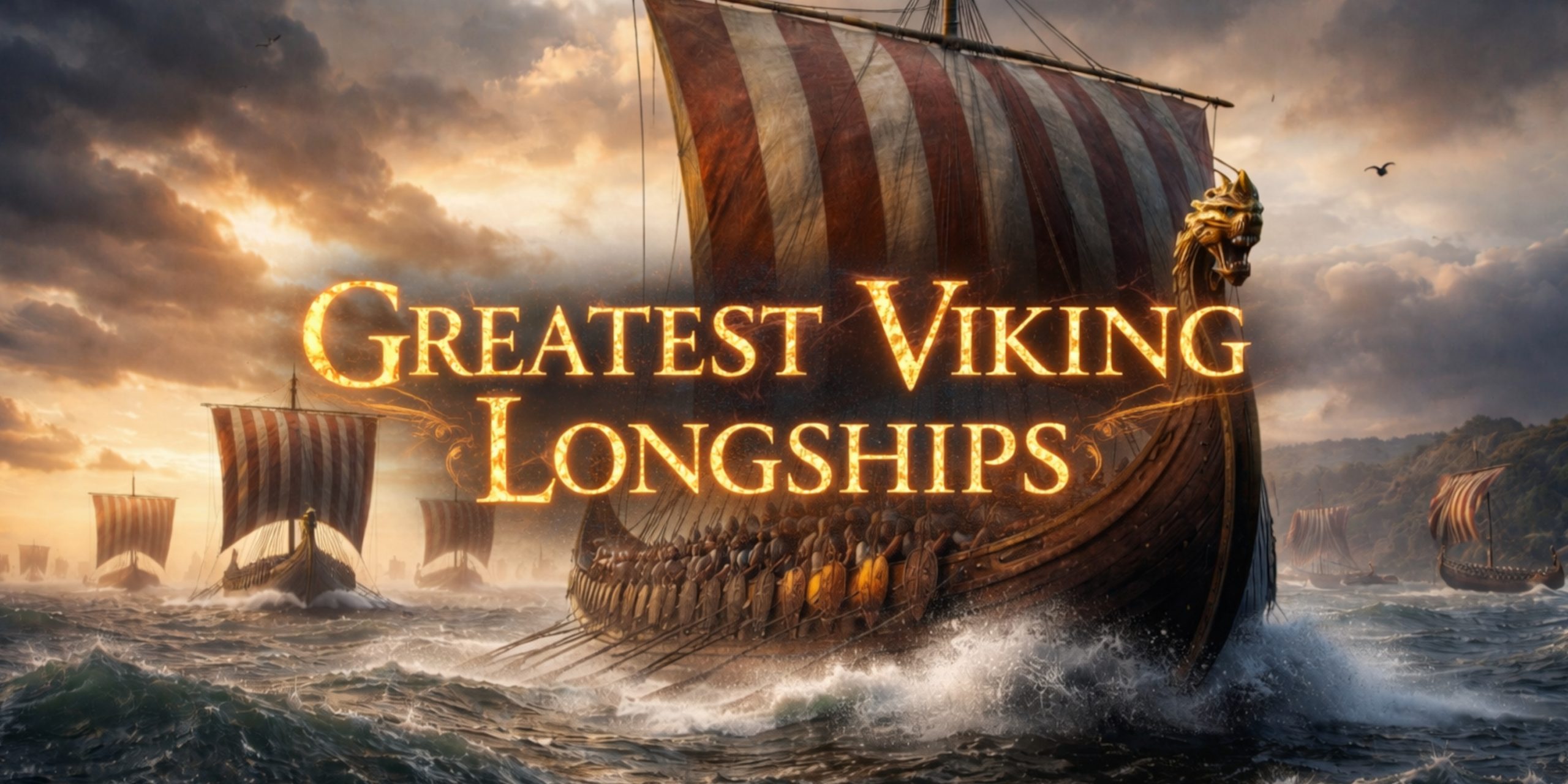
The Viking longship remains one of the most extraordinary machines of the medieval world. It carried raiders, kings, traders and explorers from the fjords of Norway to the rivers of Russia, the shores of England and, rather inconveniently for the locals, all the way to North America.
Fast, shallow and surprisingly elegant, these ships could slip up a river, cross an ocean and land an army before anyone had quite finished breakfast. Medieval chroniclers often wrote about them with a mixture of fear and reluctant admiration. Frankish monks, understandably, tended to focus on the fear.
What follows are the greatest Viking longships ever recorded or discovered. Some survive in the ground. Others survive only in sagas and chronicles. A few blur the line between history and legend, which is very much the Viking way.
What Made a Viking Longship Great?
Before looking at the individual ships, it is worth understanding what separated an ordinary longship from a famous one.
The greatest vessels were usually:
- Larger and faster than their rivals
- Capable of carrying dozens, sometimes hundreds, of warriors
- Built for kings or powerful jarls
- Associated with famous battles, invasions or voyages
- Remembered in chronicles, sagas or archaeology
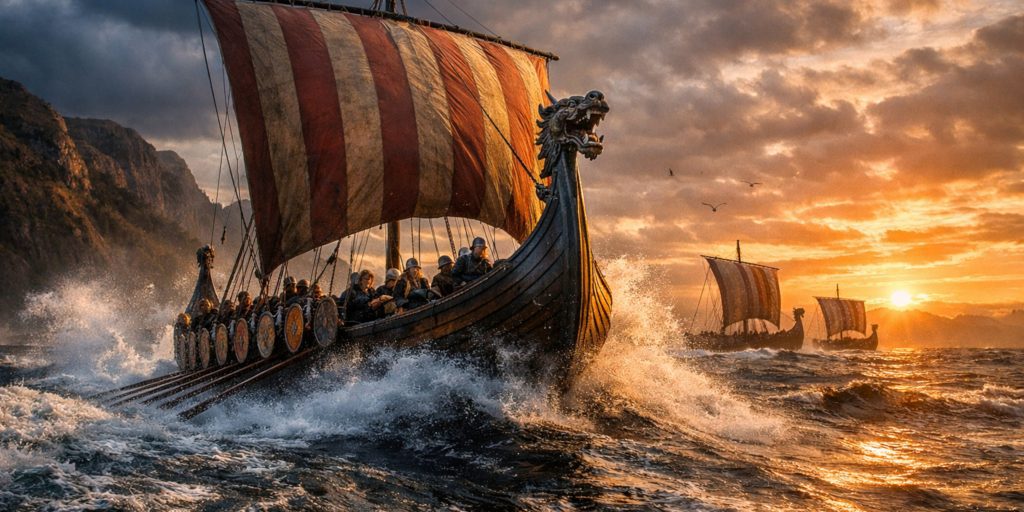
Most Viking longships were clinker-built, with overlapping planks fixed together by iron rivets. This gave them strength while keeping them flexible enough to survive rough seas. They had shallow draughts, which meant they could sail close to shore and move up rivers where larger ships would run aground.
A good longship could be rowed when there was no wind, sailed when there was, and dragged over land when absolutely necessary. The combination made the Vikings alarmingly difficult to pin down.
Ormen Lange, The Long Serpent
No Viking ship is more famous than Ormen Lange, the Long Serpent of King Olaf Tryggvason of Norway.
Built around the late tenth century, the ship was said to be the largest and finest longship in Scandinavia. According to the sagas, it had thirty-four rowing benches and a dragon-headed prow covered in gilded decoration. The vessel was built so large that even seasoned sailors reportedly stared at it in disbelief.
Snorri Sturluson wrote that:
“The Long Serpent was the best and most costly ship ever built in Norway.”
The ship became legendary during the Battle of Svolder around AD 1000. Olaf Tryggvason found himself trapped by a coalition of Danish, Swedish and Norwegian enemies. As the rest of his fleet collapsed around him, he fought from the deck of Ormen Lange.
The saga account turns the ship into almost a floating fortress. Olaf’s men held off repeated attacks, firing arrows and hurling spears from the higher deck. Eventually the enemy boarded. Olaf, rather than surrender, is said to have leapt into the sea in full armour.
Which was brave, dramatic, and perhaps not ideal for swimming.
Ormen Lange itself was captured and taken by Olaf’s enemies. After that, the ship vanishes from history. Whether it continued to serve another king or rotted quietly in a fjord, nobody knows.
Roskilde 6, The Largest Viking Longship Ever Found
For centuries, Ormen Lange existed only in saga literature. Then archaeology produced something astonishing.
In 1997, excavations at Roskilde in Denmark uncovered fragments of an enormous warship now known as Roskilde 6. Dating to around AD 1025, it is the largest Viking longship ever discovered.
The surviving remains suggest a ship approximately 37 metres long. That is far larger than most known Viking vessels and very close to the size described for royal ships in the sagas.
Roskilde 6 probably had room for nearly forty pairs of oars and may have carried around one hundred warriors. It was almost certainly built for a king, perhaps connected to the reign of Cnut the Great or one of his rivals.
Archaeologists reconstructed enough of the hull to reveal an exceptionally sleek vessel. It was narrow, fast and designed for war rather than trade.
The ship gives us a glimpse of what the great royal fleets of the eleventh century may really have looked like. If Ormen Lange sounded suspiciously grand in the sagas, Roskilde 6 suggests the storytellers may actually have been underselling it.
Skuldelev 2, The Great Raider
Another of the most impressive longships ever discovered is Skuldelev 2, found in Roskilde Fjord in the 1960s.
Built in Dublin around AD 1042 from oak timber, the ship measured roughly 30 metres in length. It was a true ocean-going warship, designed for speed and long-distance voyages.
The vessel probably had sixty rowers and could travel at impressive speed under sail. Experiments with the reconstructed ship, Sea Stallion from Glendalough, have shown that such a vessel could cross the North Sea far faster than many historians once believed.
Skuldelev 2 is important because it reveals just how connected the Viking world had become. A ship built in Viking Dublin using Irish timber and Scandinavian techniques could sail to England, Norway or Denmark with relative ease.
It is difficult not to admire the sheer practicality of it all. While many medieval rulers struggled to organise a road, the Vikings casually maintained a maritime network stretching across half of Europe.
The Gokstad Ship
Discovered in a burial mound in Norway in 1880, the Gokstad ship is perhaps the finest preserved Viking longship ever found.
Dating to the late ninth century, it was buried with a powerful chieftain or king. The ship is about 24 metres long and beautifully built, with sixteen oars on each side.
Unlike the larger royal warships of the later Viking Age, the Gokstad ship was both practical and versatile. It could sail in open seas, carry warriors and perhaps serve for exploration.
Modern sailing tests with replicas have shown that the ship was remarkably seaworthy. It could cross the North Atlantic and may have resembled the sort of vessel used by Norse explorers travelling to Iceland, Greenland and Vinland.
The burial also contained shields, weapons, tents, gaming boards and even peacocks. Quite why a Viking chieftain needed peacocks in the afterlife is unclear. Perhaps even the Norse occasionally lost an argument with the interior decorator.
A contemporary Arab observer, Ahmad ibn Fadlan, described Viking ships in general terms during his travels:
“Their ships are like great birds upon the sea.”
The Gokstad ship is perhaps the closest surviving example of that image.
The Oseberg Ship
The Oseberg ship, found in Norway in 1904, is one of the most beautiful Viking vessels ever discovered.
Built around AD 820, it was buried as part of an elaborate grave for two high-status women. The ship itself is slightly smaller and less practical as a warship than the Gokstad vessel, but its decoration is extraordinary.
The prow and stern are covered with intricate carved animal patterns, twisting serpents and interlaced designs. The craftsmanship is astonishing.
The Oseberg ship shows that Viking vessels were not simply tools of war. They were also symbols of prestige, wealth and political power. A great ship announced the status of its owner long before a single sword was drawn.
Although Oseberg may not have been among the fastest or strongest longships, it deserves its place among the greatest because it demonstrates the artistic ambition of the Viking world.
Modern depictions of Vikings often make them look permanently muddy and furious. Oseberg is a useful reminder that these people also appreciated beauty, fine carving and, on occasion, a surprisingly tasteful bit of woodwork.
The Dragon of Harald Hardrada
Harald Hardrada, the formidable King of Norway, was said to possess a magnificent dragon ship during his invasion of England in 1066.
The exact name of the ship is uncertain in surviving sources, though some accounts refer to a great dragon-prowed flagship. Harald sailed with a huge fleet to northern England and fought at the Battle of Stamford Bridge.
The Anglo-Saxon Chronicle remembered the scale of the invasion with obvious alarm:
“There came Harald, King of Norway, into the north with more than three hundred ships.”
Harald’s flagship would have been among the grandest of these. Such ships often had brightly painted shields lining the gunwales, carved dragon heads and richly decorated sails.
After the defeat at Stamford Bridge, only a fraction of Harald’s fleet returned to Norway. According to later tradition, so many men had died that only twenty-four ships were needed for the survivors.
That detail may be exaggerated, but it captures the sense of catastrophe. The age of the great Viking invasions was drawing to a close.
The Ships of the Great Heathen Army
The Great Heathen Army, which invaded England in AD 865, did not rely on a single famous ship. Instead, its power came from a fleet of longships working together.
These vessels carried thousands of warriors across the North Sea and up the rivers of England. Unlike later Norman armies, which required elaborate supply chains and enough paperwork to make a monk weep, the Vikings could move rapidly and strike almost anywhere.
Contemporary English chroniclers described the arrival of the fleet with horror:
“A great heathen army came into England.”
The longships of the Great Heathen Army were probably medium-sized vessels, practical rather than luxurious. They needed to be fast, manoeuvrable and capable of landing troops quickly.
Their success changed English history. Within a few years, much of England had fallen under Viking control.
Drekar, The Dragon Ships of Legend
The largest and most prestigious Viking warships were often called drekar, or dragon ships.
These vessels were distinguished by carved dragon heads at the prow and were usually owned by kings. The dragon was intended to terrify enemies and perhaps impress allies, though one suspects it also helped prevent sailors from losing their own ship in a crowded harbour.
Several famous Viking rulers owned dragon ships:
- Olaf Tryggvason with Ormen Lange
- Cnut the Great with his royal fleet
- Harald Hardrada during the invasion of England
- Sweyn Forkbeard during his campaigns against England
Most of these ships have not survived, but the sagas describe them in vivid terms. They were larger, more ornate and more heavily crewed than ordinary longships.
The dragon ship became the ultimate symbol of Viking power. To own one was to announce that you were not merely a chieftain with ambitions. You were a king.
How Fast Were the Greatest Viking Longships?
The finest Viking longships were astonishingly quick.
Modern reconstructions suggest that a large longship could travel:
- Around 10 to 15 knots under sail in good conditions
- Roughly 5 knots under oars
- More than 100 miles in a day
The reconstructed Sea Stallion from Glendalough, based on Skuldelev 2, managed speeds that surprised even experienced sailors.
This helps explain how Viking fleets could appear seemingly out of nowhere. A settlement might go to sleep believing itself safe and wake to discover a fleet in the harbour and several extremely enthusiastic Norsemen heading for the monastery.
Where Can You See Viking Longships Today?
Several of the most famous Viking ships can still be seen in museums.
- The Gokstad and Oseberg ships are displayed in Oslo
- Skuldelev ships can be seen at Roskilde in Denmark
- Fragments of Roskilde 6 are also preserved and exhibited
- Full-size replicas such as Sea Stallion from Glendalough have sailed internationally
Seeing one in person is a strangely moving experience. These ships are not enormous by modern standards, yet they feel alive in a way many ancient artefacts do not. You can look at the hull and imagine the creak of timber, the slap of waves and the uncomfortable certainty that somebody nearby is about to shout in Old Norse.
Takeaway
The greatest Viking longships were more than vessels. They were engines of conquest, symbols of kingship and masterpieces of medieval engineering.
Ormen Lange became legendary through saga and battle. Roskilde 6 revealed just how vast royal longships could be. The Gokstad and Oseberg ships survived to show us the craftsmanship behind the legend. Skuldelev 2 proved that Viking warships could cross seas with alarming speed and efficiency.
Without these ships, the Viking Age would never have spread so far or lasted so long. The longship was the reason the Norse could raid England, settle Iceland, found kingdoms in Ireland and reach the shores of North America.
In the end, the Viking longship was perhaps the most important weapon the Norse ever possessed. Not an axe, not a sword, but a beautifully built hull of oak, driven by sail, oar and the sort of confidence usually associated with people who have never been told that something is impossible.