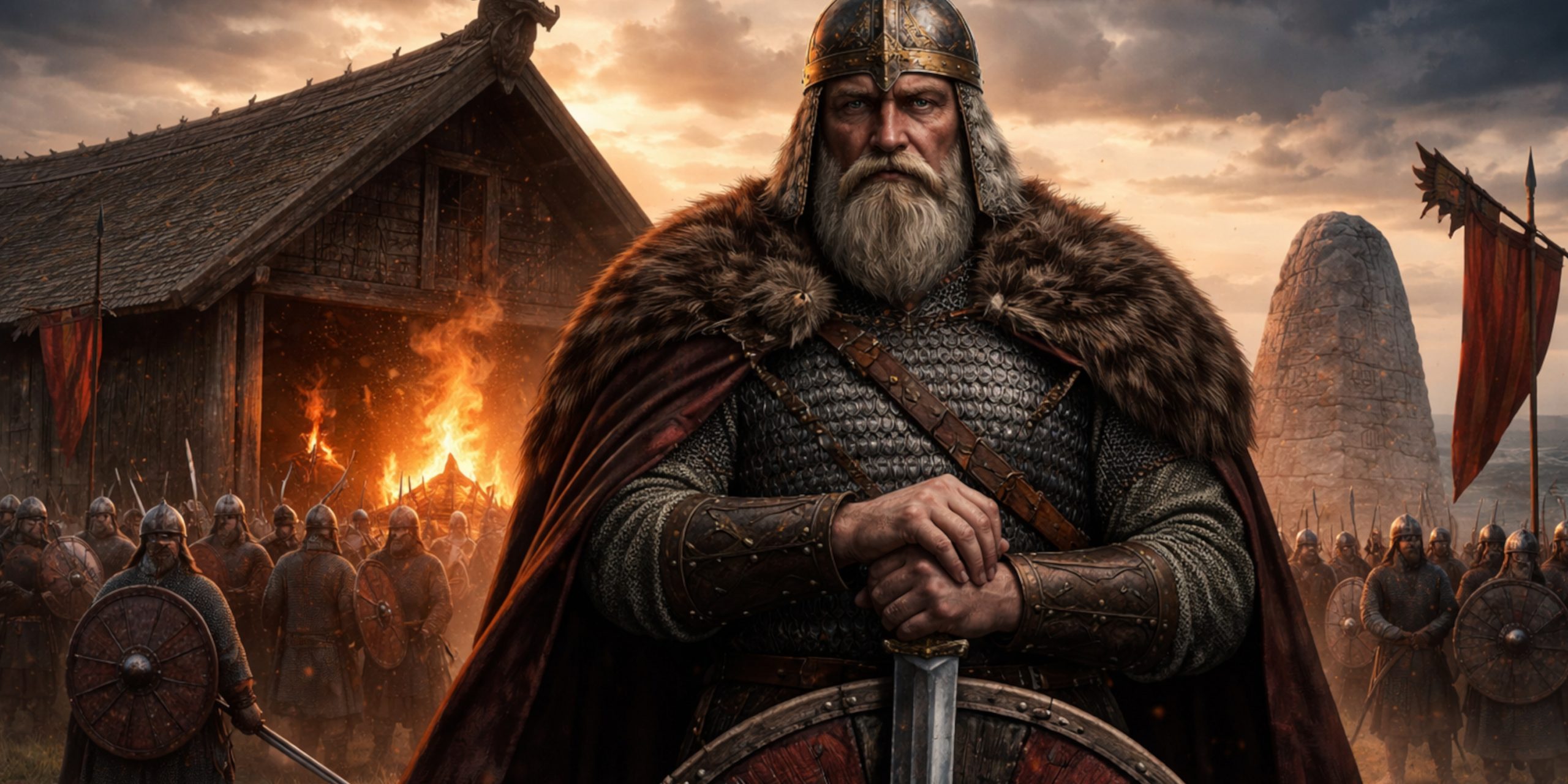
When we talk about the birth of Denmark as a kingdom, everything keeps circling back to Gorm the Old. He stands at the hinge point between fragmented Viking lordship and something recognisably royal. He is half legend, half documentary shadow, yet his presence is firm enough that Danish history still uses him as a starting line.
Gorm ruled in the first half of the tenth century, probably from the 930s until his death around 958. He was the father of Harald Bluetooth, and in many ways his reign exists to be contrasted with his son’s. Gorm represents the old order, pagan, martial, rooted in ancestral authority rather than written law or Christian kingship.
The Political Landscape of Gorm’s Denmark
Denmark in Gorm’s time was not a neatly bounded state. Power rested on personal loyalty, kinship, and control of land rather than borders. Gorm’s achievement was not conquest on a grand scale, but consolidation. He appears to have unified much of Jutland under his rule and stabilised a royal centre in eastern Jutland.
What interests me most as a historian is how quiet his reign appears in the sources. That silence suggests stability. Viking kings who failed tend to leave loud archaeological scars. Gorm leaves fewer, more deliberate ones.
Battles and Military Acumen
We have no detailed battle narratives tied directly to Gorm. That absence is frustrating, but also revealing. His power seems to have rested on deterrence rather than constant warfare.
The few references we do have suggest clashes with German and Saxon forces to the south, especially along the Danevirke defensive system. Gorm likely prioritised holding territory over raiding abroad, a shift from earlier Viking rulers who built prestige through overseas campaigns.
From a military perspective, this points to a ruler who understood logistics and loyalty. Maintaining control over Jutland required local support, not just battlefield success. Gorm’s real skill may have been knowing when not to fight.
Arms and Armour of Gorm’s Era
No weapon can be definitively linked to Gorm himself, but the material culture of tenth century Denmark is well understood.
A king like Gorm would have fought with a pattern welded Viking sword, broad bladed and well balanced, supported by a spear as a primary battlefield weapon. Shields were round, wooden, leather faced, and centre gripped. Mail shirts were rare and expensive, worn only by elite warriors. Helmets were practical, iron caps rather than anything decorative.
What stands out is how conservative this kit is. There is no sign of experimentation or imported fashion. Gorm’s Denmark armed itself to defend land and authority, not to project image abroad.
Pagan Kingship and Belief
Gorm is remembered as a committed pagan. Later Christian chroniclers portray him as resistant, even hostile, to the new faith. Whether this was ideological or political is open to debate.
In my view, Gorm understood that Christianity came bundled with foreign influence. Accepting it too early risked undermining his authority. By holding to pagan tradition, he reinforced continuity with ancestral kingship, burial rites, and law.
His death marks the end of that world. Within a generation, Denmark was officially Christian.
The Jelling Stones and Royal Memory
Gorm’s most tangible legacy lies at Jelling. The smaller Jelling Stone, raised by Gorm in memory of his wife Thyra, is the earliest known royal inscription in Denmark.
It is spare, restrained, and deeply personal. No boasts. No divine claims. Just lineage and remembrance. As a historian, I find that restraint striking. It feels deliberate.
The larger stone, raised by Harald Bluetooth, reframes the story. Christianity, conquest, and kingship all appear there. Together, the stones show a generational shift in how power was presented.
Where to See Artefacts from Gorm’s Reign
Visitors can see material linked to Gorm and his dynasty at several key sites.
The National Museum of Denmark in Copenhagen holds artefacts from the Jelling complex and elite Viking burials of the same period. The Jelling site itself is now a UNESCO World Heritage location, with reconstructed mounds, interpretive displays, and the stones protected within a climate controlled structure.
Standing there, you feel the weight of intention. This was not just a burial site. It was a statement.
Latest Archaeology and New Insights
Recent archaeological work at Jelling has transformed our understanding of Gorm’s court. Excavations have revealed a vast palisaded enclosure, large halls, and evidence of planned construction on a royal scale.
This suggests that Gorm ruled from a permanent power centre, not a roaming war camp. The scale rivals contemporary sites in England and the Carolingian world. Denmark, under Gorm, was already thinking like a kingdom.
For me, this is the most important shift in how we see him. He was not simply the last pagan king. He was the first to rule Denmark as a structured state.
Final Thoughts from a Historian
Gorm the Old rarely gets credit for what he achieved because his son rewrote the narrative in stone and silver crosses. Yet without Gorm’s consolidation, Harald Bluetooth would have had nothing to convert.
History often remembers the reformer and forgets the stabiliser. Gorm deserves better. His reign feels like the quiet moment before the door closes on the Viking Age and opens onto medieval Scandinavia.
Watch the documentary: