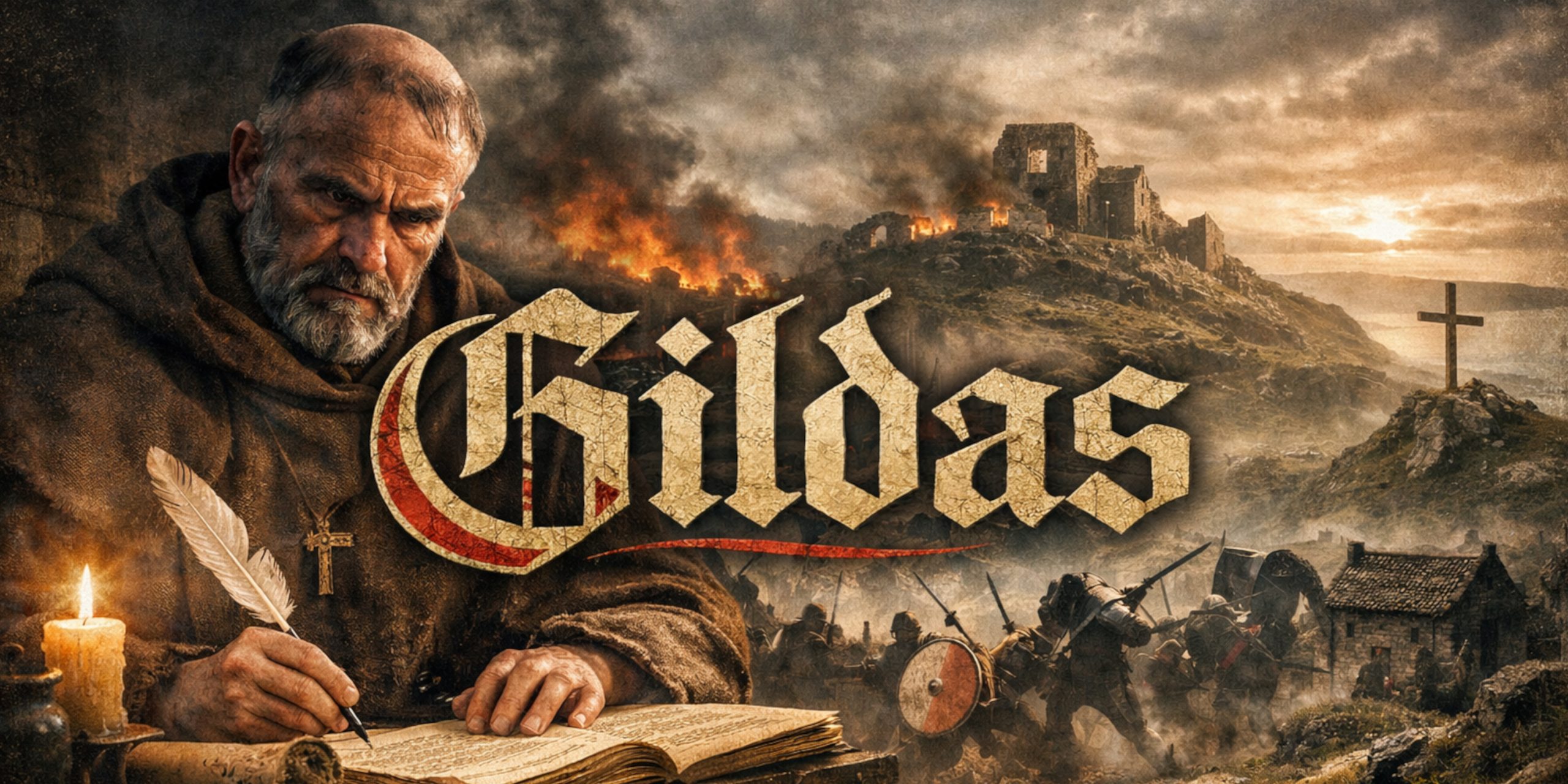
Gildas is one of those figures historians circle warily. He stands at the edge of written history in Britain, half seen through a single surviving work and a tangle of later tradition. He was a monk, a moralist, and an eyewitness of a Britain coming apart at the seams after Rome’s withdrawal. He did not set out to be a historian, yet without him the early sixth century would be close to silent.
What survives is sharp, opinionated, and sometimes exhausting to read. That is part of its value. Gildas wrote while the wounds were still open.
Historical Context
Gildas lived in sub-Roman Britain, likely during the late fifth and early sixth centuries. Roman administration had collapsed, local warlords filled the vacuum, and external pressure from Picts, Scots, and Anglo-Saxon settlers reshaped the island. Literacy had not vanished, but it had narrowed to clerical circles. Writing was no longer about administration. It was about judgement.
Britain at this point was fragmented and anxious. Gildas writes as someone who believed moral decay, not military weakness, explained the disasters of his age. That conviction defines everything he wrote.
The Surviving Work
Gildas is known almost entirely through De Excidio et Conquestu Britanniae which translates roughly as On the Ruin and Conquest of Britain. It is not a narrative history in the modern sense. It is a sermon written with a pen dipped in acid.
The text falls into three broad movements. First, a brief and selective sketch of Britain’s Roman past and its fall. Second, a fierce denunciation of contemporary British kings, named and shamed with remarkable confidence. Third, a withering attack on the clergy, whom Gildas saw as morally compromised and spiritually lazy.
Dates, places, and sequences matter far less to him than sin and consequence. When modern readers complain about the lack of clear chronology, they are missing the point. Gildas thought the facts were obvious. The lesson was what mattered.
What We Can Say With Confidence
Gildas was a highly educated cleric trained in Latin rhetoric. His writing shows familiarity with classical authors and the Bible, handled with fluency rather than imitation. He likely belonged to a monastic community and spent time in western Britain, possibly Wales or the southwest.
He was close enough to major political figures to name kings directly, which suggests he was not writing from isolation. He may have travelled, taught, or advised. He almost certainly expected his work to be read aloud.
Beyond that, certainty collapses quickly. Later medieval traditions place his birth around the year 500 and link him to famous monastic foundations, but these accounts were written centuries later and serve devotional aims more than historical clarity.
The Facts, Such As They Are
Gildas was alive during the aftermath of the Saxon settlements.
He wrote in Latin and expected a literate clerical audience.
His surviving work is a moral sermon, not a chronicle.
He names five British kings and condemns them openly.
He believed Britain’s suffering was divine punishment.
That is the solid ground. Everything else floats.
Gildas and Arthur
Any discussion of Gildas eventually collides with King Arthur. Gildas mentions a major British victory at Mount Badon but never names its commander. Later writers filled the silence with Arthur.
As a historian, I find this omission more interesting than any confirmation would have been. If Arthur existed as later tradition describes, Gildas chose not to celebrate him. Either Arthur was not central to Gildas’s moral argument, or hero worship was precisely what Gildas wanted to undermine.
Silence, here, is a statement.
Reliability and Limits
Gildas is indispensable and infuriating in equal measure. He is close to events but uninterested in balance. He exaggerates, moralises, and selects evidence to serve his argument. Yet he is not careless. His bitterness feels earned.
When he condemns rulers, he does so with detail that suggests personal knowledge. When he generalises, he does so with the confidence of someone who expects no contradiction.
Used carefully, Gildas anchors the period. Used uncritically, he distorts it.
Kings Named by Gildas
Gildas names five contemporary British rulers in De Excidio et Conquestu Britanniae. He does not introduce them as kings in a neutral sense. Each appears as part of a moral indictment, and none escape criticism. The tone is deliberate. These mentionings are warnings, not records of achievement.
Constantine
Ruler of Dumnonia, likely covering parts of modern Cornwall and Devon. Gildas accuses Constantine of tyranny, moral corruption, and betrayal of oaths. He presents him as a ruler who cloaked violence in Christian language, which clearly offended Gildas more than simple brutality.
Aurelius Caninus
A shadowy figure, possibly ruling somewhere in southern Britain. Gildas condemns him for cruelty and compares him unfavourably even to biblical tyrants. The lack of geographic detail suggests Gildas expected his audience to know exactly who this was.
Vortiporius
King of Demetia, roughly modern Dyfed in southwest Wales. Gildas portrays Vortiporius as aged, corrupt, and morally decayed. The criticism is personal and sharp, aimed as much at private conduct as public rule.
Cuneglasus
Possibly ruling in northern Wales or the Hen Ogledd. Gildas attacks Cuneglasus for violence, pride, and adultery, describing him as a would-be tyrant restrained only by circumstance. The language suggests a volatile and ambitious ruler.
Maelgwn Gwynedd
The most powerful and best-documented of the five. Maelgwn ruled Gwynedd and was a dominant figure in sixth-century Wales. Gildas condemns him harshly for abandoning monastic life to seize power and for what he saw as spectacular moral failure. This passage reads less like distant judgement and more like personal disappointment.
Events Gildas Mentions
Gildas rarely dates events precisely and never lays them out as a timeline. Still, several key moments appear repeatedly, framed as causes and consequences of moral decline.
Roman Rule and Withdrawal
Gildas describes Roman Britain as flawed but ordered. The withdrawal of Roman authority marks the beginning of Britain’s unravelling. He treats this not as a military inevitability but as the opening act in a moral collapse.
Saxon Foederati and Betrayal
He recounts the decision by British leaders to invite Saxon warriors as mercenaries. Their later rebellion and expansion are described as both treachery and divine punishment. Gildas places heavy blame on British leadership for this decision.
Saxon Raids and Devastation
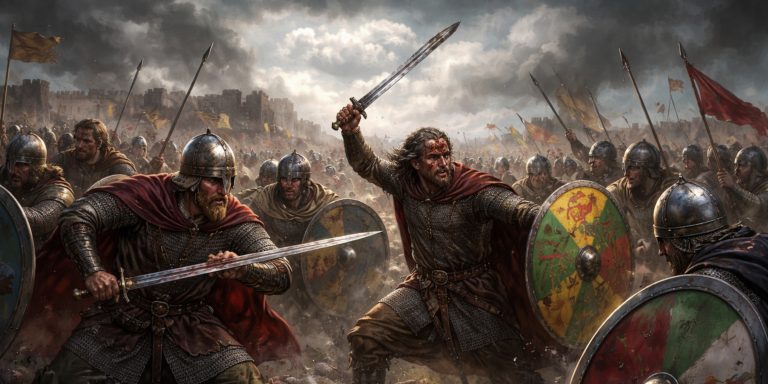
Burned cities, slaughtered populations, and social breakdown dominate this section. The imagery is vivid and bleak. Gildas presents the invasions as a scourge sent in response to sin, not simply as conquest.
The British Resistance
Gildas briefly notes a period of organised resistance led by Ambrosius Aurelianus, a Romano-British leader of noble descent. This is one of the few moments where he allows cautious praise.
The Battle of Mount Badon
The most famous event in Gildas’s work. He describes a decisive British victory that halted Saxon advances for a generation. Crucially, he does not name the commander. Later tradition filled that silence with Arthur, but Gildas himself remains pointedly uninterested in hero-making.
Historical Note
Gildas mentions kings to condemn them and events to explain suffering. He is not trying to preserve memory in a neutral way. He is prosecuting his own age. That is frustrating when we want dates and clarity, but invaluable when we want to understand how sixth-century Britons explained the collapse of their world.
Legacy
Gildas shaped how Britain remembered its own collapse. Later writers like Bede relied on him heavily, sometimes reluctantly, because there was nothing else of comparable weight. Medieval chroniclers turned Gildas into a saintly authority. Modern historians treat him as a difficult witness who must be cross-examined rather than believed outright.
His influence runs deeper than facts. He framed early British history as a moral drama, a pattern that echoes through medieval writing long after the circumstances changed. Even today, discussions of Britain’s post-Roman chaos often carry his assumptions, whether acknowledged or not.
A Historian’s View
I have always liked Gildas more than I trust him. He is angry, disappointed, and convinced that his society is squandering its last chances. That tone feels human. It also feels familiar.
Gildas reminds us that history is not always written to preserve memory. Sometimes it is written to warn, to scold, or simply to shout into the void. For early medieval Britain, that shout is all we have.