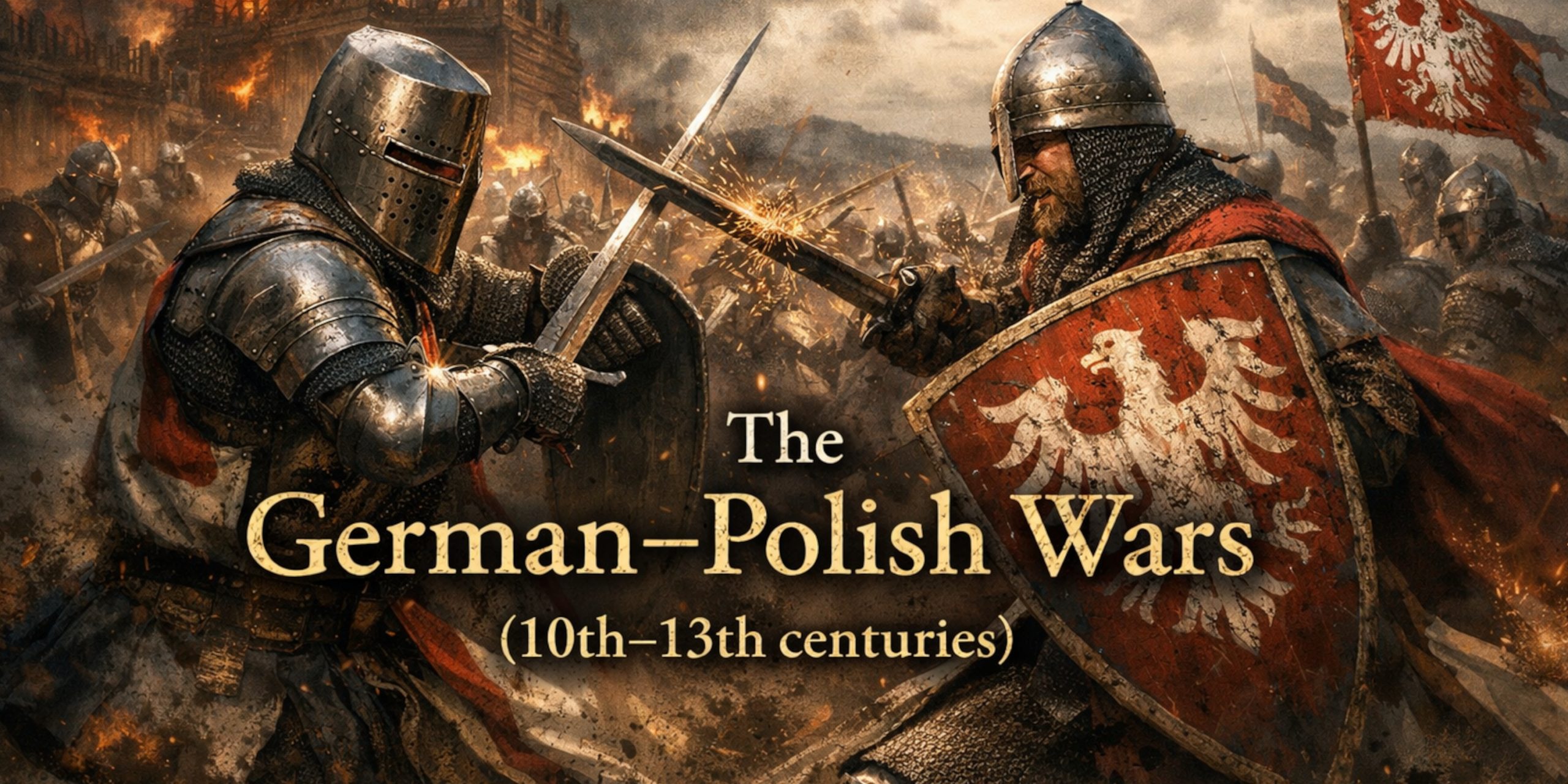
The wars between the rising Polish state and the German rulers of the Holy Roman Empire stretched across more than three centuries. They were not one continuous conflict, but a chain of campaigns, raids, sieges and uneasy peaces. At their heart lay a simple question: who would control the lands between the Elbe and the Vistula?
For the German emperors and margraves, the eastern frontier was a place to expand influence, collect tribute and remind their neighbours who was supposed to be in charge. For the Polish Piasts, it was a matter of survival. Poland was a young kingdom surrounded by ambitious neighbours, and its rulers were rarely inclined to bow politely and accept their allotted place.
The result was a long and often bitter rivalry. It produced famous kings, ruined fortresses, scorched borderlands and enough broken treaties to make any medieval notary quietly despair.
Origins of the Conflict
The struggle began in the 10th century, when the Piast dynasty under Mieszko I forged the first recognisable Polish state. Mieszko’s realm expanded rapidly across Greater Poland, Silesia and parts of Pomerania. That expansion brought Poland into direct contact with the eastern frontier of the Holy Roman Empire.
German rulers had already established border territories, known as marches, east of the Elbe. Their purpose was simple enough: push further east whenever possible, Christianise the local Slavic peoples and ensure that tribute flowed in the correct direction.
Mieszko I accepted Christianity in 966, partly for religious reasons, but also because it made it rather more difficult for German rulers to describe Poland as a convenient pagan target. One cannot invade a newly Christian neighbour quite so easily while insisting one is merely helping civilisation.
Even so, tension remained. German margraves sought influence over Polish lands, while Polish rulers fought to keep control over Silesia, Lusatia and the frontier fortresses along the Oder.
Mieszko I and the First Clashes
Mieszko I ruled from around 960 to 992. During his reign Poland emerged as a serious regional power, and conflict with the Empire became inevitable.
The most important early struggle came after the death of Emperor Otto I. Mieszko supported rivals to Otto II and manoeuvred carefully among German factions. By the late 970s there were signs of open conflict. Archaeological evidence suggests that major Polish strongholds such as Gniezno and Ostrów Lednicki were rapidly strengthened during this period.
The likely reason is plain enough. Mieszko expected a German invasion.
A campaign by Otto II may have reached deep into Poland around 979, although the details remain frustratingly obscure. Medieval chroniclers, as usual, were much more interested in who married whom than in the precise number of men who marched through a muddy forest.
By 990, Mieszko had emerged stronger. He defeated Bohemia and secured Silesia, with indirect support from the Empire. That left Poland larger, richer and considerably harder to intimidate.
Bolesław the Brave and the Great Wars of 1002–1018
The greatest phase of the German–Polish struggle came under Bolesław I, known to history as Bolesław the Brave.
Bolesław inherited his father’s realm in 992 and transformed it into a kingdom powerful enough to challenge the Empire directly. He was ambitious, formidable and not especially inclined to accept instructions from German emperors.
At first, relations with Emperor Otto III were remarkably warm. In 1000, Otto visited Gniezno and recognised Bolesław as an important ruler. There were grand ceremonies, gifts and enough political theatre to satisfy an entire season of historical drama.
Then Otto died.
His successor, Henry II, had a much colder view of Poland. The result was a long war fought in several phases between 1002 and 1018.
Why the War Began
The immediate issue was control of Lusatia, Meissen and Bohemia. Bolesław seized these lands after political turmoil in Germany. Henry II insisted that they belonged within the Empire and demanded that Bolesław acknowledge him as overlord.
Bolesław refused.
That refusal set off fifteen years of warfare.
Major Battles and Campaigns
The Campaign of 1005
Henry II marched east with German and pagan Lutici allies. The German army reached as far as Poznań. Bolesław avoided a decisive battle and instead forced Henry into negotiation.
The resulting peace forced Poland to surrender some earlier gains, but the conflict was far from over.
The Campaigns of 1007–1013
Bolesław struck first in 1007 and retook Lusatia and Meissen. German attempts to recover them failed repeatedly.
In 1013 the two rulers agreed to the Peace of Merseburg. Bolesław kept Lusatia as a fief. Medieval diplomacy, like medieval warfare, often consisted of one side pretending to accept terms until it had gathered enough troops to ignore them.
The Battle of Krosno Odrzańskie, 1015
In 1015 Henry II launched another invasion. His army attempted to cross the Oder near Krosno Odrzańskie.
Bolesław’s forces blocked the crossing and inflicted serious losses. Several German nobles were killed, including Margrave Gero II.
The battle prevented Henry from advancing into the heart of Poland and showed that the Piast state could defend its frontier effectively.
The Siege of Niemcza, 1017
The most famous episode of the war came in 1017, when Henry II besieged the fortress of Niemcza in Silesia.
Niemcza held out against repeated assaults. Polish defenders, reinforced from outside, resisted for weeks until the emperor was forced to withdraw.
The siege entered Polish legend as a symbol of resistance. It also demonstrated the growing strength of Polish fortifications. A German army could invade Poland, but conquering it proved rather more difficult.
The Peace of Bautzen, 1018
The war ended with the Peace of Bautzen in 1018.
Bolesław emerged in a remarkably strong position. He retained Lusatia and nearby territories, and Poland gained recognition as an independent power rather than a subordinate frontier state.
For Bolesław, it was the high point of Piast power. A few years later he crowned himself king.
The War of 1109
Another major German–Polish conflict broke out in 1109.
This time the struggle involved Emperor Henry V and Bolesław III Wrymouth. Henry supported Bolesław’s exiled half-brother Zbigniew and invaded Poland in an attempt to restore him.
The campaign quickly became one of the most famous wars in Polish memory.
The Siege of Głogów
Henry V besieged the town of Głogów in Silesia. According to later Polish chroniclers, the Germans used local children as hostages during the siege.
The defenders refused to surrender.
Whether every detail of the story is true remains uncertain, but the tale became one of the defining episodes of Polish medieval history.
The Battle of Hundsfeld
After the failed siege, Henry’s army suffered further losses at Hundsfeld. The exact location of the battle remains disputed, but the result does not.
The German invasion collapsed, and Henry V withdrew.
For Poland, the campaign of 1109 became proof that the kingdom could survive even the direct intervention of an emperor.
Later Wars in the 12th and 13th Centuries
The later centuries saw fewer great invasions but constant tension along the frontier.
After the fragmentation of Poland in the 12th century, German rulers often intervened in disputes between rival Piast princes. Rather than fighting one united kingdom, they dealt with several smaller duchies, each quite capable of quarrelling with the others without any outside assistance.
German settlers moved eastward during the process known as the Ostsiedlung. Towns in Silesia and Pomerania adopted German law and customs. German influence increased, especially in western Poland.
At the same time, Polish rulers still resisted imperial claims. Silesia became the chief area of dispute. By the 13th century many Silesian dukes had accepted close ties with the Empire, although they remained culturally and politically linked to Poland.
The arrival of the Teutonic Knights in the Baltic added another layer to the rivalry. German military power now appeared not only from the west but also from the north.
Important Battles of the German–Polish Wars
| Battle | Date | Result | Significance |
|---|---|---|---|
| Battle near Cedynia | 972 | Polish victory | Mieszko I defeated forces led by Margrave Hodo and secured western Poland |
| Campaign of Poznań | 1005 | Inconclusive peace | Henry II forced negotiations but failed to dominate Poland |
| Battle of Krosno Odrzańskie | 1015 | Polish victory | Stopped Henry II crossing the Oder |
| Siege of Niemcza | 1017 | Polish victory | One of the decisive moments of the wars |
| Siege of Głogów | 1109 | Polish victory | Failed German siege during Henry V’s invasion |
| Battle of Hundsfeld | 1109 | Polish victory | Forced Henry V to retreat from Poland |
Arms, Fortresses and Warfare
The German–Polish wars were fought with the typical weapons of the early and high Middle Ages.
Polish warriors relied heavily on armoured cavalry, spear-armed infantry and strong wooden fortresses. German armies fielded knights, infantry levies and siege equipment.
Polish strongholds were especially important. Fortresses such as Gniezno, Niemcza, Głogów and Wrocław were built from timber and earth, often with massive ramparts.
These defences could be astonishingly resilient. A medieval fortress of timber and earth may sound unimpressive to modern ears, rather like a village attempting to defend itself with an ambitious fence. In practice, however, such strongholds could absorb enormous punishment.
Archaeology
Archaeology has transformed our understanding of these wars.
Excavations at Ostrów Lednicki, Gniezno and Poznań have revealed the scale of early Piast fortifications. Massive earthworks, charred timber and weapon fragments show that these centres were repeatedly strengthened in expectation of war.
At Niemcza, excavations have uncovered traces of the great ramparts that resisted Henry II in 1017. Archaeologists have also found arrowheads, spearheads and evidence of fire damage.
Finds from Cedynia and the Oder frontier suggest that many of the battles took place close to fortified river crossings. That should not surprise anyone. Medieval armies disliked rivers almost as much as they disliked arriving without enough food.
Archaeologists in Silesia and Lusatia have also uncovered burial sites and military objects linked to the frontier wars. These include:
- Iron spearheads and axes
- Fragments of mail armour
- Spurs and horse equipment
- Burnt remains of timber fortifications
- Silver coins from both Polish and German rulers
Together, these finds reveal a frontier that was not quiet, remote or empty. It was one of the most heavily contested regions in medieval Europe.
Contemporary Quotes
“Bolesław was more daring than any man of his age.”
Thietmar of Merseburg
“The emperor laid siege to Niemcza, but could not take it.”
Thietmar of Merseburg
“Bolesław did not cease until he had enlarged his kingdom beyond measure.”
Gallus Anonymus
“The Poles resisted with such courage that the Germans despaired.”
Later Polish chronicle tradition on the campaign of 1109
These sources must be read with caution. Medieval chroniclers were rarely impartial. Most wrote to praise their patrons and denounce their enemies. Even so, their accounts preserve the atmosphere of the age: ambitious rulers, fragile alliances and a frontier where war was always only a season away.
Legacy of the German–Polish Wars
The German–Polish wars shaped Central Europe.
They fixed the Oder and Silesian frontier as the central point of tension between Poland and the Empire. They helped create the Polish kingdom as an independent power. They also established a long memory of resistance to German expansion that remained important in Polish history for centuries.
For Germany, the wars showed the limits of imperial power in the east. The emperors could raid, besiege and threaten, but they could not easily absorb Poland.
By the end of the 13th century, the relationship between Germany and Poland had changed. Trade, settlement and dynastic politics increasingly replaced open war. Yet the old frontier disputes never truly disappeared.
Like many medieval quarrels, they had a habit of waiting patiently for the next generation to start them all over again.