It is one thing to talk about what a sword represents. It is another to look closely at what it actually is.
Steel composition, blade geometry, wear patterns, repairs, these details tend to get ignored in favour of legend. Yet they are often the only honest parts of the story.
So this version goes deeper. Not just why these swords matter, but what they were like in the hand, or at least what we can reasonably reconstruct.
1. Excalibur
Why It Is Famous
Excalibur defines kingship in Arthurian legend. It is not just a weapon, it is proof of legitimacy.
The shifting versions of its origin reflect how medieval writers reshaped authority to suit their audience.
Physical Attributes and Materials
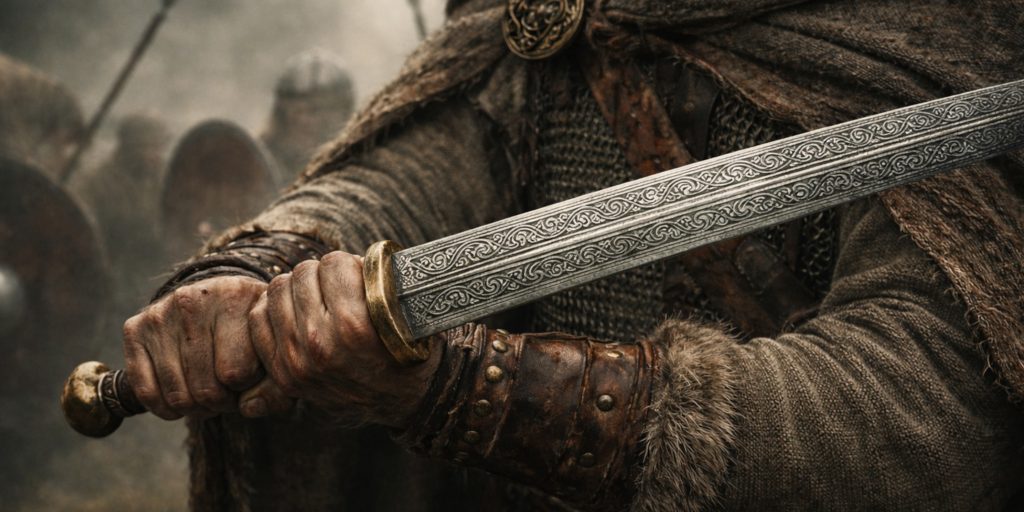
- Typically depicted as a high medieval arming sword or early longsword
- Double edged blade, straight profile, often broad with a central fuller
- Crossguard simple and straight, sometimes slightly downturned
- Grip designed for one hand, occasionally extended in later depictions
- Materials imagined as high quality crucible or pattern welded steel, though purely speculative
- Often described as unbreakable or imbued with light, which is more poetic than metallurgical
Condition
Entirely legendary. No physical specimen exists.
Where to See It Today
Nowhere in material terms. It survives in literature, art, and a rather persistent national imagination.
2. Joyeuse

Why It Is Famous
Linked to Charlemagne and later French coronations, Joyeuse became a political tool dressed as an heirloom.
Physical Attributes and Materials
- Blade length approximately 80 cm, though sections vary in age
- Straight double edged blade with a narrow fuller
- Hilt features gold and decorative elements added in later periods
- Pommel and guard show Carolingian and later medieval influences
- Constructed from multiple phases of steel, indicating refurbishment and ceremonial adaptation
Condition
Partially original, heavily modified. It is a layered artefact rather than a single intact sword.
Where to See It Today
On display at the Louvre Museum in Paris.
3. Zulfiqar

Why It Is Famous
Zulfiqar represents justice and divine authority in Islamic tradition.
Physical Attributes and Materials
- Often depicted with a bifurcated or split tip
- Likely based on early Islamic straight swords similar to late Roman or Persian designs
- Blade would have been iron or early steel, possibly pattern welded
- Hilt likely simple, functional, without elaborate European style crossguards
Condition
No confirmed surviving blade. All reconstructions are symbolic or artistic.
Where to See It Today
Visible through artistic depictions, calligraphy, and historical artefacts bearing its image.
4. The Sword of Saint Peter

Why It Is Famous
Connected to a biblical event, which ensured its survival as a relic regardless of accuracy.
Physical Attributes and Materials
- Single edged blade resembling a falchion
- Broad cutting edge with slight curve toward the tip
- Forged from iron with early steel edge hardening
- Simple hilt construction, minimal guard
Condition
Corroded but preserved. Clearly medieval in origin rather than ancient.
Where to See It Today
Displayed in Poznań Cathedral, Poland.
5. Wallace Sword

Why It Is Famous
A symbol of Scottish resistance, amplified over centuries.
Physical Attributes and Materials
- Total length over 1.6 metres
- Long double edged blade suited for two handed use
- Steel construction typical of late medieval great swords
- Extended grip allowing leverage and reach
- Guard and pommel show later alterations
Condition
Partially reconstructed. Some components replaced or extended in later periods.
Where to See It Today
Wallace Monument, near Stirling.
6. Honjo Masamune
Why It Is Famous
A masterpiece of Japanese swordsmithing and a symbol of Tokugawa rule.
Physical Attributes and Materials
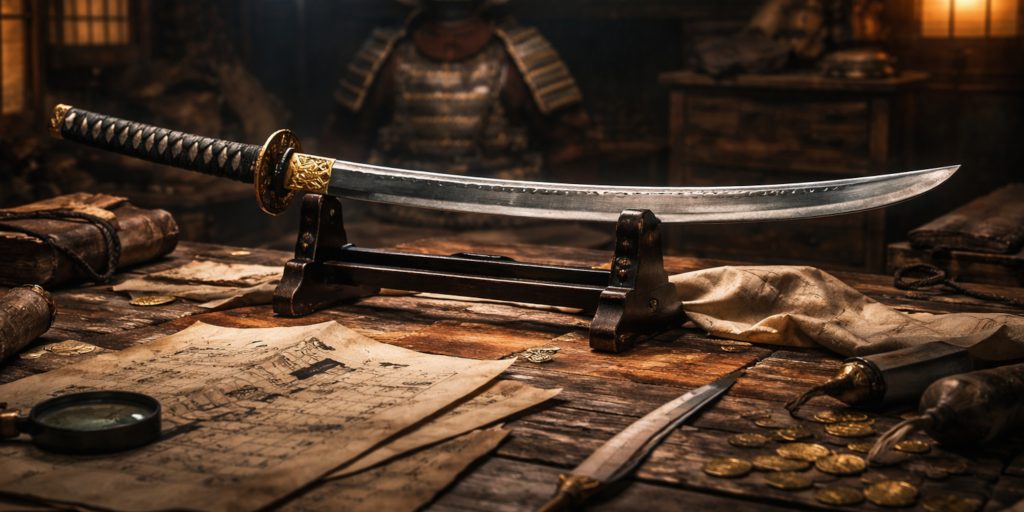
- Katana with pronounced curvature
- Differentially hardened steel producing a visible hamon
- Folded steel construction creating layered grain patterns
- Elegant balance between cutting power and resilience
- Likely signed tang, though details are lost with the sword
Condition
Unknown. The sword has been missing since the mid 20th century.
Where to See It Today
Currently lost. No confirmed location.
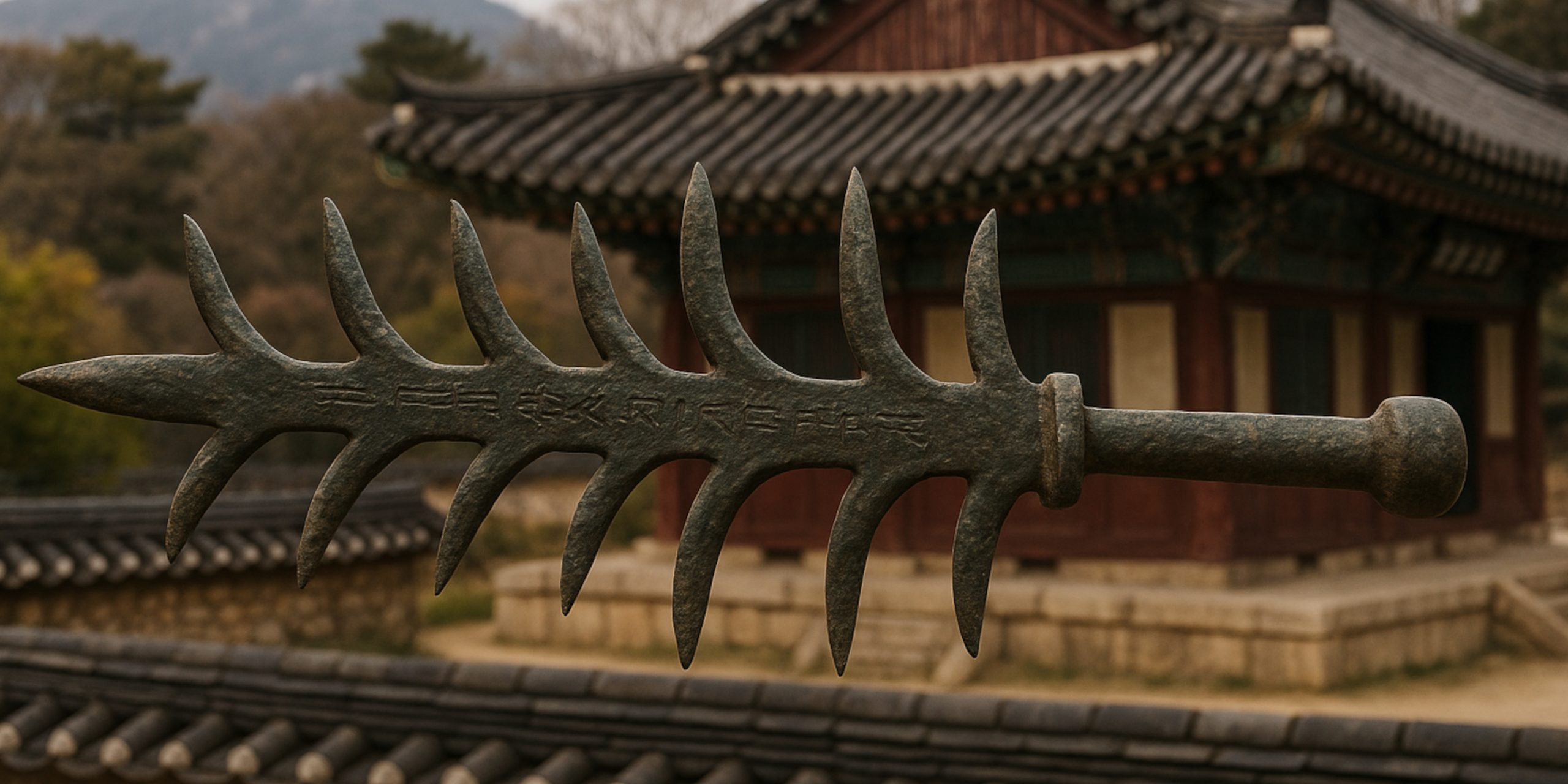
7. The Seven Branched Sword

Why It Is Famous
A diplomatic object and one of the strangest sword designs ever produced.
Physical Attributes and Materials
- Central blade with six lateral protrusions
- Forged from iron with inscriptions along the blade
- Not sharpened for combat use
- Symmetrical design suggesting ceremonial purpose
Condition
Well preserved but heavily corroded. Structural integrity intact.
Where to See It Today
Held at Isonokami Shrine in Japan.
8. Curtana
Why It Is Famous
Represents mercy within British coronation tradition.
Physical Attributes and Materials
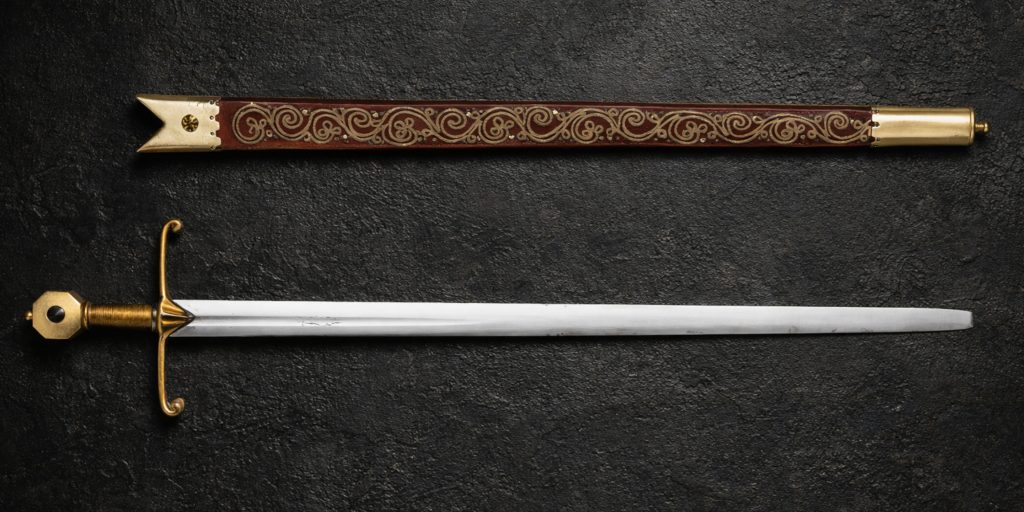
- Straight double edged blade with squared blunt tip
- Steel blade with polished ceremonial finish
- Hilt decorated with gold and regalia elements
- Balanced more for display than combat
Condition
Excellent, maintained as part of ceremonial regalia.
Where to See It Today
Part of the Crown Jewels at the Tower of London.
9. Durandal
Why It Is Famous
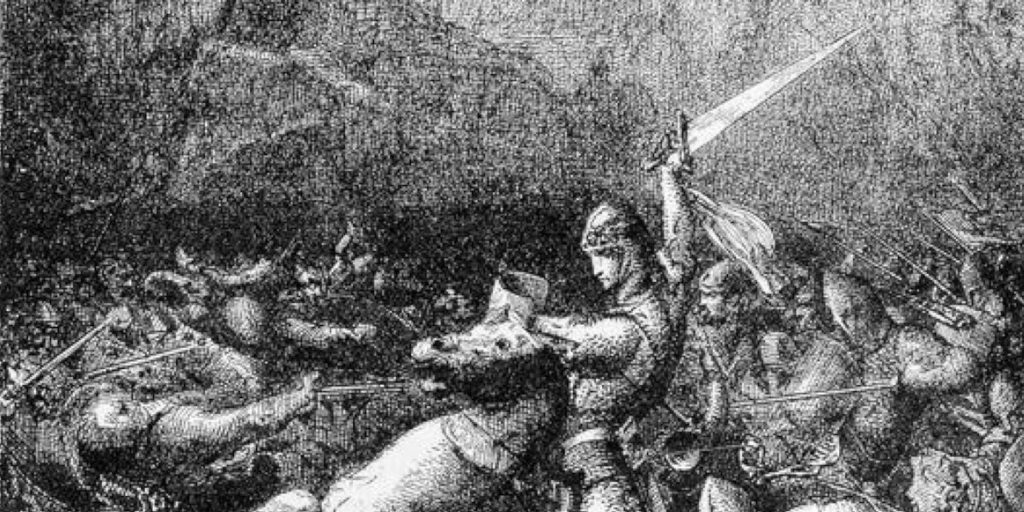
A legendary indestructible sword tied to Roland.
Physical Attributes and Materials
- Traditionally described as a straight double edged sword
- Said to contain holy relics within the hilt
- Likely based on early medieval Frankish swords
- No confirmed physical match to descriptions
Condition
The Rocamadour sword is heavily weathered and likely not original to the legend.
Where to See It Today
Rocamadour, France, though the association is symbolic.
10. Tizona

Why It Is Famous
Linked to El Cid and Spanish military identity.
Physical Attributes and Materials
- Blade length around 1 metre
- Straight double edged blade with a fuller
- Steel construction with visible ageing
- Hilt modified in later centuries
Condition
Partially original, with later additions and restoration.
Where to See It Today
Museum of Burgos, Spain.
11. Gram
Why It Is Famous
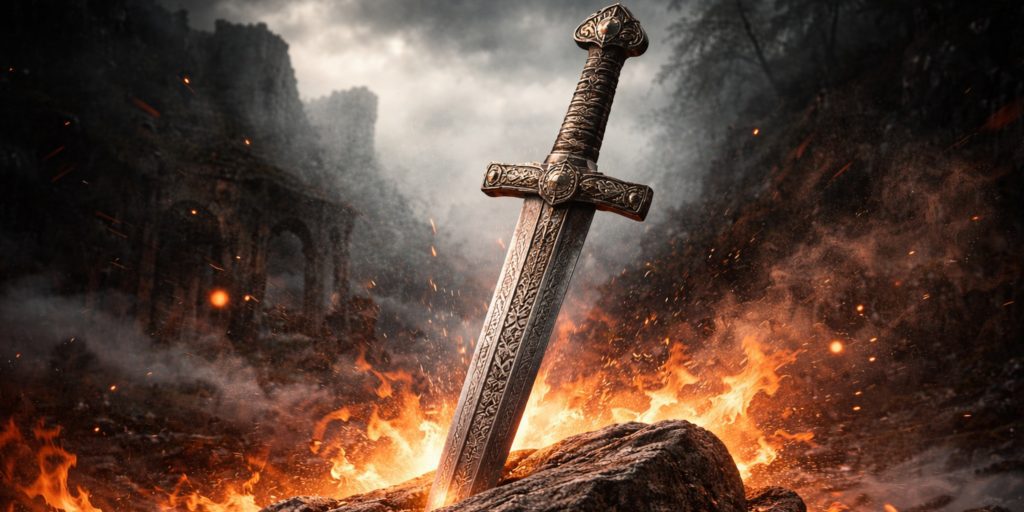
Central to Norse myth and the story of Sigurd.
Physical Attributes and Materials
- Typically imagined as a Viking era sword
- Pattern welded blade with a straight double edge
- Short guard and lobed pommel
- Balanced for one handed use with shield
Condition
Entirely mythical. No surviving artefact.
Where to See It Today
Exists in saga literature and later artistic interpretations.
12. Kusanagi no Tsurugi

Why It Is Famous
One of Japan’s Imperial Regalia, tied to myth and imperial authority.
Physical Attributes and Materials
- Likely an early straight sword, possibly chokuto style
- Iron or early steel construction
- Minimal curvature compared to later katana
- Design likely simple, reflecting early Japanese metallurgy
Condition
Unknown. The sword is not publicly displayed or studied.
Where to See It Today
Believed to be housed at Atsuta Shrine, inaccessible to the public.
13. Sword of Goujian

Why It Is Famous
If most swords on this list survive through story, this one survives through sheer defiance of time.
The Sword of Goujian belonged to a king of the Yue state during the Spring and Autumn period of ancient China. That alone would make it notable. What makes it remarkable is that when it was discovered in a tomb in 1965, it looked almost untouched.
No heavy corrosion. No structural decay. Still sharp.
For a weapon over two thousand years old, that borders on unsettling. It quietly undermines the assumption that ancient metallurgy was crude or inconsistent. In this case, it was precise, controlled, and arguably ahead of its time.
It is one of the rare swords where the legend comes after the object.
Physical Attributes and Materials
- Length approximately 55–56 cm
- Bronze blade with a high tin content, giving hardness and edge retention
- Distinctive diamond pattern etched across the blade surface
- Blackened rhombic decorations combined with lighter polished bronze
- Handle inlaid with blue glass and turquoise elements
- Guard features geometric design typical of Yue craftsmanship
- Blade shows advanced anti corrosion properties, likely due to sulphur rich compounds and tight casting control
- Straight double edged design, optimised for thrusting and cutting
Condition
Exceptional.
The blade remains largely untarnished, with visible patterning and a still defined edge. It is widely considered one of the best preserved ancient weapons ever discovered.
Where to See It Today
Housed in the Hubei Provincial Museum in China.
Displayed under controlled conditions, which feels entirely justified given that it has already outlasted most expectations by two millennia.
Takeaway
By the time you reach the end of this list, the pattern feels less neat than it did at the start.
Some swords survive only in story. Some survive in altered, carefully maintained forms that tell us as much about later centuries as their own. And then, occasionally, one turns up like the Sword of Goujian, sitting in near perfect condition as if it has been waiting to prove a point.
It complicates things, in a good way.
We like to sort objects into clear categories. Real or myth. Authentic or symbolic. Yet these swords refuse to stay in their boxes. Joyeuse is both artefact and invention. Tizona is part history, part reconstruction. Excalibur has no blade at all, yet remains one of the most influential weapons ever imagined.
And then Goujian’s sword quietly sits there, sharp, intact, and very real. No embellishment required.
If there is a thread running through all thirteen, it is not just power or craftsmanship. It is memory. What people chose to preserve, reshape, or believe.
As a historian, I am meant to favour evidence. Still, I find myself drawn to the uncomfortable middle ground where fact and legend overlap. That is where these swords seem to live.
Not just as weapons, but as objects people refused to forget.