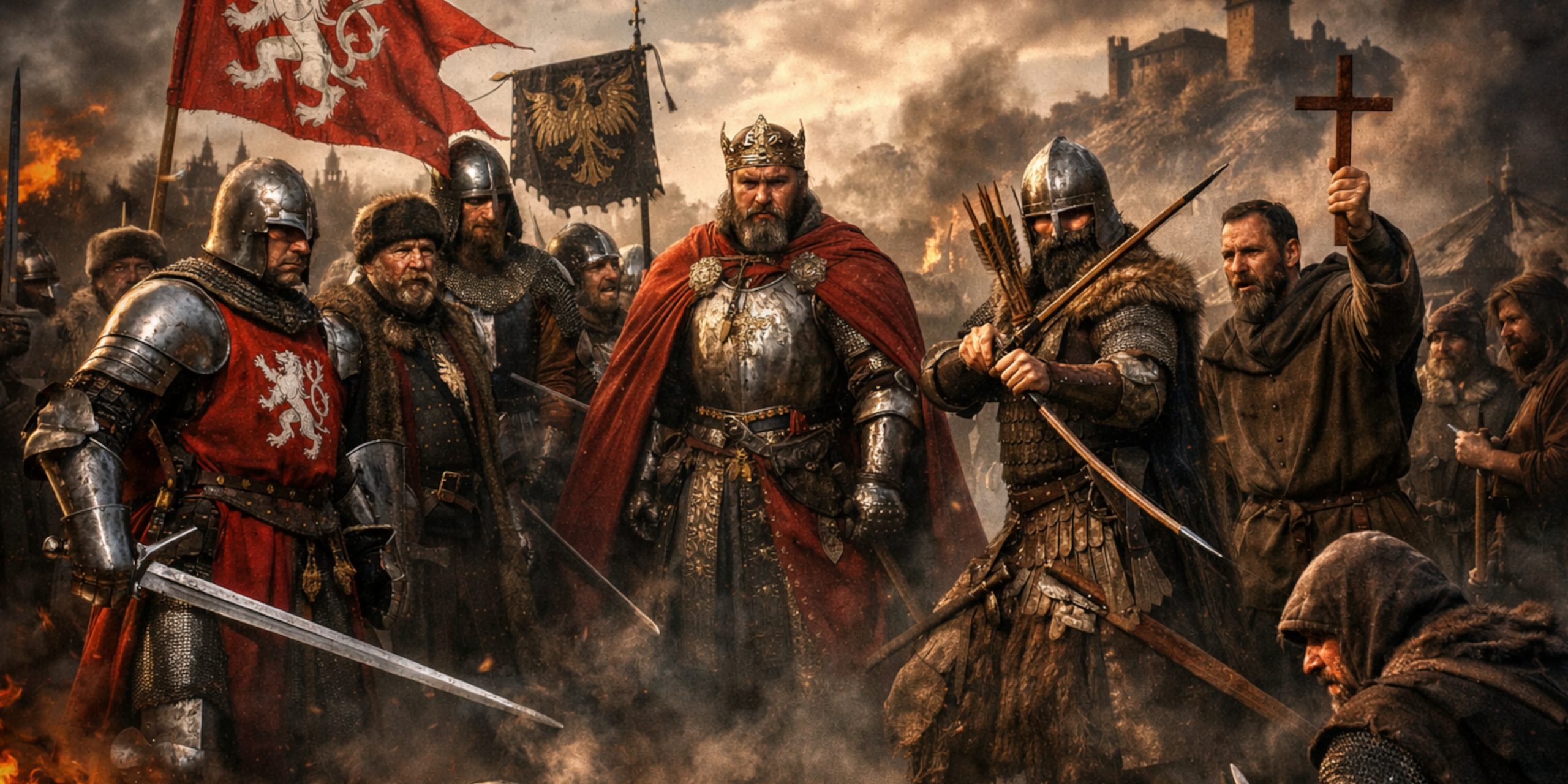
Medieval Bohemia is not exactly the place for quiet evenings and polite disagreements. In Kingdom Come: Deliverance II, politics runs on ambition, grudges, and the occasional sword fight in a muddy field.
The sequel expands the political landscape far beyond the villages of the first game. Rival nobles, royal claimants, mercenary bands, and religious factions all compete for power. Some want stability. Others want revenge. Most simply want control of Bohemia.
Understanding these factions makes the story far richer. It also explains why Henry keeps finding himself caught between powerful men who all insist they are the rightful saviours of the kingdom.
Below is a clear guide to the major factions shaping the conflict.
The Loyalists of King Wenceslas
At the centre of the political crisis stands Wenceslaus IV of Bohemia, the troubled king whose weakness helped spark the chaos in the first place.
His supporters remain loyal to the idea of a legitimate Bohemian crown, even if the king himself has a reputation for poor judgement and heavy drinking.
Goals
- Restore Wenceslas to secure control of the kingdom
- Resist foreign influence over Bohemian politics
- Maintain the authority of the traditional crown
Key Traits
| Trait | Details |
|---|---|
| Political stance | Royal legitimacy |
| Strength | Noble support in parts of Bohemia |
| Weakness | Poor leadership reputation |
These loyalists believe that rebellion will only worsen the kingdom’s instability. Their position is simple. A flawed king is still better than foreign rule.
Henry’s allies from the first game often sit within this faction, which means players will likely interact with it frequently.
The Sigismund Faction
Opposing Wenceslas stands his ambitious half brother Sigismund, Holy Roman Emperor, one of the most powerful figures in Central Europe.
Sigismund is not interested in subtlety. His approach involves armies, political pressure, and a healthy dose of intimidation.
Goals
- Seize control of Bohemia
- Remove Wenceslas from power
- Expand influence across the Holy Roman Empire
Key Traits
| Trait | Details |
|---|---|
| Political stance | Pragmatic expansion |
| Strength | Military resources and imperial allies |
| Weakness | Viewed as an outsider by many Bohemians |
Sigismund’s forces were already present in the first game, particularly through the feared Cuman mercenaries. In the sequel, his political reach appears even wider.
From a storytelling perspective he represents the looming threat behind much of the conflict.
Bohemian Noble Houses
Medieval politics rarely works as a simple two sided war. Bohemian noble families play their own dangerous game.
Some support Wenceslas. Others quietly lean toward Sigismund. A few prefer to keep both sides guessing while protecting their own estates.
Characteristics
- Regional power bases
- Private armies and retainers
- Constant shifting alliances
These nobles operate in the grey area of medieval politics. They can be allies one day and rivals the next.
For Henry this means diplomacy can matter just as much as swordplay. Winning the favour of the right lord may open doors that brute force cannot.
Mercenary Companies
War attracts professionals. Bohemia has no shortage of them.
Mercenary bands operate across the region, selling their swords to whoever offers the best payment. Loyalty is rarely ideological. Coin tends to settle most debates.
Typical Composition
- Veteran infantry
- Crossbowmen and archers
- Mounted men at arms
Mercenaries are unpredictable. A company that serves one faction today may fight for their enemies tomorrow.
Players will often encounter them guarding roads, raiding settlements, or enforcing the will of powerful nobles.
The Cumans
Returning from the first game, the Cumans remain one of the most recognisable enemy forces.
Historically they were steppe warriors who entered the service of Hungarian rulers. In the story they frequently appear as allies of Sigismund’s campaign.
Combat Style
| Feature | Description |
|---|---|
| Mobility | Skilled mounted fighters |
| Weapons | Sabres, bows, and light lances |
| Tactics | Fast raids and ambushes |
Their presence adds a distinct flavour to the battlefield. Compared with heavily armoured Bohemian knights, Cuman warriors fight with speed and aggression.
Players familiar with the first game will remember them as some of the most dangerous opponents in the countryside.
Religious Reformers
Religion also plays a growing role in Bohemian politics.
The teachings of Jan Hus and other reform minded clergy were beginning to challenge the established Church hierarchy. While the full Hussite Wars would erupt later, the ideological tensions were already building during this period.
Core Ideas
- Criticism of church corruption
- Calls for moral reform
- Greater religious independence for Bohemia
These movements create another layer of tension. Faith and politics mix together in ways that often lead to unrest.
For Henry this means conflicts are not always about land or power. Sometimes they are about belief.
Bandits and Local Power Brokers
Not every faction wears a noble banner.
War disrupts trade, weakens law enforcement, and leaves many men with weapons but no employment. The result is predictable.
Bandit groups spread through forests and countryside, forming loose networks of criminals and opportunists.
Typical Activities
- Roadside ambushes
- Smuggling
- Protection rackets in isolated villages
These groups rarely shape the grand politics of the kingdom, but they create constant danger for travellers. In gameplay terms they ensure that even quiet roads never stay peaceful for long.
Takeaway
The strength of Kingdom Come: Deliverance II lies in how grounded its world feels.
Instead of a simple heroes versus villains structure, the game presents a messy political landscape where everyone has a reason for their actions. Some factions seek stability. Others chase power. A few simply try to survive the storm.
For players this creates meaningful choices. Supporting one group may close doors with another. Helping a noble today might anger his rival tomorrow.
That tension is exactly what makes medieval history so fascinating. Bohemia in this era was a powder keg of ambition, religion, and dynastic rivalry.
And poor Henry, once again, is standing right in the middle of it.