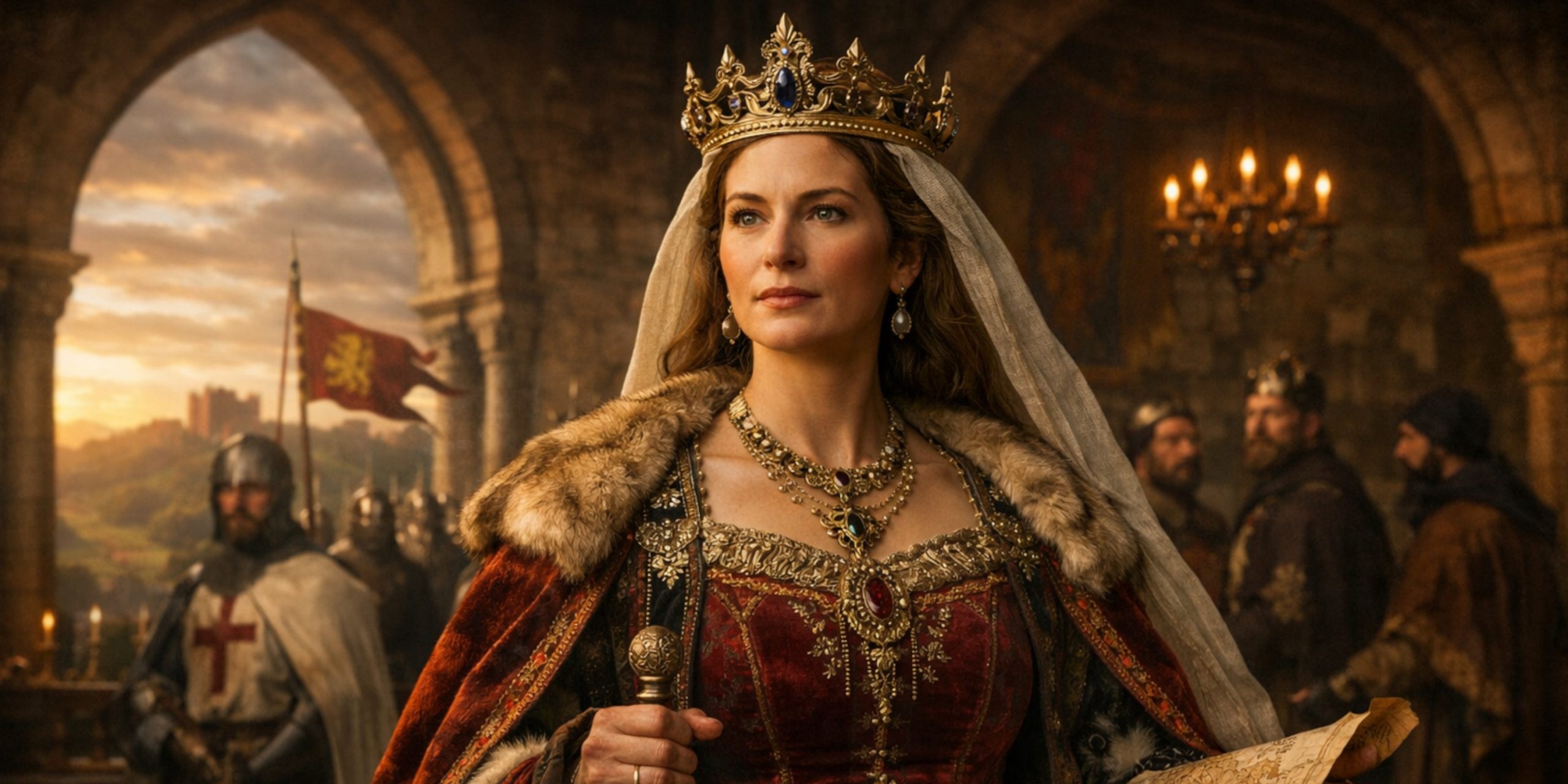
Few medieval figures feel as modern as Eleanor of Aquitaine. She inherited one of the richest duchies in Europe, married two kings, rode on crusade, endured imprisonment, and helped shape the Plantagenet empire. Chroniclers alternately admired and feared her. Later writers mythologised her. Historians still argue about her.
When I first began studying the twelfth century, Eleanor stood out not because she was exceptional in surviving sources, but because she appears again and again at turning points. She is never far from power, and often at its centre. That alone demands attention.
Early Life and Inheritance
Eleanor was born around 1122, probably in Poitiers, the daughter of William X, Duke of Aquitaine. Aquitaine was no minor territory. It stretched across much of south western France, culturally distinct from the north and wealthy through agriculture, trade and courtly life.
In 1137 her father died on pilgrimage. Eleanor, still a teenager, inherited the duchy in her own right. That detail matters. She was not merely a royal bride bringing a dowry. She was the ruler of Aquitaine, and any husband would rule through her claim.
Within months she married Louis, heir to the French throne, who became King Louis VII shortly after. Overnight, Eleanor was Queen of France.
Queen of France
The marriage to Louis VII of France joined northern Capetian monarchy with southern Aquitanian culture. It was not an easy fit.
Louis had been raised for the church before the death of his elder brother pushed him into kingship. He was pious, serious and cautious. Eleanor grew up in a court famed for poetry, music and aristocratic display. The contrast has often been exaggerated, yet tension between them is clear in the record.
They had two daughters but no surviving son. That failure was politically significant. Medieval monarchy depended on male succession, and the absence of an heir strained the marriage.
The Second Crusade
In 1147 Eleanor accompanied Louis on the Second Crusade, an extraordinary decision for a reigning queen. Chroniclers report that she and her ladies rode in martial attire, though the details are likely embellished.
In Antioch she was reunited with her uncle Raymond, Prince of Antioch. Their political disagreements with Louis over crusade strategy led to scandalous rumours, including accusations of improiety. These stories say more about the anxieties of male chroniclers than about Eleanor’s conduct.
The crusade itself was a failure. The marriage did not recover from the strain. In 1152 it was annulled on grounds of consanguinity. Eleanor retained Aquitaine. Within weeks she married again.
Marriage to Henry and the Angevin Empire
Her second husband was Henry II of England, Count of Anjou and soon to be King of England. The match reshaped European politics.
Through Henry and Eleanor’s union, a vast territorial bloc emerged, stretching from the Scottish border to the Pyrenees. Historians call it the Angevin Empire, though it was less a unified state than a collection of lands held by one formidable family.
Eleanor bore Henry eight children, including Richard I of England and John of England. These sons would become kings, crusaders and, in John’s case, a ruler whose failures reshaped English governance.
For a time Eleanor played an active role in administration, particularly in Aquitaine. Charters attest to her authority. She was no ceremonial consort.
Rebellion and Imprisonment
The marriage to Henry deteriorated. In 1173 their sons rebelled against their father, encouraged at least in part by Eleanor. The reasons were personal and political. Henry had distributed titles without real power. Ambitious princes demanded more.
Eleanor attempted to join the revolt but was captured. For around fifteen years she was held in varying degrees of confinement in England. It was not a dungeon existence in the dramatic sense, yet it was a loss of freedom and influence.
Henry died in 1189. Richard I immediately ordered his mother’s release.
Regent and Political Matriarch
Richard spent much of his reign abroad, first on crusade, then in captivity. During his absence Eleanor acted as regent in England. In her sixties, she travelled tirelessly, negotiated alliances and secured her son’s ransom.
After Richard’s death in 1199, she supported John’s claim to the throne against rival interests in France. Even in advanced age she crossed the Pyrenees to arrange the marriage of her granddaughter Blanche to the future French king.
This late phase of her life is, to my mind, the most impressive. It reveals stamina, calculation and a clear sense of dynastic survival.
Court Culture and Patronage
Eleanor’s court at Poitiers has been associated with the rise of courtly love literature, troubadour poetry and refined aristocratic ideals. The evidence is patchy and sometimes romanticised by later writers, yet Aquitaine was undeniably a centre of cultural innovation.
Her daughters, including Marie of Champagne, also became patrons of literature. Whether Eleanor directly shaped the ideology of courtly love remains debated, but she operated in a world where art and politics intertwined.
As a historian, I am wary of turning her into the origin point of every chivalric flourish. Still, she clearly understood the symbolic power of culture.
Personality and Reputation
Contemporary writers describe Eleanor as intelligent, charismatic and strong willed. Some also call her dangerous. That label tends to follow women who exercise authority in male dominated systems.
Later legend exaggerated her into a near mythic figure, sometimes even associating her with the stories of Fair Rosamund or portraying her as manipulative beyond reason. The truth is more grounded and more interesting. She was a ruler navigating ruthless politics with limited room for error.
She made bold choices. Some failed. Many succeeded.
Death and Burial
Eleanor died in 1204 at Fontevraud Abbey. Her tomb effigy shows her holding a book, an unusually active pose for medieval funerary sculpture. Whether that reflects personal literacy or symbolic wisdom, it feels appropriate.
She was buried beside Henry II and Richard I. Even in death she rests at the heart of a dynasty that shaped medieval Europe.
Legacy
Eleanor of Aquitaine changed the political map of western Europe. Through her marriages she linked the French and English crowns. Through her children she influenced crusade, rebellion and the development of English royal authority.
Her support of Richard, her resistance to Henry, her stewardship of Aquitaine, all speak to a woman who understood power intimately.
Studying Eleanor reminds me how fragile medieval authority could be. It depended on lineage, land, loyalty and luck. She possessed all four, and when luck failed her, she relied on the others.
She was not a modern feminist icon transported into the twelfth century. She was something more complex: a feudal ruler who refused to fade into the margins.
That, in itself, is remarkable.